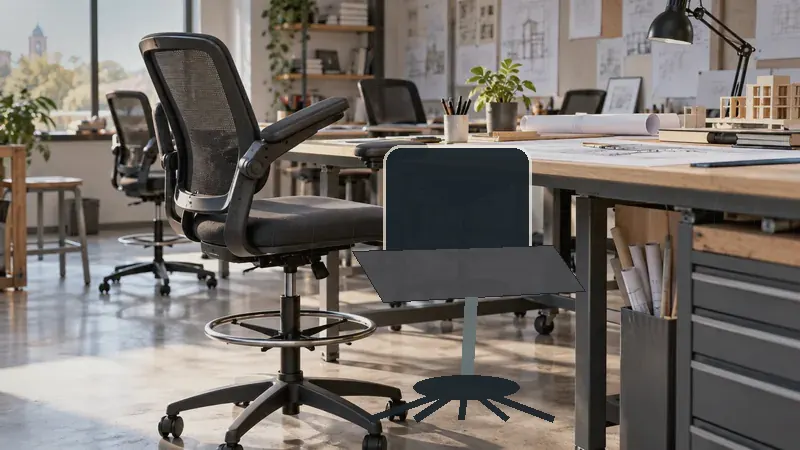
A drafting stool can quietly shape an entire afternoon in the studio. A seat that sits too low leaves your shoulders hunched over the paper, while a chair that is too tall can make your feet dangle and your posture feel awkward. Artists looking for the best drafting stools for artists are usually balancing several needs at once: height, stability, comfort, mobility, footprint, and the type of work surface they use.
The products below split into two clear groups. Wooden artist stools offer a compact, warm-looking seat with simple height adjustment, while rolling drafting chairs bring back support, foot rings, cushions, and a wider height range. Buyers often focus on the seat itself and forget to measure the drafting table, counter, or standing desk first. That small mistake can turn a promising stool into an uncomfortable mismatch. Our top overall pick is the MEEDEN Artist Wooden Drafting Stool because its 19 to 26-inch range, compact footprint, and solid beech construction suit many home studios without adding bulky hardware.
Different artists will reach different conclusions. A painter who moves between stations may prefer casters and a backrest, while someone sketching in a compact bedroom studio may value a lightweight wooden stool that tucks away easily. The comparison below offers a quick way to narrow the field.
Best Drafting Stools for Artists Comparison Table
| Product | Best For | Seat Height | Material or Finish |
|---|---|---|---|
| MEEDEN Artist Wooden Drafting Stool | Best Overall | 19 to 26 inches | German beech wood |
| SUPERJARE Drafting Chair with Backrest, B08YCY8JWY | Back support and mobility | 23.6 to 32.2 inches | PU leather and chrome metal base |
| SUPERJARE Drafting Chair with Backrest, B0FW4WXTNK | Rolling studio work | 23.6 to 32.2 inches | PU leather and chrome metal base |
| MEEDEN Walnut Drafting Stool | Wooden stool with a wider seat | 19 to 26 inches | Solid beech wood with oil finish |
| VISWIN Adjustable Drafting Stool | Budget-conscious artists | 19 to 26 inches | Beech wood with protective finish |
| conda Adjustable Height Wooden Drafting Stool | Simple natural studio seating | 19.9 to 25 inches | Solid beech wood |
| Brick Attic Drafting Chair with Backrest | Tall work surfaces | 33.86 to 41.75 inches | PU leather and memory foam |
| VISWIN Adjustable Drafting Stool, Walnut | Walnut-look studio décor | 19 to 26 inches | Beech wood with walnut finish |
| FREEKYROCK Office Drafting Chair with Footrest | Longer seated sessions | 24.01 to 31.89 inches | PU leather and metal frame |
The detailed reviews below explain how each seat fits different studio layouts, body-support preferences, and work-surface heights.
1. MEEDEN Artist Wooden Drafting Stool , Best Overall

The MEEDEN Artist Wooden Drafting Stool earns the top spot through balance rather than a long list of complicated mechanisms. Its seat adjusts from 19 to 26 inches, a useful range for many drafting tables, standing desks, and elevated art surfaces. The 16.5-inch width and 11.8-inch depth also make it easier to fit beside a crowded easel or under a compact workbench. In a small apartment studio, that restrained shape can feel like a breath of fresh air compared with a five-wheel chair.
German beech construction gives the stool a warm, furniture-like appearance that works naturally around sketchbooks, paint jars, and timber worktables. The swivel-style height adjustment lets an artist fine-tune the seat instead of settling for a fixed perch. It does not include a backrest or foot ring, so the experience is more active and upright than a cushioned rolling chair. For short drawing sessions, casual sketching, or artists who shift between sitting and standing, that simplicity is a real strength.
Pros
- 19 to 26-inch adjustable height range
- Compact 16.5-inch-wide footprint
- German beech construction
- Suitable for drafting tables and standing desks
- Assembly instructions and tools are included
Cons
- No backrest or foot ring for extended seated work
- Wooden seat provides less cushioning than the rolling chair options
This is the strongest fit for artists who want a compact, attractive stool with straightforward adjustment and minimal visual clutter. It may be less comfortable for someone spending many consecutive hours seated or needing lumbar support. Buyers who prefer a quiet studio with no casters will appreciate its furniture-like design, while artists who move constantly between stations may prefer a wheeled model.
To buy this product, click here.
2. SUPERJARE Drafting Chair with Backrest , Best for Back Support

Artists who spend a full morning refining details may welcome the SUPERJARE’s shift toward chair-like support. Its hydraulic lift moves the seat from 23.6 to 32.2 inches, giving it more reach for high drafting surfaces than the wooden stools. A detachable backrest lets the chair change character, so it can provide upper-body support during long sessions or become a backless stool when the artist needs more freedom to lean forward.
The adjustable circular footrest is particularly useful at elevated heights. Instead of leaving the legs hanging beneath a tall desk, the artist can rest the feet and adjust the working position. A four-inch foam cushion covered in waterproof, oil-resistant PU leather should also be easier to wipe clean after a dusty charcoal session or a splash near the studio sink. Five casters add mobility, although rolling seating naturally needs more floor clearance than a stationary wooden stool.
Pros
- 23.6 to 32.2-inch hydraulic height range
- Detachable backrest
- Adjustable circular footrest
- Four-inch high-density foam cushion
- Five dual-wheel casters and 300-pound listed capacity
Cons
- Rolling base takes more space than a compact wooden stool
- PU leather has a more utilitarian look than natural wood
This chair suits artists working at high tables, counters, or multi-purpose studio stations where mobility and back support matter. It is a weaker match for a quiet, minimalist corner where every inch counts. Choose it over the wooden options if your sessions regularly stretch into several hours and you want the option of a backrest without committing to a fixed office chair.
To buy this product, click here.
3. SUPERJARE Drafting Chair with Backrest , Best Rolling Studio Option

This SUPERJARE listing offers the same core configuration that makes the model appealing for active studios: hydraulic height adjustment, a detachable backrest, a foot ring, and five rolling casters. The 23.6 to 32.2-inch range gives an artist room to match a taller drafting surface without raising the shoulders toward the ears. That matters during fine line work, where an awkward seat height can make a relaxed posture feel impossible.
The combination of a thick foam cushion and wipe-clean PU leather is practical around paint, ink, and studio dust. The chair can glide between a drafting table, supply shelf, and secondary work surface, saving an artist from repeatedly standing up during a busy project. It is still a substantial chair, though, and its rolling base may feel excessive beside a small tabletop board. Check the available floor space before choosing a mobile design.
Pros
- Broad 23.6 to 32.2-inch seat-height range
- Backrest can be removed
- Footrest supports elevated seating positions
- High-density foam and easy-clean PU leather
- Casters support movement around a studio
Cons
- Less compact than the fixed wooden stools
- Rolling movement may be unnecessary for artists who stay at one station
Artists who alternate between drawing, painting, and nearby studio tasks may get the most from this design. It also fits a shared creative workspace where one seat must serve several work heights. A fixed wooden stool remains the cleaner choice for a tiny room, while this SUPERJARE model makes more sense for buyers who value adjustable support and easy repositioning.
To buy this product, click here.
4. MEEDEN Walnut Drafting Stool , Best Wooden Stool with a Wider Seat
The walnut-finish MEEDEN brings a slightly more decorative presence to the studio. Its European beechwood construction is paired with an oil finish, giving the stool a furniture-style appearance that can sit comfortably beside a gallery counter or home kitchen island after the sketchbook is closed. The seat adjusts from 19 to 26 inches, matching the range of the top MEEDEN pick while offering a widened seating surface.
A triangular base is listed for stability, and the stool has a stated 220-pound capacity. Those details make it more appropriate for buyers who want a stationary perch with a defined foundation rather than a swiveling office chair on casters. The trade-off is familiar: the stool offers a firm wooden seat and no back support. Imagine a quick watercolor study at the table, and it feels well matched. Picture a six-hour digital illustration session, and a cushioned chair may become more appealing.
Pros
- 19 to 26-inch adjustable height
- Widened seat surface
- Solid European beechwood construction
- Oil finish suits home and studio décor
- Triangular base with a listed 220-pound capacity
Cons
- No padded seat or backrest
- Stationary base is less convenient for moving between work areas
This is a good match for artists who want their stool to look like part of the room rather than office equipment. The wider seat and walnut appearance give it a more settled, furniture-like feel. Skip it in favor of a rolling chair if you need back support or frequently travel between several elevated surfaces.
To buy this product, click here.
5. VISWIN Adjustable Drafting Stool , Best Value

For artists building a first studio, the VISWIN offers the essential drafting-stool formula without adding a rolling base or complicated controls. Its swiveling seat adjusts from 19 to 26 inches, and the beechwood frame uses a two-tone finish with a protective coating. That combination makes it easy to place beside a drafting table, standing desk, kitchen counter, or gallery work surface without the room looking like a clinic.
The listed triangle base, lightweight construction, and compact form all point toward flexible home use. An artist might carry it from a workroom to a kitchen island, then slide it beside a table when guests arrive. The waterproof surface should simplify routine cleanup, although the wooden seat remains firmer than the foam-padded rolling chairs. A listed 176-pound capacity also makes checking the intended user and daily workload especially important before purchase.
Pros
- 19 to 26-inch swiveling height adjustment
- Solid beechwood construction
- Protective, easy-clean surface
- Lightweight design for moving around the home
- Useful for drafting, painting, and architectural drawing
Cons
- Listed 176-pound capacity is lower than several rolling options
- Wooden seat lacks the cushioning and back support of chair-style models
The VISWIN is best for a lighter-duty creative workspace where low clutter and easy movement matter more than plush comfort. It makes sense for sketching, painting, and occasional drafting, especially in a room that serves multiple purposes. Artists needing a broader capacity rating or a padded seat should look toward the rolling selections instead.
To buy this product, click here.
6. conda Adjustable Height Wooden Drafting Stool , Best Simple Natural Design

The conda stool keeps the visual language refreshingly simple. Its solid beechwood construction, natural finish, and clean lines make it easy to imagine beside a bright window, a timber drafting table, or a row of storage shelves. The seat adjusts from 19.9 to 25 inches, a slightly narrower range than the 19 to 26-inch models, yet still useful for many standard-height and moderately elevated work surfaces.
Its appeal is largely practical. The listing includes an assembly manual and tools, while the multi-use format allows the stool to move between drafting, painting, office work, and kitchen use. There is no backrest, foot ring, or caster system to complicate the silhouette. That stripped-back approach can be welcome when the artist wants to sit upright for a short sketch and then stand to judge the composition from across the room.
Pros
- 19.9 to 25-inch height adjustment
- Solid beechwood construction
- Natural finish and clean profile
- Suitable for drafting, painting, and general studio use
- Assembly instructions and tools are included
Cons
- Shorter height range than several competing wooden stools
- No backrest, footrest, padding, or wheels
Choose the conda when the goal is a quiet, uncluttered seat for moderate-height surfaces. It fits artists who like a natural wood aesthetic and do not need to roll across the room. A higher drafting table or long seated session may call for one of the chairs with a taller range and more body support.
To buy this product, click here.
7. Brick Attic Drafting Chair with Backrest , Best for Very Tall Work Surfaces
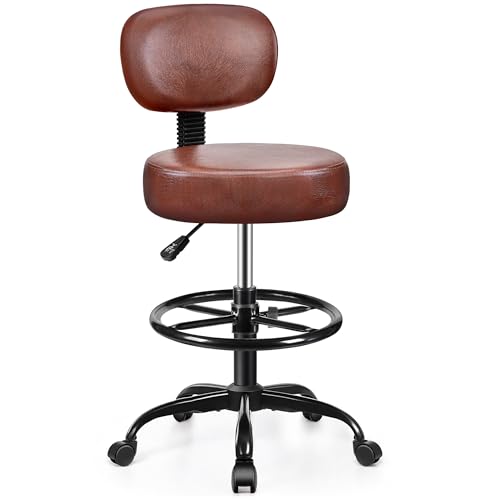
The Brick Attic stands apart through its unusually tall seat-height range of 33.86 to 41.75 inches. That makes it a specialized option for standing-height counters, very tall drafting stations, and work areas where ordinary drafting stools leave the artist too low. Its adjustable foot ring can move through a 7.87-inch range, giving the legs a place to rest at those higher positions.
A detachable curved backrest adds flexibility, while the 15.8-inch cushion uses PU leather and high-density memory foam. The five-star caster base and stated 300-pound capacity give it a distinctly commercial-studio character. Think of a printmaking counter, a tall demonstration surface, or a standing desk that sits well above ordinary table height. For a conventional drafting table, however, this chair may rise far beyond what the artist needs.
Pros
- Very tall 33.86 to 41.75-inch seat-height range
- Adjustable footrest ring
- Detachable curved backrest
- Memory foam cushion with easy-clean PU leather
- Five-star caster base and listed 300-pound capacity
Cons
- Too tall for many conventional drafting tables
- Larger rolling base needs generous floor clearance
This is the specialist pick for artists whose work surface is genuinely high. It can make a tall counter feel usable without forcing the legs into an awkward position. Measure the desk from floor to work surface before buying, because the impressive height range becomes a liability if the table is closer to ordinary desk height.
To buy this product, click here.
8. VISWIN Adjustable Drafting Stool, Walnut , Best Walnut Finish

The walnut version of the VISWIN brings the same practical stool format to artists who prefer a deeper wood appearance. It adjusts from 19 to 26 inches, uses a swiveling seat, and is intended for drafting, painting, architectural drawing, and general studio work. In a room filled with pale timber, white walls, and warm task lighting, the walnut finish can give the seating area a richer visual anchor.
Its protective surface is useful near art materials, and the lightweight build should make it easier to move when a project takes over the table. The triangle base provides the listed support structure, while the 176-pound capacity places it in the lighter-duty range of this group. Like the other compact wooden stools, it asks the artist to provide their own posture changes and breaks because there is no backrest or padded cushion.
Pros
- 19 to 26-inch adjustable seat height
- Walnut finish suits warmer studio décor
- Solid beechwood construction
- Protective surface helps with routine cleanup
- Lightweight and suitable for several work areas
Cons
- Listed 176-pound capacity requires careful buyer matching
- No rolling base, backrest, or padded seat
This version is a sensible choice for artists who care about the visual character of a wooden stool and want a moderate adjustment range. It is especially suitable for sketching corners, craft rooms, and shared home spaces. Buyers focused on long-session comfort should compare it with the SUPERJARE or FREEKYROCK chairs instead.
To buy this product, click here.
9. FREEKYROCK Office Drafting Chair with Footrest , Best for Extended Sessions

The FREEKYROCK is aimed at artists who want a drafting-height chair with more structured support. Its seat adjusts from 24.01 to 31.89 inches, covering elevated desks and many counter-height surfaces. A metal-frame backrest is shaped around the lower back, while the footrest adjusts from 9.45 to 16.93 inches. Those features give the chair a more supportive setup for digital illustration, detailed drawing, or studio administration that keeps the artist seated for longer stretches.
The 3.15-inch foam cushion and waterproof PU leather add a practical layer for messy creative spaces, and the listed 330-pound capacity is the highest in this roundup. Silicone wheels with double-ball bearings are intended to move quietly across different flooring. This is still a rolling office-style chair, so it will take more room than the wooden stools and may feel visually heavy in a delicate sketching nook. For a multi-use studio, its broader support package is compelling.
Pros
- 24.01 to 31.89-inch adjustable seat height
- Adjustable footrest from 9.45 to 16.93 inches
- Metal-frame backrest with lumbar-focused shape
- 3.15-inch foam cushion and waterproof PU leather
- Listed 330-pound capacity and silicone casters
Cons
- Bulkier than the compact wooden artist stools
- Office-chair styling may not suit every home studio
The FREEKYROCK fits artists who value support, a taller working position, and easy movement more than a minimal footprint. Its adjustment range is useful for a shared studio with several surface heights. A smaller room or short sketching routine may favor the MEEDEN or VISWIN stools, while a longer seated workflow gives this chair a clearer advantage.
To buy this product, click here.
Buying Guide for Best Drafting Stools for Artists
Match the Seat Height to the Work Surface
Start with the distance from the floor to the top of the drafting table or desk. A 19 to 26-inch wooden stool can suit many moderate-height surfaces, while the SUPERJARE and FREEKYROCK chairs reach into taller counter and drafting positions. The Brick Attic belongs to a different category altogether, with a starting height above 33 inches. Measure first, then leave enough room for your legs beneath the surface.
Choose Between a Wooden Stool and a Rolling Chair
Wooden stools keep the footprint small and the room visually calm. They work well when an artist sits briefly, shifts position often, or alternates between sitting and standing. Rolling chairs offer more support and movement, but their bases need clear floor space. Casters are useful beside a supply cart or multiple workstations, yet they can feel like overkill at a single fixed table.
Think About Back Support and Foot Position
A backrest can be valuable during long digital art sessions or detailed work, while a foot ring helps prevent the legs from hanging at elevated heights. The wooden models provide neither feature, so they encourage a more active posture. The SUPERJARE chairs offer removable backrests and adjustable foot rings, and the FREEKYROCK combines both with a structured back. Pick the support level that matches the way you actually work, rather than the way a product photo looks.
Check Seat Materials and Cleanup Needs
Natural beechwood brings a warm studio feel and is easy to understand visually, but it is firmer than foam. PU leather cushions are easier to wipe after charcoal dust, ink, or paint splashes, although they create a more office-like appearance. Artists working with wet materials may prefer a cleanable surface, while someone sketching with graphite may care more about the simplicity of wood.
Measure the Footprint and Clearance
A stool that fits under the desk can preserve valuable floor space in a bedroom studio. Rolling bases extend outward, and a backrest may need extra clearance behind the chair. Mark the intended area with painter’s tape before ordering. That quick outline can reveal whether a five-star base will bump into storage bins or whether a narrow wooden stool will slide neatly beside the table.
Check Capacity and Intended Use
Several listings provide a stated capacity, including 176 pounds for the VISWIN stools, 220 pounds for the MEEDEN Walnut model, 300 pounds for the SUPERJARE and Brick Attic chairs, and 330 pounds for the FREEKYROCK. Use those figures as part of the fit calculation, alongside seat dimensions and daily use. A chair intended for occasional sketching may feel very different from one selected for hours of routine studio work.
Best Drafting Stools for Artists FAQ
What Height Should a Drafting Stool Be?
The correct height depends on the work surface and the artist’s leg position. Measure the table height, then look for a stool range that lets the forearms rest comfortably without lifting the shoulders. A foot ring becomes more useful as the seat rises.
Are Wooden Drafting Stools Comfortable for Long Sessions?
Wooden stools provide a firm seat and usually lack back support or padding. They can work well for shorter drawing periods and active sit-to-stand routines. Artists who remain seated for several hours may prefer a foam-cushioned chair with a backrest.
Do Artists Need a Rolling Drafting Chair?
No. Casters help artists move between work surfaces, supplies, and tools, but they also require more floor clearance. A stationary stool is often better for a compact studio or a single fixed drafting table.
Is a Backrest Useful for Drawing?
A backrest can help during long seated tasks, especially digital illustration or detailed line work. Some artists prefer to lean forward freely, so a removable backrest offers more flexibility than a permanently fixed design.
What Is the Difference Between a Drafting Stool and a Bar Stool?
A drafting stool is generally selected for work-surface compatibility and may include height adjustment, a foot ring, casters, or back support. A bar stool may be fixed at one height and may not match the posture or clearance needed at a drafting table.
Which Drafting Stool Is Best for a Small Art Studio?
The MEEDEN Artist Wooden Drafting Stool, VISWIN models, and conda wooden stool have compact, stationary designs. Their narrow profiles are easier to place beside a table or tuck away after a project. Measure the seat and base area before choosing.
Are PU Leather Drafting Chairs Easy to Clean?
The listed PU leather models are intended to be wiped clean, which can be convenient around art materials. Follow the manufacturer’s care guidance and avoid assuming that every solvent or paint will come off without marking the surface.
Final Verdict
The MEEDEN Artist Wooden Drafting Stool is the strongest overall fit among these nine options. Its 19 to 26-inch adjustment range, German beech construction, and compact 16.5-inch width give it a useful blend of studio practicality and furniture-like appeal. It makes sense for artists who want a straightforward seat beside a drafting table without adding casters, a tall backrest, or a bulky base.
Artists who need more support should look at the SUPERJARE chairs or the FREEKYROCK. The FREEKYROCK offers the broadest listed capacity and a supportive footrest setup, while the SUPERJARE models provide a removable backrest and a 23.6 to 32.2-inch range. For a very tall work surface, the Brick Attic is the specialist choice. Before ordering, measure the table, check the clearance beneath it, and match the seat style to your actual working rhythm. A compact wooden stool may be perfect for quick sketches, while a cushioned rolling chair earns its space during long, detail-heavy sessions.
