
A stray construction line through a doorway symbol can turn a clean floor plan into a smudged gray patch surprisingly fast. A conventional block eraser often removes too much graphite and rubs across neighboring dimensions, while an electric eraser spins over a tiny target with a light buzz. That controlled action is why architecture students, illustrators, and technical drafters keep one beside their mechanical pencils.
The main buying mistake is judging electric erasers by refill count alone. Tip diameter has a larger effect on drafting precision, and the difference between a 2.3 mm tip and a 5 mm tip becomes obvious around lettering, hatch patterns, and narrow extension lines. Power source matters too. Rechargeable models suit a permanent desk, while AAA-powered tools can be easier to revive during a studio deadline if spare batteries are nearby.
Different users will favor different balances of control, runtime, portability, and refill supply. The dual-motor AFMAT EE25 earns our top overall position because it keeps both 2.3 mm and 5 mm tips installed, reducing fiddly holder changes in the middle of a drawing. Simpler tools from Mont Marte and Mr. Pen remain appealing for occasional corrections and tighter budgets.
Quick Answer
Best overall: The AFMAT EE25 Dual-Motor Electric Eraser combines two ready-to-use tip sizes with rechargeable power and 140 refills. Best value: The AFMAT EEW001 supplies the same two useful refill diameters and a large refill bundle in a straightforward AAA-powered body. Best compact option: The five-inch Mr. Pen Electric Eraser Kit slips neatly into a crowded pencil pouch and includes a cleanup brush.
Short on reading time? The table provides a quick look at the nine selected options, with each product name linked to its full review.
Best Electric Erasers for Drafting Comparison Table
| Product | Best For | Power | Tips And Refills |
|---|---|---|---|
| AFMAT EE25 Dual-Motor Electric Eraser | Overall versatility | Rechargeable | 2.3 mm and 5 mm, 140 refills |
| AFMAT EE04 Rechargeable Electric Eraser | Single-ended control | 600 mAh rechargeable battery | 2.3 mm and 5 mm, 140 refills |
| Blue Rechargeable Electric Eraser | Large refill supply | 600 mAh rechargeable battery | 2.3 mm and 5 mm, 140 refills |
| AFMAT EEW001 Electric Eraser | Battery-powered value | Two AAA batteries | 2.3 mm and 5 mm, 140 refills |
| AFMAT EE03 Rechargeable Electric Eraser | Broad ergonomic grip | Rechargeable | 2.3 mm and 5 mm, 140 refills |
| Mont Marte Electric Eraser | Technical drawing basics | Two AAA batteries | 30 refills |
| AFMAT EE04 Pink Electric Eraser | Easy identification in shared spaces | Rechargeable | 2.3 mm and 5 mm, 140 refills |
| Mr. Pen Electric Eraser Kit | Compact pencil cases | Battery operated | 5 mm refills, 36 included |
| ARTME Electric Eraser | Students and mixed tip use | Two AAA batteries | 2.3 mm and 5 mm, 22 refills |
The detailed reviews below show how those specifications translate into everyday corrections, from lifting a narrow graphite line to cleaning a broader shaded area.
1. AFMAT EE25 Dual-Motor Electric Eraser: Best Overall

The defining feature of the AFMAT EE25 is its dual-ended motor arrangement. A 2.3 mm refill can remain installed at one end while a 5 mm refill sits at the other, ready for broader cleanup. Picture correcting a thin window mullion and then lifting graphite from a shadowed wall section. Instead of pulling out a tiny holder and hunting across the desk for another tip, you can turn the tool around and keep moving.
AFMAT includes 100 small refills, 40 large refills, a brush, a charging cable, spare holders, and protective caps. The listing states a working time of four to five hours per charge. That combination fits long drawing sessions where loose crumbs collect around lettering guides and repeated tip changes become irritating. The caps also help protect both exposed ends while the tool rattles around in a supply case.
Pros
- Dual-motor design keeps both refill sizes installed simultaneously
- Fine 2.3 mm tip suits narrow lines and small drafting details
- Wider 5 mm tip handles broader graphite marks
- Includes 140 refills, a brush, spare holders, and a charging cable
- Rechargeable battery avoids routine AAA battery replacement
Cons
- Two-ended construction is bulkier than a slim single-tip eraser
- Strong powered rotation still requires a light hand on thin or delicate paper
This is the strongest fit among the options compared here for users who switch frequently between precise corrections and wider cleanup. Its advantage is workflow rather than a magical ability to erase every medium. Heavy grooves left by hard pencil pressure may remain visible, and delicate tracing paper still calls for patience. Buyers wanting the simplest possible pencil-case tool may prefer Mont Marte or Mr. Pen, but frequent drafters should appreciate having both tip sizes ready.
To buy this product, click here.
2. AFMAT EE04 Rechargeable Electric Eraser: Best Single-Ended Model

Some drafters prefer a conventional single-ended body because it feels familiar between the fingers, much like a thick technical pen. The AFMAT EE04 takes that route while supplying separate holders for 2.3 mm and 5 mm refills. The larger switch is intended for easy thumb activation, so a brief press can lift a misplaced tick mark without requiring the broad rubbing motion of a block eraser.
Its built-in 600 mAh lithium-ion battery makes sense on a desk where a USB cable is usually within reach. The bundle contains 100 small refills and 40 large ones, plus three packs of spare holders and a brush. A student working through a stack of plans can use the slim tip around dimensions, then install the broad tip for sketch shading. Changing holders interrupts the flow, however, which separates this model from the dual-ended EE25.
Pros
- Includes both 2.3 mm and 5 mm eraser holders
- Large switch supports quick one-button operation
- Rechargeable 600 mAh battery eliminates disposable battery dependence
- Generous set of 140 refills covers frequent drafting use
- Includes a brush and spare rubber holders
Cons
- Switching tip sizes requires changing the holder
- The sensitive button may take practice when making very brief corrections
Choose the EE04 if you want rechargeable convenience in a traditional, single-tip form. It fits users who normally leave the 2.3 mm refill installed and reach for the 5 mm size less often. The light-pressure operation should help reduce aggressive scrubbing, yet paper condition, graphite hardness, and pencil pressure will still affect the final surface. For constant back-and-forth tip changes, the EE25 has the clearer practical edge.
To buy this product, click here.
3. Blue Rechargeable Electric Eraser With 140 Refills: Best Slim Rechargeable Kit

This blue rechargeable kit favors a narrow circular body over a chunky rectangular housing. That shape can be useful during line work because the fingers can roll and reposition the tool much as they would a marker. For a tiny graphite speck beside a scale note, the 2.3 mm holder provides the precise contact area that a broad manual eraser lacks.
The listed package is substantial: 100 small refills, 40 large refills, a cleaning brush, and a USB cable. Its built-in battery has a stated 600 mAh capacity. The 5 mm holder broadens the tool’s role beyond technical corrections, allowing it to lift larger pencil areas in concept sketches. Since only one holder is used at a time, a cluttered desk can make the loose alternate holder surprisingly easy to misplace.
Pros
- Round, slim body supports pencil-like handling
- Rechargeable 600 mAh battery suits regular desk use
- Includes fine 2.3 mm and broad 5 mm refill sizes
- Large bundle provides 140 replacement erasers
- Supplied brush clears crumbs without hand smearing
Cons
- Only one refill size can be mounted at a time
- The listing does not specify a hard storage case for the small accessories
This kit makes the most sense for someone who values a slim grip and expects to use the fine refill for most corrections. Keep the unused holder and refills in a small zip pouch rather than loose in a drafting drawer. That simple bit of organization prevents a late-night scavenger hunt when a wider tip is suddenly needed for a rendered elevation.
To buy this product, click here.
4. AFMAT EEW001 Electric Eraser: Best Value

The EEW001 skips an internal rechargeable battery and runs on two AAA batteries. That sounds old-school, but it has a practical upside during studio crunch time: depleted cells can be replaced in seconds rather than tethering the eraser to a cable. Its listed dimensions are 6.54 by 0.6 inches, creating a long, slender profile that should settle easily beside pens and lead holders.
AFMAT pairs the body with both 2.3 mm and 5 mm holders, 140 refills, and a small brush. The narrow tip can nibble away at a misplaced section line with a controlled whir, while the broader one is better for clearing a patch of graphite. Batteries are absent from the package, so the eraser cannot go directly from the shipping box to a drawing unless two AAA cells are waiting nearby.
Pros
- Replaceable AAA power can be restored without charging downtime
- Slender 0.6-inch-wide body is easy to store
- Two refill diameters cover detailed and broad corrections
- Includes 100 small and 40 large refills
- Cleanup brush keeps eraser debris away from graphite work
Cons
- Two required AAA batteries are not included
- Users must remove and replace holders to change tip diameter
The EEW001 suits students, traveling sketchers, and occasional drafters who prefer common batteries over another USB-powered device. A spare pair of AAA cells in the supply pouch makes it pleasantly independent from outlets. Users who erase for extended periods may favor a rechargeable model to reduce battery consumption, while those making intermittent corrections should find this format refreshingly uncomplicated.
To buy this product, click here.
5. AFMAT EE03 Rechargeable Electric Eraser: Best Broad Grip

Measuring 5.7 by 1.2 inches according to the listing, the AFMAT EE03 has a wider body than the pencil-thin EEW001. That broader shape may feel more secure to users who dislike pinching narrow tools through a long drawing session. Its large, sensitive switch requires only a gentle press, useful when the target is a tiny graphite fleck squeezed between crisp parallel lines.
The rechargeable package covers the essentials generously. It contains 40 large refills, 100 small refills, a USB cable, a brush, and spare holders. The 2.3 mm tip is the drafting workhorse, especially around numerals and symbols, while the 5 mm tip brings more contact area to sketch cleanup. The width that gives the EE03 its substantial grip also occupies more space in a tightly packed pencil roll.
Pros
- Broad 1.2-inch body may suit users who prefer a fuller grip
- Rechargeable power avoids keeping AAA batteries on hand
- Large switch allows activation with light thumb pressure
- Includes 140 refills across two useful diameters
- Package adds a brush, charging cable, and spare holders
Cons
- Wider body is less pencil-like than slimmer alternatives
- Single-ended holder requires manual tip changes
The EE03 is aimed at a desk-based user who wants a rechargeable motor and a thicker barrel. Someone with a tiny pencil case will probably appreciate the Mont Marte or Mr. Pen footprint more. At a permanent drafting station, though, the wide grip, refill supply, and easy-to-find button create a practical setup for frequent but brief corrections.
To buy this product, click here.
6. Mont Marte Electric Eraser: Best for Basic Technical Drawing

Mont Marte keeps its electric eraser refreshingly simple: an ergonomic handle, one-button operation, cordless AAA power, and 30 refills. The listing identifies graphite and colored pencil as suitable media, giving the tool a place in both measured technical work and presentation drawings. A quick tap can brighten a small highlight or refine a wandering pencil edge without the sweeping motion that scatters gray smudges.
This is a leaner bundle than the 140-refill AFMAT kits, yet that may be perfectly sensible for a student who needs occasional correction rather than a mountain of spare rubber. Two AAA batteries are required and must be purchased separately. Keep them in the same pencil box, and the eraser can travel between class, library, and studio without waiting beside a USB outlet.
Pros
- Straightforward one-button control has a short learning curve
- Suitable for graphite and colored pencil according to the listing
- Compact cordless format works well in portable tool kits
- Includes 30 replacement erasers
- Ergonomic handle is intended to support steady control
Cons
- Batteries are required but absent from the package
- Refill supply is much smaller than the 140-piece kits
Mont Marte is a sensible match for occasional drafting corrections, classroom exercises, and mixed pencil artwork. Heavy users will burn through 30 refills sooner and should investigate replacement availability before committing. For someone who wants to press a button, make a clean little correction, and toss the tool back into a pencil case, its restrained package avoids unnecessary complexity.
To buy this product, click here.
7. AFMAT EE04 Pink Electric Eraser: Best for Shared Workspaces

In a classroom where five nearly identical black tools are scattered across a table, a bright pink body is easier to claim at cleanup time. This EE04 shares the practical rechargeable format and 5.7 by 1.2-inch listed dimensions of its family, with a broad switch placed for easy activation. The color does not alter erasing performance, but quick visual identification has genuine value in a crowded architecture studio.
The kit contains two holder sizes, 100 small refills, 40 large refills, a brush, a USB cable, and spare holders. Fine 2.3 mm rubber is suited to close work around annotations, while 5 mm rubber handles broader marks. Only one holder runs at once, so switching from a tiny line correction to a shaded patch still involves a pause and a few loose components on the desk.
Pros
- Distinctive color is easy to identify among shared supplies
- Rechargeable body removes the need for disposable AAA cells
- Supports both 2.3 mm and 5 mm eraser refills
- Includes 140 refills for repeated corrections
- Comes with a brush, charging cable, and spare holders
Cons
- Performance features largely mirror the black EE04 model
- Changing between fine and broad tips requires swapping holders
This version is primarily a color preference rather than a technical upgrade. It belongs in a shared studio, school supply kit, or busy household where dark tools tend to disappear into a drawer. Buyers who care more about instant access to two mounted tips should spend their attention on the EE25, while EE04 fans can simply select the body that will be easiest to spot.
To buy this product, click here.
8. Mr. Pen Electric Eraser Kit: Best Compact Option
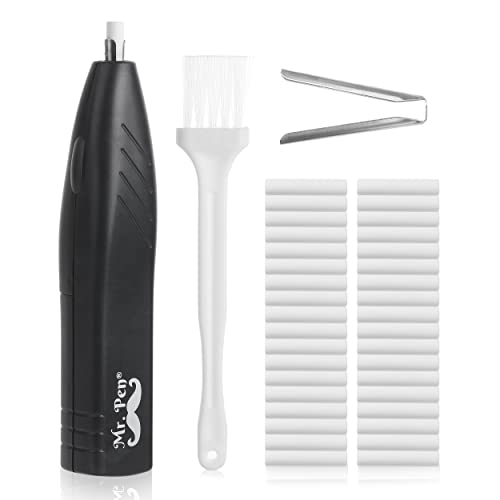
At a listed five inches long and one inch wide, the Mr. Pen kit is made for the pencil case that already bulges with compasses, scales, fineliners, and lead tubes. Its motor rotates a 5 mm refill over the target area, and the included 4.5-inch brush sweeps away crumbs before they get dragged through soft graphite. That little brush is more useful than it looks when presentation work needs to stay clean.
The package includes 36 extra refills, each listed at 0.2 by 0.98 inches. Compared with the dual-size kits, this model concentrates on a single, broader refill format. It can erase targeted portions of sketches and drawings, but a 5 mm contact point offers less clearance around tightly spaced dimension text than a 2.3 mm tip. Mr. Pen also warns against storing the product on wood, painted, varnished, or coated surfaces.
Pros
- Five-inch body fits readily into small pencil cases
- Includes 36 extra refills for continued use
- Supplied brush clears loose rubber and graphite particles
- Lightweight plastic construction supports portability
- One refill format keeps operation and replacement straightforward
Cons
- 5 mm refill is less precise than the 2.3 mm options
- Storage warning requires care around finished desk surfaces
Mr. Pen works best for students, sketchers, and drafters who prioritize a compact kit over the narrowest possible correction point. It is better suited to cleaning isolated marks and moderately broad pencil areas than threading between tiny notes. Store it in its pouch or a separate container, especially on a finished drafting desk, and use the brush rather than your palm to clear the soft gray debris.
To buy this product, click here.
9. ARTME Electric Eraser: Best for Students

The ARTME Electric Eraser measures a listed 6.5 by 0.6 inches, a slim shape that can slide beside pencils in a school bag or work case. It accepts 2.3 mm and 5 mm refills, so it can handle a narrow correction on a chart and then tackle a broader patch in a sketch. Operation is controlled by a button and powered by two AAA batteries.
Inside the package are two plastic nib holders, ten small refills, and twelve large refills. That 22-piece refill supply is modest beside AFMAT’s 140-piece bundles, but it gives a new user both diameters without producing a bulky box of supplies. Batteries are absent, making two fresh AAA cells a necessary addition before the first satisfying buzz across the paper.
Pros
- Slim 6.5 by 0.6-inch body fits common school and work bags
- Supports precise 2.3 mm and broader 5 mm refills
- Package includes separate holders for both refill sizes
- Replaceable AAA power is convenient away from charging ports
- Simple button control suits first-time electric eraser users
Cons
- Included supply of 22 refills is relatively limited
- Two AAA batteries must be purchased separately
ARTME makes sense for a student exploring powered correction without committing to a huge refill system. Its two tip sizes cover the central drafting tasks, and common batteries keep the setup easy to understand. Frequent users should check compatible refill availability early, while occasional users can enjoy a narrow, portable tool that handles homework, charts, plans, and pencil art without taking over the supply pouch.
To buy this product, click here.
How to Choose an Electric Eraser for Drafting
Start With Tip Diameter
A 2.3 mm refill gives you room to work around dimension numerals, arrowheads, hatch lines, and small symbols. It behaves like a pinpoint correction tool, touching a limited patch while nearby graphite remains intact. A 5 mm refill covers ground faster and suits broad sketch marks, highlights, or shaded presentation work. For mixed drafting and drawing, a kit supporting both diameters provides the most flexibility.
Think about a floor-plan correction beside a narrow wall line. The small tip offers welcome clearance there. Now imagine removing a thumb-sized patch from a loose concept sketch. The same tiny refill would feel painfully slow, and the 5 mm option would be the better fit.
Single-Ended Versus Dual-Ended Designs
Single-ended erasers are generally straightforward and can feel more like an ordinary writing tool. Their trade-off appears whenever you need another tip diameter because the refill holder must be removed and replaced. Small holders have a habit of vanishing under tracing paper, so a divided accessory box helps keep the setup orderly.
A dual-ended model such as the AFMAT EE25 leaves a fine tip and broad tip ready at opposite ends. That arrangement is especially useful during mixed-media presentation work, where technical lines and graphite shading sit side by side. The body is less minimal, but the reduction in tip-swapping can outweigh the added bulk.
Rechargeable Power Versus AAA Batteries
Rechargeable models work naturally at a permanent desk. Plug the eraser into a USB power source between sessions, and there are no disposable batteries rolling through the drawer. Battery condition still matters, however. A depleted internal cell cannot be exchanged as quickly as a pair of AAA batteries.
AAA-powered erasers suit travel, classrooms, and workspaces where outlets are scarce. Spare cells can bring a silent tool back to life in moments, which feels mighty handy before a review or submission. Their ongoing battery use is the compromise, particularly for someone making corrections every day.
Grip, Switch Placement, and Pressure
A slim barrel supports pencil-like handling, while a wider grip may feel less cramped during repeated corrections. Neither shape is universally superior. Consider how you hold mechanical pencils and technical pens. Users with a relaxed tripod grip may prefer a narrow cylinder, while those who dislike pinching small tools may welcome the wider AFMAT bodies.
The switch should be easy to reach without forcing the tip sideways. Electric erasers rely on rotation, so heavy downward pressure is rarely helpful. A gentle touch lets the refill work at the surface and reduces the chance of roughening paper. Start with a brief tap on scrap paper before approaching a carefully inked sheet.
Refills and Accessories
A large refill count is useful, but compatibility after the original bundle runs out matters more. Check the required diameter and holder style before ordering replacements. A kit with 140 pieces looks reassuring on a crowded shelf, yet those pieces still need dry, organized storage so fine refills do not bend or disappear.
Brushes are genuinely practical rather than decorative extras. Brushing crumbs away prevents the side of your hand from dragging graphite dust across a crisp border. Caps and cases also protect exposed rubber in a backpack where rulers, compass points, and pencil shavings can leave everything looking a bit battered.
Paper and Drawing Medium
Electric erasers are most commonly used with erasable pencil media, but results vary with paper texture, lead hardness, pigment, and drawing pressure. Deeply impressed lines may remain visible after the graphite is lifted. Colored pencil can also behave differently from ordinary graphite because some pigments stain or bind firmly to the sheet.
Use short, controlled contacts rather than grinding in one place. Thin tracing paper and soft surfaces deserve particular caution. A scrap from the same pad is the safest place to judge pressure, refill behavior, and surface change before the motor touches a nearly completed plan.
Best Electric Erasers for Drafting FAQ
What Tip Size Is Best for Technical Drafting?
A 2.3 mm tip is generally more useful for detailed technical corrections because it can work around small lettering, dimensions, and closely spaced lines. A 5 mm tip is faster for broad pencil marks and shaded areas. Drafters handling both line work and presentation sketches should look for a two-size kit.
Can an Electric Eraser Remove Ink?
These products are primarily intended for erasable drawing media such as graphite, with some listings also mentioning colored pencil. Standard permanent drawing ink generally cannot be cleanly erased from ordinary paper. Abrading the surface may damage it, so correction fluid, a drafting film method, or redrawing may be more appropriate depending on the medium.
Will an Electric Eraser Tear Tracing Paper?
It can roughen or tear thin paper if held in one spot with excessive pressure. Support the sheet on a smooth surface, use a fresh fine tip, and touch the mark in short bursts. Testing on an offcut from the same paper provides a safer preview of how the surface will react.
Are Rechargeable Electric Erasers Better Than Battery-Powered Models?
Rechargeable models are convenient for regular desk use and eliminate routine purchases of AAA batteries. Replaceable-battery models are easier to revive immediately during travel or class. The better format depends on access to charging, frequency of use, and whether you routinely carry spare batteries.
Why Does My Electric Eraser Leave a Faint Line?
The pencil may have pressed a groove into the paper, or graphite may be embedded in a textured surface. A powered eraser removes the erasable material but cannot flatten a deep indentation. Using lighter pencil pressure during initial construction lines makes later cleanup cleaner and less abrasive.
How Should Electric Eraser Crumbs Be Removed?
Use a soft brush and sweep away from completed graphite areas. Wiping crumbs with your palm can smear graphite and skin oils across the sheet, leaving a cloudy patch. Several kits in this roundup include a small brush for precisely this mundane but important job.
How Long Do Electric Eraser Refills Last?
Refill life varies with correction size, pressure, motor speed, and paper texture. Broad, aggressive erasing consumes rubber faster than brief detail work. Replace a refill once it becomes too short for the holder to grip securely, and avoid extending a tiny piece so far that it bends under rotation.
Can Electric Erasers Create Highlights in Pencil Drawings?
Yes. A narrow refill can lift small accents from graphite shading, while a wider refill can open broader light areas. The result depends on the pencil, paper, and darkness of the layer. Gradual passes usually provide more control than trying to reach bright white paper in one prolonged press.
Final Verdict
The AFMAT EE25 Dual-Motor Electric Eraser is our top overall recommendation because its two active ends solve a real drafting annoyance. Keeping 2.3 mm and 5 mm refills installed makes it quick to move from a tiny dimension correction to a wider graphite patch. Rechargeable power, protective caps, a brush, spare holders, and 140 included refills round out a kit suited to frequent technical and artistic work.
For a less elaborate setup, the AAA-powered AFMAT EEW001 offers two tip sizes and the same substantial refill count in a slim body. The compact Mr. Pen kit is easier to tuck into an overloaded pencil case, though its 5 mm refill is less suitable for very tight line work. Match the tool to your paper, preferred grip, and correction scale. Fine drafting benefits most from a 2.3 mm option, while regular mixed sketching makes dual-size access far more useful.
