A blueprint can survive years in a busy studio, then suffer serious damage during one careless move. A damp basement, a tightly wound tube, or a stack of drawings with no labels can turn a useful plan into a curled, brittle puzzle. Learning how to store blueprints means matching the storage method to the document’s material, size, access needs, and expected lifespan.
For active plan sets, compare blueprint storage racks for organized access and blueprint tubes for transport or temporary storage. Match either option to the condition of the drawings; fragile originals may need flat archival storage.
For long-term care, flat storage in a clean, dry, stable environment is generally the safest starting point. Rolls and tubes have an important place too, especially for transport or temporary storage, but they create curl and can put stress on fragile paper. The practical approach is to separate active drawings from archival documents, label everything clearly, and handle large sheets with calm, supported movements.
Choose Storage Based on the Blueprint’s Purpose
Before selecting a cabinet, portfolio, or tube, decide whether the drawing is being used every day, carried to a job site, or preserved as a record. A student may need quick access to a set of studio drawings, while an architect’s office may need to protect completed plans that are rarely opened. Those situations look similar on paper, but they call for different storage habits.
Active drawings can tolerate practical organization, provided they are protected from spills, sharp edges, excessive pressure, and repeated folding. Long-term records deserve more careful handling and, when their historical or legal value matters, preservation advice from an archivist or conservator. A faded reproduction and a fragile original may share the same dimensions while needing very different treatment.
| Storage Method | Useful For | Main Consideration |
|---|---|---|
| Flat drawers or portfolios | Long-term storage, frequently consulted sheets, fragile originals | Requires enough space for the full sheet to lie flat |
| Archival folders or boxes | Grouped drawings and moderately sized documents | Folders should fit without forcing the sheets to bend |
| Large-diameter tubes | Transport and temporary storage | Documents remain curled and may be difficult to flatten |
| Vertical roll storage | Organized collections of rolled drawings | Rolls need support, labels, and protection from crushing |
| Hanging storage | Oversized sheets in a suitable filing system | Edges and attachment points must not carry excessive weight |
Flat Storage Is Usually Best for Long-Term Use
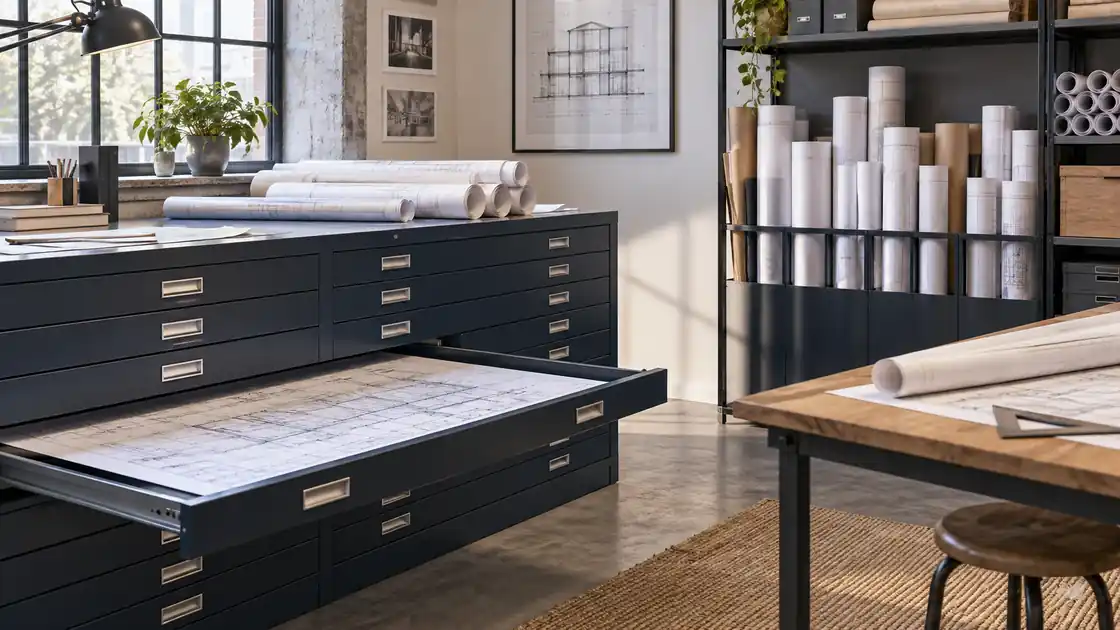
Flat storage keeps the paper relaxed instead of forcing it into a permanent curve. A wide horizontal drawer, map cabinet, or suitably sized portfolio can support the entire sheet and reduce handling. When someone needs an old floor plan six months later, the drawing can slide out smoothly rather than springing open like a stubborn paper scroll.
Use a storage surface that is clean, level, and large enough for the document. The sheet should not hang over an edge, catch on a neighboring drawer, or be compressed by a lid that is too small. If several drawings share a drawer, place them in logical groups and avoid creating a heavy, tightly packed pile that makes the bottom sheets difficult to retrieve.
Use Folders to Separate Drawings
Folders help prevent loose sheets from rubbing against one another and make a collection easier to identify. For ordinary office or studio organization, clean folders made for document storage may be sufficient. For historically important or preservation-sensitive drawings, use archival materials selected for that purpose and avoid assuming that every folder labeled “archival” has identical properties.
Oversized drawings should not be squeezed into a folder that is only slightly smaller. A corner that catches during removal can tear before the rest of the sheet even moves. Leave enough room for the drawing to enter and exit without scraping, and keep fasteners, paper clips, rubber bands, and adhesive notes away from delicate originals unless a qualified preservation professional has approved them.
When Rolled Storage Makes Sense
Rolling is practical when a drawing must be transported, when flat storage is unavailable, or when the document is already designed for short-term use as a rolled plan set. A tube protects the outside of the roll from dust and knocks, and a contractor can carry several large sheets through a doorway without wrestling with a wide, flapping bundle.
Even so, rolling should not automatically be treated as the ideal permanent method. Paper that stays curled can resist flattening, and forcing an old or brittle sheet open may cause cracks along existing folds or edges. A recently printed plan set and a delicate historic drawing may both fit inside a tube, but that does not make the same storage routine appropriate for both.
How to Roll a Blueprint More Safely
Roll the sheet loosely around a large, smooth core rather than winding it tightly around a narrow object. A larger diameter creates a gentler curve and reduces the sharpness of the curl. Keep the drawing clean and dry, place it on a clear surface, and support the sheet as you roll so one corner does not drag across the table.
- Remove clips, pins, staples, and other objects that could press into the paper.
- Check the sheet for tears, brittle edges, raised ink, or loose fragments before moving it.
- Use a clean, smooth core with enough diameter to avoid a tight coil.
- Roll gradually and evenly, keeping the edges aligned without forcing them.
- Secure the roll with a loose, nonabrasive band or place it directly into a protective tube.
- Label the outside of the tube and store it where it cannot be crushed, overheated, or exposed to moisture.
Do not force a brittle drawing to roll simply because its dimensions are inconvenient. If it resists, crackles, or shows flaking media, stop and seek conservation guidance. The quiet sound of paper fibers breaking is not a storage problem to solve with more pressure.
Store Tubes Horizontally or Vertically With Care
A tube should be supported so it does not bend, roll off a shelf, or carry the weight of other containers. Horizontal shelves work well when tubes are prevented from rolling, while vertical storage can be useful when each tube is clearly identified and supported at the bottom. Avoid placing heavy boxes on top of tubes, since a crushed end can damage the drawing inside.
Tube labels should remain readable without opening the container. Record the project name, sheet numbers, date, revision, and any relevant scale or discipline, such as structural, electrical, or architectural. A short index stored separately can save a long search through identical brown tubes later.
Control Moisture, Light, Temperature, and Dust
Blueprint storage does not need to be complicated, but the environment should be reasonably clean, dry, and stable. Basements, garages, attics, and exterior sheds often experience moisture swings or temperature extremes that are unsuitable for important paper records. A cabinet in a conditioned interior room is usually more predictable than a box beside a furnace or a damp concrete wall.
Keep documents away from plumbing, windows with strong direct sunlight, radiators, vents, and places where condensation may form. Light can fade some inks, dyes, and reproductions, while moisture can encourage mold growth, soften paper, and cause sheets to stick together. A student who stores drawings near a sunny studio window may notice the exposed edge changing color long before the rest of the sheet.
Dust is less dramatic but still troublesome. Grit can scratch surfaces as drawings slide across one another, and fine debris can become trapped in folds or along rolled edges. Clean the storage area regularly, but do not spray household cleaner near open drawings. If a document becomes wet, moldy, unusually brittle, or stuck to another sheet, separate it from the rest of the collection and obtain professional advice rather than experimenting with heat or aggressive cleaning.
Handle Large Sheets Before and After Storage
Large paper behaves awkwardly because its surface area gives it plenty of room to sag, fold, and catch on corners. Move an oversized blueprint with two hands or with another person supporting the opposite side. Carrying one end through a doorway while the other end drags behind can produce a crease that was not visible until the sheet is opened on the drafting table.
Clear the route before lifting the drawing. Shut drawers, move chairs, and remove pencils or tools from the receiving surface. If the sheet is folded, open it gradually on a broad, clean table rather than snapping it flat. A gentle, supported movement is especially important when the paper has become dry or stiff with age.
Keep food, drinks, ink bottles, and cutting tools away from the storage area. A coffee ring may be annoying on a disposable working print, but it can permanently obscure a dimension or note on an original plan. Store active drawing tools nearby if needed, but keep them in a separate container so a sharp divider or metal edge cannot rub against the paper.
Label and Organize Drawings for Retrieval
Good storage is not only about preventing damage. It should also help someone find the correct sheet without opening every folder. Label folders, drawers, and tubes with consistent information, such as project name, sheet number, revision, date, and drawing type. If the same project has several versions, make the revision status prominent rather than relying on a tiny handwritten note in the corner.
Sort drawings according to how people actually retrieve them. Project-based groups work well for an architecture studio, while discipline and sheet number may be more useful in an engineering archive. Keep superseded revisions separate from current working documents so an old plan does not accidentally return to the drafting table or job site.
- Use clear, durable labels on folders, boxes, drawers, and tubes.
- Keep current drawings separate from superseded or reference copies.
- Record sheet numbers and revision dates consistently.
- Store related schedules, details, and notes together when practical.
- Maintain a simple inventory for large collections.
- Use a digital scan or index to identify documents without unnecessary handling.
Digital records can support organization, but they should not be treated as a complete substitute for preserving the physical document when the original has evidentiary, historical, or contractual value. Scan important sheets at an appropriate resolution, use descriptive filenames, and store copies in more than one location. A digital index can prevent repeated searching while the original remains safely protected in its folder.
Short-Term Working Storage Versus Archival Storage
Working storage is built around access. Drawings may be placed in a portfolio beside a drafting board, carried in a tube between studio and site, or kept in a labeled project drawer for the duration of an assignment. Minor curl may be acceptable when the sheet will be opened repeatedly and replaced soon.
Archival storage is built around stability and minimal handling. Important originals should be evaluated for paper condition, media, previous repairs, and environmental risks. A conservator or archival professional can recommend suitable enclosures when the collection has historical, legal, or cultural importance. Do not assume that a modern office supply, plastic sleeve, or household box is automatically safe for every type of blueprint.
| Situation | Practical Approach |
|---|---|
| Daily studio reference | Use labeled flat folders or a portfolio on a clean, accessible surface |
| Transport to a meeting or site | Use a protective tube or portfolio sized for the sheets, avoiding tight rolling |
| Completed project records | Use organized flat storage when space allows, with clear revision and project labels |
| Historic or fragile originals | Minimize handling and seek preservation guidance for enclosures and environment |
What to Do With Folded or Damaged Blueprints
Folding may be unavoidable for a field copy, but repeated folding weakens the same lines and creates a predictable failure point. If a drawing is already folded, keep it folded only when opening it would cause damage, and avoid flattening it with books, weights, an iron, or a heat source. Pressure and heat can distort paper, affect printed media, or transfer surface marks.
For a mildly curled modern print, a conservatively sized flat folder and time may be enough, but the correct treatment depends on the paper and image layer. Do not tape tears from the front with ordinary clear tape. Adhesive can stain, become brittle, or make later repair more difficult. Fragile originals, flaking surfaces, mold, water damage, and stuck sheets belong with a qualified paper conservator rather than a home repair kit.
Frequently Asked Questions
Should Blueprints Be Stored Flat or Rolled?
Flat storage is generally preferable for long-term preservation and frequent consultation because it avoids maintaining a curl. Rolling is useful for transport or temporary storage when the roll is loose, supported, labeled, and protected from crushing. The condition and importance of the drawing should guide the decision.
Can Blueprints Be Stored in Plastic Sleeves?
Plastic sleeves vary in material and construction, so do not assume that any sleeve is suitable for long-term document storage. A sleeve may also trap moisture or fit too tightly. For important drawings, select enclosures intended for the document’s preservation needs and follow advice from an archival supplier or conservator.
How Should Rolled Blueprints Be Labeled?
Label the tube or outer enclosure with the project name, sheet numbers, revision, date, and discipline when relevant. Keep the label visible and maintain an inventory for collections with many similar rolls. Avoid writing directly on a fragile original.
Is a Basement a Good Place to Store Blueprints?
A basement is often risky because moisture, condensation, and flooding can damage paper. If the space is dry and well controlled, storage may be possible, but important drawings should be kept away from exterior walls, pipes, floors, and other potential moisture sources. A stable interior room is usually easier to manage.
A Practical Blueprint Storage Routine
Begin by separating drawings into active, transport, completed, and preservation-sensitive groups. Flatten and organize the sheets that need regular access, roll only what genuinely needs a tube, and keep fragile originals out of improvised storage. Add labels before the collection grows into an anonymous stack.
Then inspect the storage environment. Look for sunlight, dust, leaks, heat, crowding, and sharp objects that could damage paper during retrieval. With clean handling, suitable support, consistent labeling, and a storage method matched to the document’s purpose, blueprints remain readable and ready for the next drafting table instead of becoming a mystery inside a crushed tube.
