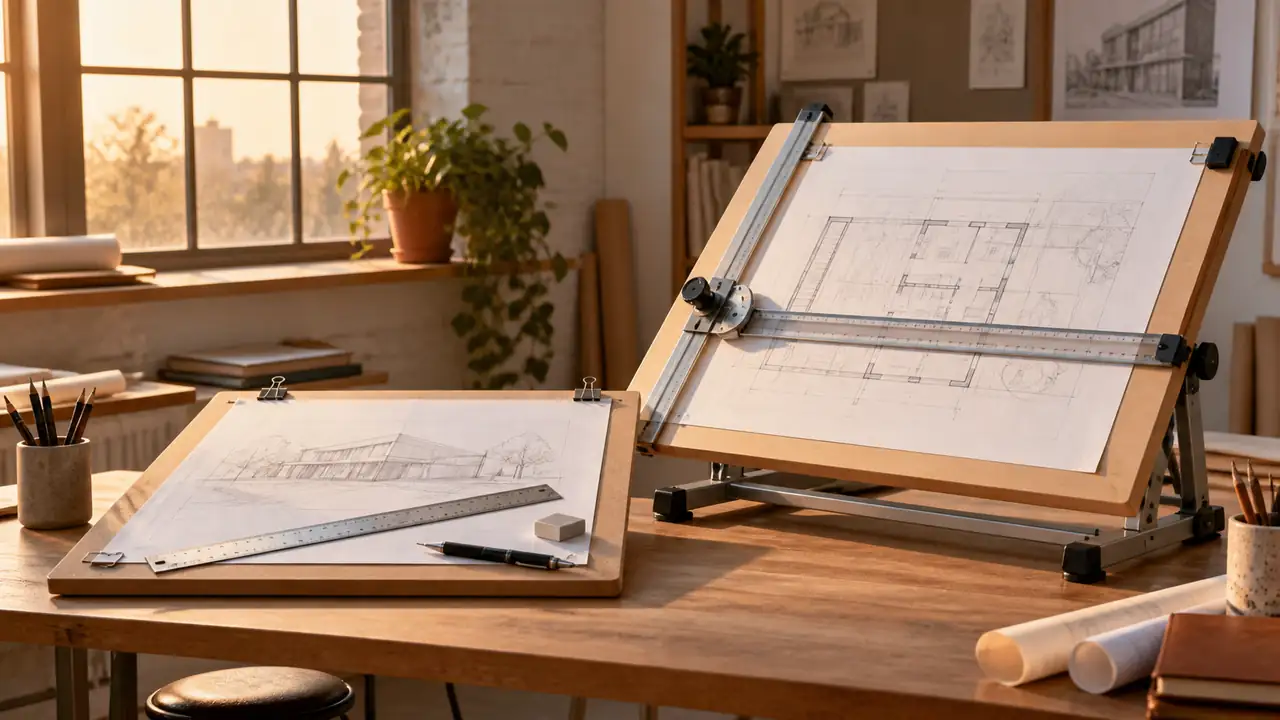
Search for a flat surface for sketching or technical drawing, and two names appear almost immediately: drawing board and drafting board. The labels sound like they should describe different tools, but in everyday use they often refer to the same basic equipment.
If portability or desk space is a deciding factor, compare portable drafting boards and tabletop drafting boards alongside the features discussed below.
The practical difference usually lies in context rather than a strict industry definition. “Drawing board” is the broader term for a rigid, flat surface used to support paper while drawing. “Drafting board” often suggests a board intended for more precise technical work, such as architectural drafting, engineering drawings, lettering, or work with a T-square and drafting triangles. Even so, manufacturers, schools, and artists may use the terms differently, so the name alone does not tell you everything about the board.
Drawing Board vs Drafting Board: The Short Answer
A drawing board and a drafting board are commonly interchangeable terms for a firm work surface used to hold paper flat during drawing. A drafting board may be described more specifically as a board designed for technical drafting, often with features that support accurate alignment and repeated measurements.
| Comparison | Drawing Board | Drafting Board |
|---|---|---|
| General meaning | A rigid surface for drawing, sketching, or artwork | A rigid surface associated with technical or precision drawing |
| Typical work | Sketching, illustration, painting, and general drawing | Architectural, engineering, mechanical, and technical drafting |
| Surface | Usually flat and smooth | Usually flat, smooth, and suited to alignment tools |
| Common accessories | Clips, tape, drawing pins, or a portable case | T-square, parallel rule, drafting triangles, scales, and clips |
| Angle adjustment | May be fixed or adjustable, depending on the design | May be designed to work on a tilted drafting table or stand |
| Terminology | Broad and flexible | More closely associated with precision drafting, but not formally separate in every context |
That overlap explains why a student may call a portable A2 surface a drawing board while a technical-drawing supplier lists a similar surface as a drafting board. The work may be identical even when the catalog wording changes.
What Is a Drawing Board?
A drawing board is a solid, flat surface that supports a sheet of paper while someone draws. It may be made from wood, composite board, plastic, or another rigid material, with a smooth face that allows a pencil, pen, marker, or brush to move without the flex and wobble of a thin sheet placed on a soft desk.
For a student sketching in a studio, the board may simply provide a clean, portable surface that travels in a portfolio. For an illustrator working at a kitchen table, it can create a more stable drawing area and protect the paper from an uneven tabletop. Some boards have clips or a carrying handle, while others are plain panels intended to rest on a desk or drafting stand.
The term is deliberately broad. A board used for freehand perspective sketches and a board used for measured floor plans may both be sold as drawing boards, even though the accessories and working methods differ.
Typical Features of a Drawing Board
A basic drawing board may include few features beyond a smooth, rigid surface. More specialized versions can include:
- Paper clips or corner clamps for holding a sheet in place.
- A bevelled or rounded edge that is comfortable to work against.
- Slots, handles, or a lightweight construction for carrying.
- A surface sized for common paper formats such as A3 or A2.
- Compatibility with a stand, table, or portable drawing case.
When the board is used for watercolor or wet media, surface material and moisture resistance become more important. When it is used with a T-square, a straight, stable edge matters more than portability. The name remains “drawing board,” but the useful specifications change with the task.
What Is a Drafting Board?
A drafting board is a rigid drawing surface associated with accurate technical drawing. It gives the drafter a stable plane for producing lines, lettering, dimensions, symbols, and geometric constructions. In traditional manual drafting, the board is used with tools such as a T-square, parallel rule, set squares, compass, technical pen, and scale ruler.
In a classroom, a drafting board may be the surface on which a student lays out an architectural plan with a parallel rule. In an engineering office, a similar surface might support a detailed mechanical drawing. The board does not create accuracy by itself, but it gives alignment tools a dependable base and keeps the paper from shifting during repeated measurements.
Some drafting boards are simple portable panels. Others form part of a larger drafting table with a tilting work surface, edge guides, storage, or a mechanism for changing the board angle. This is why “drafting board” can describe both a standalone panel and the main work surface of a drafting workstation.
Features That Suggest Technical Drafting Use
A board is more likely to be called a drafting board when it has features suited to measured work, such as:
- A straight, reliable working edge for a T-square or parallel rule.
- A smooth surface that supports clean pencil and ink lines.
- A rigid core that resists bending under hand pressure.
- Enough room around the paper for rulers, triangles, and notes.
- Mounting or support options that allow the work surface to tilt.
These features are practical rather than exclusive. A careful illustrator may want the same rigid edge and smooth face, while a technical drafter may use a very plain board without any built-in guide. The intended workflow matters more than the printed label.
Where the Two Terms Actually Differ
The clearest difference is usually breadth of meaning. Drawing board may refer to almost any rigid surface used for drawing. Drafting board tends to point toward precision, measured layouts, and traditional drafting equipment.
Consider two desks in the same studio. One has a portable board covered with a loose sheet of paper, where a student makes charcoal studies and quick thumbnail sketches. The other has a larger surface with a parallel rule, scale ruler, and technical pens arranged along the edge. Both are drawing boards in the broad sense, but the second is more naturally described as a drafting board.
Terminology also shifts between regions and suppliers. One manufacturer may call a portable technical surface a drawing board, while another calls it a drafting board because it is marketed for architecture or engineering. There is no universal naming rule that forces every seller to use the terms in one particular way.
| Practical Question | What to Look For |
|---|---|
| Will you use a T-square or parallel rule? | A straight, stable edge and sufficient board rigidity |
| Will the board travel to class or a field location? | Manageable weight, carrying features, and protection for the surface |
| Will you draw large plans? | A working area that leaves room for tools around the sheet |
| Will you use wet media? | A surface whose material and care instructions suit moisture exposure |
| Will you work at an angle? | Compatibility with a stand, adjustable table, or support system |
Drawing Board, Drafting Board, and Drafting Table
A drafting board is not automatically the same thing as a drafting table. The board is the work surface. The table is the complete support system, which may include legs, a frame, height adjustment, tilt adjustment, drawers, trays, or a built-in parallel rule.
A portable board placed on a regular desk remains a drawing board, even if it is used for technical drafting. A large tilting table has a drafting board as its working surface, but the table adds the structure and adjustment mechanism around it. Confusing these terms can lead to an awkward setup, especially when a product description gives the board dimensions but not the total footprint of the table.
For example, an architecture student may carry a lightweight board between studio and home, then place it on a desk at a comfortable angle. A professional workspace may instead use a fixed drafting table with a larger surface and dedicated edge guide. The paper, ruler, and drawing method may be similar, but the surrounding equipment is quite different.
Which Term Should You Use?
Use “drawing board” when you mean the general tool or want to include sketching, illustration, painting, and technical drawing. Use “drafting board” when the discussion centers on measured drawing, drafting instruments, architectural plans, engineering layouts, or a traditional drafting workstation.
Neither term is wrong when the same physical board is being described. If you are searching for equipment, look past the title and examine the details that affect the work:
- Overall dimensions and usable drawing area.
- Surface flatness and rigidity.
- Edge design and compatibility with a T-square or parallel rule.
- Paper-holding method.
- Portability and storage requirements.
- Whether the board works on a desk, stand, or drafting table.
- Surface compatibility with pencil, ink, marker, paint, or cutting tools.
Usable area deserves particular attention. A board may be advertised by its nominal outside dimensions, yet clips, edge guides, handles, or a surrounding frame can reduce the space available for paper. Someone laying out an A2 sheet needs room not only for the sheet itself, but also for alignment and tool movement around its edges.
Does a Drawing Board Need to Be Tilted?
No. A drawing board can be used flat, tilted, or placed on an adjustable support. The appropriate position depends on the drawing method, paper size, tools, and the user’s workspace.
A flat board may suit quick sketches or work that must remain level. A tilted surface can make it easier to view a large sheet and may be convenient for traditional drafting, but the angle is not a universal requirement. A student working on a small sketchbook at a kitchen table may need no adjustment at all, while someone lettering a large plan may prefer a supported incline.
Any tilt mechanism should be stable and easy to lock. A board that creeps downward while a straightedge is being used is frustrating and can disturb alignment. Stability matters more than having the largest possible adjustment range.
Choosing the Right Description for Your Work
For freehand sketching, illustration, and general art, a drawing board is usually the most natural term. Prioritize a smooth, rigid surface, a size that fits the paper, and a way to secure the sheet without damaging it.
For architectural or engineering drafting, the phrase drafting board better reflects the workflow, but the same physical selection principles still apply. The board should have a dependable edge, enough clearance for instruments, and a support arrangement that keeps the paper steady during repeated construction lines and measurements.
For a mixed workflow, do not let the label narrow your search. A board used for a morning of measured floor plans may support afternoon perspective sketches just as well. Compatibility with your tools and workspace tells you more than whether the package says “drawing” or “drafting.”
Frequently Asked Questions
Are Drawing Boards and Drafting Boards the Same Thing?
Often, yes. The terms overlap heavily and may describe the same rigid drawing surface. “Drawing board” is generally broader, while “drafting board” more often emphasizes technical or measured drawing.
Can You Use a Drawing Board for Architectural Drafting?
Yes, provided it is large and rigid enough for the paper and tools involved. Check for a straight working edge if you plan to use a T-square or parallel rule, and allow usable clearance around the sheet.
Is a Drafting Board the Same as a Drafting Table?
No. A drafting board is the work surface. A drafting table is the supporting furniture or complete workstation, which may include legs, tilt adjustment, storage, and drafting guides.
Does a Drafting Board Have to Include a Parallel Rule?
No. A parallel rule may be built into a drafting table, attached separately, or omitted entirely. A drafting board can be a plain panel used with a separate T-square, ruler, or triangle.
What Is More Important Than the Name?
Look at rigidity, usable dimensions, surface quality, paper retention, edge accuracy, portability, and compatibility with your drafting tools. Those characteristics determine how well the board supports the work.
The Practical Distinction
In the comparison between drawing board vs drafting board, the difference is mainly one of emphasis. A drawing board is the general category. A drafting board usually signals a surface intended for more structured, precise, or technical work, but the terms are not separated by a universal standard.
When evaluating a board, focus on the surface and the workflow rather than the name on the label. A stable edge, suitable working area, secure paper placement, and comfortable support will matter far more than whether the manufacturer calls it a drawing board or a drafting board.
