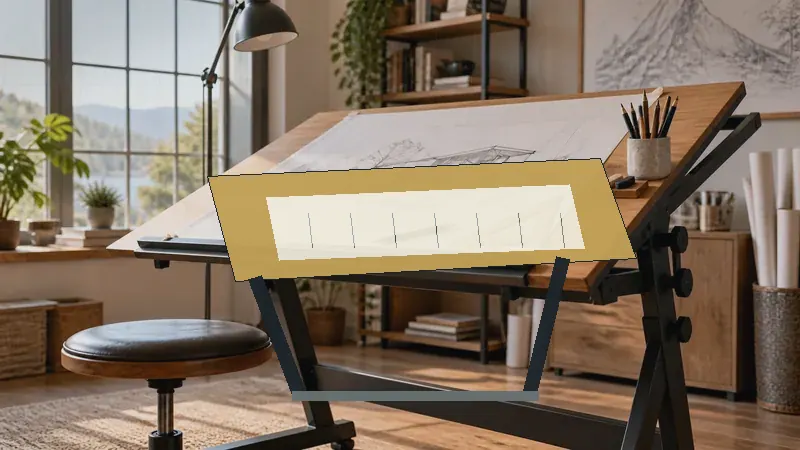
A tabletop drafting board earns its keep when a kitchen table, studio desk, or classroom bench needs to become a precise drawing surface without committing to a full drafting table. The major differences appear quickly once the pencil starts moving: some boards include parallel bars for repeated horizontal lines, some rely on a separate T-square, and others focus on a broad angled surface for sketching, painting, or large paper. Size matters too. A compact board is easier to store, while a larger 23-by-31-inch or 24-by-36-inch surface gives a generous sheet more breathing room.
Buyers often focus on the number of angle positions and overlook the details that shape daily use. Check the usable board dimensions, the way the straightedge travels, the amount of tabletop space required, and whether the surface has a pencil ledge or storage drawer. A student sharing a small apartment may value portability and quick folding, while an architect working on measured layouts may prefer a parallel motion bar and a ruler with an inking edge. Among these options, the Acurit 20-by-26-inch PXB Drawing Board stands out as the strongest overall balance of drafting control, adjustable positioning, and manageable size.
For a fast overview, the table below puts all nine tabletop drafting boards side by side before the detailed reviews.
Best Tabletop Drafting Boards Comparison Table
| Product | Best For | Board Size | Adjustment | Key Feature |
|---|---|---|---|---|
| Acurit 20" x 26" PXB | Overall drafting use | 20" x 26" | 7 angles, up to 45 degrees | Parallel motion bar |
| DOLEMODUO 20" x 26" | Students and value seekers | 20" x 26" | Adjustable tabletop angle | Parallel bar and stainless steel rule |
| U.S. Art Supply 26" x 21" | Artists and general drawing | 26" x 21" | 6 positions | Beechwood construction and pencil ledge |
| Acurit 24" x 36" PXB | Large-format work | 24" x 36" | 7 angles, up to 45 degrees | Large parallel-bar surface |
| DOLEMODUO 23" x 31" | Architectural drawings | 23" x 31" | Adjustable tabletop angle | Large surface with parallel bar |
| Acurit 16" x 21" PXB | Small workspaces | 16" x 21" | 7 angles, up to 45 degrees | Compact parallel motion system |
| Falling in Art Extra Large Easel Board | Painting and mixed media | 29 1/2" x 19 1/5" base area | 5 positions, flat to about 80 degrees | Foldable beechwood easel design |
| DJAR 5-Position Drafting Table | Budget tabletop use | 25 3/5" x 19" | 5 positions, flat to 70 degrees | T-ruler and rubber rope |
| U.S. Art Supply A2 Wooden Board | Organized drawing setups | 25 5/8" x 19" | 6 positions | Pencil ledge and storage drawer |
The detailed reviews below show where each board fits, where it falls short, and what kind of workspace it suits best.
1. Acurit Multi-Angled 20" x 26" PXB Drawing Board With Parallel Motion Bar Best Overall

The Acurit 20-by-26-inch PXB is the most complete fit for buyers who want genuine drafting control without moving to a full-size drafting table. Its fitted straightedge travels with a parallel motion system, so repeated horizontal lines have a consistent guide instead of relying on a loose ruler that can shift across the page. The transparent ruler includes inch markings and an inking edge, a useful touch for technical layouts where a freshly drawn line should not drag against the moving bar.
The board also gives a small home studio some welcome flexibility. Seven angle positions reach up to 45 degrees, allowing the surface to sit nearly flat for certain layouts or rise for a more comfortable seated setup. A 17mm laminated melamine surface is nonporous and intended to resist scratches, dents, and everyday marks, while rubber feet and a handle support movement between a desk and storage area. A student working beside a laptop or an artist clearing the dining table after an evening sketch can benefit from that portable format.
Pros
- Integrated parallel motion bar supports consistent horizontal lines
- Seven adjustable angles reach up to 45 degrees
- Transparent ruler includes inch markings and an inking edge
- 17mm laminated melamine surface is smooth and easy to wipe clean
- Rubber feet and a handle support tabletop stability and portability
Cons
- Its 20-by-26-inch format may feel limiting for very large sheets
- The built-in motion system adds more mechanical hardware than a basic board
This is the board to choose for measured drawing, technical sketching, and general design work where a straightedge matters every day. Buyers who mainly paint on canvas may prefer a simpler wood easel with a steeper angle range, while large-format drafters should look toward the 24-by-36-inch Acurit model. For a balanced tabletop setup, though, the Acurit combines the most relevant drafting features without taking over an entire room.
To buy this product, click here.
2. DOLEMODUO Portable 20" x 26" Drafting Board Best Value

For a student assembling a drafting setup piece by piece, the DOLEMODUO 20-by-26-inch board offers a practical feature mix. The listing describes a 17mm laminated nonporous melamine surface, a transparent straightedge with centimeter markings, and a locking system that allows the bar to glide or stay in place. That combination is useful for class assignments, layout work, and sketching sessions where a board may need to move from a bedroom desk to a shared table.
A serrated rubber track is included to support the board on a tabletop, while the adjustable angle lets the user pull the surface closer rather than leaning across a flat sheet. The included stainless steel rule adds a separate measuring option for marks that do not require the parallel bar. Picture a student switching between a precise horizontal layout and a quick freehand study. The DOLEMODUO can handle both without a bulky permanent station.
Pros
- Useful 20-by-26-inch size for general tabletop drafting
- Includes a transparent straightedge with centimeter markings
- Locking system allows the parallel bar to glide or remain fixed
- 17mm laminated surface is smooth and designed for easy cleaning
- Includes a stainless steel rule for separate measuring tasks
Cons
- Its markings are metric-focused, which may be less convenient for inch-based workflows
- The listing provides less angle detail than the Acurit PXB models
This model makes sense for students, hobbyists, and first-time buyers who want a parallel bar without moving into the premium end of the category. It gives a stronger drafting setup than a plain angled board, although buyers who need clearly stated multi-angle positioning may prefer the Acurit range. In a compact study space, its combination of size and portable construction is especially appealing.
To buy this product, click here.
3. U.S. Art Supply X-Large 26" x 21" Wooden Drawing Board Best for Artists

The U.S. Art Supply 26-by-21-inch board takes a warmer, simpler approach than the mechanical PXB boards. Its seasoned beechwood construction and natural-oil finish give it the look of a traditional studio tool, while six angle positions let it shift from a nearly flat drawing surface to a more upright setup. An artist moving between graphite, ink, and paint may appreciate that broad, uncluttered platform.
A built-in pencil ledge keeps a few frequently used tools from rolling into the floor, which sounds minor until a sharp pencil disappears beneath a desk during a busy sketch. The listing also references support for a 24-inch T-square, so buyers can build a familiar manual drafting arrangement around the board. It does not provide the integrated parallel motion system found on the Acurit and DOLEMODUO choices, but its open wooden surface suits freehand drawing and painting particularly well.
Pros
- Large 26-by-21-inch work surface
- Six adjustable angle positions
- Seasoned beechwood construction with natural-oil finish
- Built-in pencil ledge keeps drawing tools close at hand
- Portable tabletop design works in studios, classrooms, and homes
Cons
- Does not include an integrated parallel motion bar
- Wood construction may need more careful protection from wet media than a nonporous melamine surface
This board fits artists and drafters who prefer a straightforward surface and a separate T-square over a built-in mechanism. It is also a comfortable choice for someone who wants a tabletop easel feel without a large floor-standing frame. Buyers producing repeated technical lines may spend more time setting up external tools, but painters, sketchers, and general-purpose users gain a broad, uncluttered work area.
To buy this product, click here.
4. Acurit Multi-Angled 24" x 36" PXB Drawing Board With Parallel Motion Bar Best for Large-Format Work
The 24-by-36-inch Acurit PXB is the broad-shouldered member of this group. That surface gives architectural sheets, presentation layouts, and expansive sketches more room than the compact boards, reducing the familiar shuffle where a page edge bumps against a coffee mug or disappears beneath a ruler. Its parallel motion bar brings the same core drafting idea as the smaller Acurit, with a transparent ruler and inking edge for guided line work.
Seven angle positions reach up to 45 degrees, and the laminated 17mm melamine surface is nonporous for straightforward cleanup. Rubber feet and a handle are useful details, yet the board’s generous dimensions still demand a suitably deep and wide table. A design student working on a large plan may welcome the extra room, while someone in a narrow apartment could find setup and storage more demanding.
Pros
- Largest dedicated drafting surface among the PXB models listed
- Integrated parallel motion bar supports repeated horizontal lines
- Seven angle positions reach up to 45 degrees
- 17mm laminated melamine surface is nonporous and wipeable
- Includes a transparent ruler with an inking edge
Cons
- Requires substantially more tabletop and storage space than compact boards
- Its large surface may be excessive for small sketches or limited desks
Choose this Acurit when the drawing itself is the priority and the room can support the footprint. It is particularly suited to large plans, broad presentation sheets, and users who dislike folding or repositioning paper halfway through a project. For everyday notebook-sized work, the 20-by-26-inch model is easier to live with and may leave more space for a lamp, laptop, or supply tray.
To buy this product, click here.
5. DOLEMODUO Portable 23" x 31" Drafting Board Best for Architectural Drawings
The 23-by-31-inch DOLEMODUO gives buyers a middle path between a compact board and the very large Acurit. Its dimensions provide more working room for architecture sheets and design layouts while remaining a tabletop product rather than a permanent drafting station. The 17mm laminated melamine surface is described as smooth, nonporous, and easy to wipe, a practical trait for graphite dust, eraser crumbs, and the occasional ink smudge.
The transparent straightedge uses centimeter markings and includes a locking system for either controlled movement or fixed positioning. A serrated rubber track is intended to help the board stay in place while the user adjusts the drawing angle. Imagine spreading out a larger plan on a shared dining table, then clearing the entire setup later that evening. The board’s portable format supports that routine, although the extra surface area still needs careful storage.
Pros
- 23-by-31-inch size offers generous room for larger layouts
- Parallel bar supports guided horizontal lines
- Transparent straightedge includes centimeter markings
- 17mm laminated melamine surface is smooth and easy to clean
- Serrated rubber track is intended to support tabletop stability
Cons
- Larger dimensions make it less convenient for very small desks
- Metric markings may require an extra inch-based tool for some workflows
This is a sensible fit for buyers who need more paper room than a 20-by-26-inch board provides but do not want the full footprint of a 24-by-36-inch model. Architecture students and home designers can use the surface for broad plans, while artists may appreciate the open space for mixed drawing work. Buyers who rely heavily on inch markings should check their preferred measurement system before ordering.
To buy this product, click here.
6. Acurit Multi-Angled 16" x 21" PXB Drawing Board With Parallel Motion Bar Best for Small Workspaces
Some drafting boards are useful precisely because they do not consume the entire desk. The Acurit 16-by-21-inch PXB keeps the parallel motion system, transparent inch-marked ruler, and seven angle positions of the larger Acurit boards while shrinking the main work area. That makes it a compelling fit for a dorm room, apartment desk, or shared work surface where every inch around the board matters.
The laminated 17mm melamine surface is nonporous and intended to resist scratches and dents, while rubber feet and a handle help with repositioning. A smaller board can feel refreshingly nimble when a project involves letters, detail studies, or compact plans. It will feel less comfortable once a large sheet needs to lie flat with generous margins, so the size decision should follow the paper rather than the storage shelf alone.
Pros
- Compact 16-by-21-inch format suits limited desks
- Includes the Acurit parallel motion bar system
- Seven drawing angles reach up to 45 degrees
- Transparent ruler includes inch markings and an inking edge
- Handle and rubber feet support portability and placement
Cons
- Smaller surface limits room for large-format sheets
- Provides less space for supplies beside the active drawing area
Choose this model for portability and measured detail work rather than expansive plans. A student who packs away supplies each night may find the compact shape especially convenient, while a professional producing broad layouts will likely appreciate a larger board. Its main advantage is clear: it preserves useful drafting hardware in a form that is easier to fit into ordinary rooms.
To buy this product, click here.
7. Falling in Art Extra Large 5-Position Wood Drafting Table Easel Best for Painting and Mixed Media

The Falling in Art board leans toward the easel side of tabletop drafting. Its extra-large base area measures 29 1/2 inches long by 19 1/5 inches wide, and the lower ledge is intended to hold brushes, pencils, books, an iPad, or larger paper and canvas. That makes it attractive for an artist whose table shifts between sketching, painting, reading, and diamond painting during the same week.
Five incline positions range from flat to about 80 degrees, giving it a taller display angle than the Acurit boards. Solid European beechwood and four non-slip rubber feet support the foldable design, which can be carried or stored when the desk needs to return to ordinary use. A technical drafter may miss an integrated parallel bar, but a painter will likely appreciate the open platform and deep ledge more than mechanical line guidance.
Pros
- Extra-large base area accommodates broad creative projects
- Five positions range from flat to about 80 degrees
- Solid European beechwood construction
- Foldable design supports storage and transport
- Lower ledge holds tools, books, tablets, paper, or canvas
Cons
- Does not include an integrated parallel bar for technical drafting
- Its easel-style layout is less specialized for measured architectural work
This board belongs in a mixed-media studio, a classroom art space, or a home where one surface needs to serve several creative purposes. It is less persuasive for strict technical drafting, where a guided straightedge saves time and keeps line work aligned. Buyers who want a broad angled platform with a strong painting orientation should find more value here than in a compact mechanical board.
To buy this product, click here.
8. DJAR 5-Position Drafting Table for Painting Best Budget Option
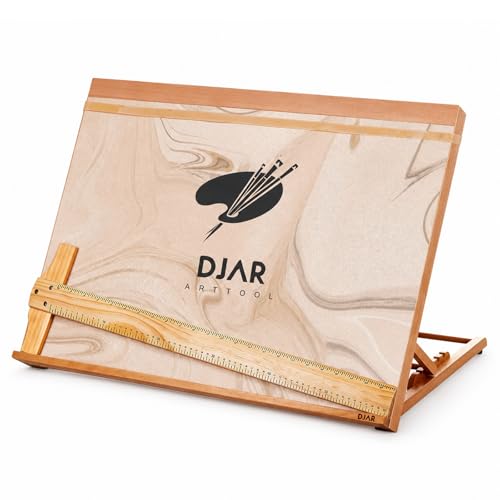
The DJAR offers a straightforward entry point for shoppers who need an angled tabletop surface without a large mechanical drafting system. Its listed dimensions are 27 inches long by 19 inches wide, and the board uses five angle positions from flat to 70 degrees. A buyer setting up a first home art station can use it for drawing, painting, reading, or tablet support without adding a full desk to the room.
The German beechwood construction has a smooth polished surface and a finish described as corrosion-resistant and waterproof. A T-ruler provides a basic path to measured lines, while the rubber rope can help hold paper or serve as a storage aid. The board folds for corner storage, which is handy after a Saturday sketching session when the dining table needs to become a dinner table again.
Pros
- Five angle positions range from flat to 70 degrees
- Foldable construction helps conserve storage space
- Includes a T-ruler for basic measured drawing
- Rubber rope can help secure paper and organize the setup
- Can serve as a drawing surface, reading stand, or tablet support
Cons
- Does not include a parallel motion bar
- Its 19-inch width may restrict larger paper and broad layouts
The DJAR is best for casual drafting, painting, school projects, and buyers who want several uses from one small tabletop tool. It is less suited to repetitive technical layouts than the Acurit or DOLEMODUO boards because the T-ruler requires more manual positioning. That trade-off keeps the design simple and approachable, especially for a beginner working with limited space.
To buy this product, click here.
9. U.S. Art Supply X-Large 25 5/8" x 19" A2 Wooden Drawing Board Best for Organization

The A2 U.S. Art Supply board is built around a familiar studio problem: pencils, erasers, clips, and small tools tend to scatter across the table until the active drawing area feels strangely tiny. Its 25 5/8-by-19-inch surface includes a pencil-holding ledge and a locking storage drawer, giving a student or hobby artist a dedicated place for supplies. The listed A2 format also makes the board relevant to buyers who work around larger standard sheets.
Six angle positions allow the surface to move from flat to upright, while seasoned beechwood and a natural-oil finish give it a traditional wooden-board character. It does not provide the guided parallel bar of the Acurit models, so repeated horizontal drafting lines will require the included setup and separate tools. Still, a drawer can be the difference between a tidy desk and a small avalanche of supplies when a project stretches across several evenings.
Pros
- 25 5/8-by-19-inch surface is suited to larger drawing formats
- Six adjustable angle positions
- Built-in pencil ledge keeps frequently used tools accessible
- Locking storage drawer adds useful organization
- Seasoned beechwood construction with natural-oil finish
Cons
- Does not include an integrated parallel motion bar
- Storage and wood construction make it less minimal than a plain portable board
This board suits students, artists, and home users who care as much about organization as line guidance. The drawer and ledge make it easier to leave a project paused without sweeping every tool into a box, while the six positions support both flat and angled work. Buyers focused on architectural precision may prefer a mechanical straightedge, but organized general drawing is where this board makes its strongest case.
To buy this product, click here.
How to Choose Among the Best Tabletop Drafting Boards
Match the Board Size to the Paper
Start with the sheet sizes you actually use. A 16-by-21-inch board is easy to fit beside a keyboard, but it leaves less room around a large drawing. A 20-by-26-inch surface is a useful middle ground for everyday drafting, while the larger DOLEMODUO and Acurit boards make more sense for broad plans and presentation work. Measure the desk, too. A board can fit the paper perfectly and still leave nowhere for a lamp, ruler, or coffee cup.
Choose a Parallel Bar for Repeated Technical Lines
A parallel bar is especially useful for floor plans, measured layouts, lettering guides, and any project with frequent horizontal lines. The Acurit and DOLEMODUO models include guided straightedges, while the wood boards rely on a T-ruler or separate tools. A manual ruler can work well for occasional lines, but a built-in bar reduces the need to reposition a loose tool every few inches.
Think About Angle Range
Angle adjustment changes how the board fits your posture and your medium. The Acurit models offer seven positions up to 45 degrees, which suits seated drafting and general drawing. The DJAR reaches 70 degrees, and the Falling in Art board reaches about 80 degrees, making those designs more attractive for painting, display, or reading. A steep angle is not automatically better for technical work. The useful range is the one that keeps the page comfortable without making tools slide away.
Compare Surface Materials
Laminated melamine offers a smooth, nonporous surface that is easy to wipe clean after graphite or ink work. Wood brings a warmer studio feel and can be pleasant for painting and sketching, though it deserves more care around wet media. Neither material answers every need. A technical drafter may prefer the predictable surface of melamine, while an artist may value the broader, more traditional feel of beechwood.
Account for Storage and Portability
Tabletop boards are often bought for flexible spaces, so think about where the board will go after the drawing ends. Handles and rubber feet help the Acurit boards move between locations. Foldable designs such as the Falling in Art and DJAR can slide into a closet or corner. Larger boards need more careful storage, particularly if they must be lifted onto a table each time. A board that is difficult to retrieve may spend more time against a wall than in use.
Decide Whether Organization Matters
A pencil ledge is handy for the tools used constantly, while a storage drawer gives a project a temporary home between sessions. The U.S. Art Supply A2 board adds both features, and the 26-by-21-inch version includes a pencil ledge without a listed drawer. Buyers who already use a separate supply caddy may prefer a cleaner surface, but anyone working in a shared room may appreciate having pencils and erasers contained near the board.
Best Tabletop Drafting Boards FAQ
What Size Tabletop Drafting Board Should I Buy?
Choose a board that comfortably supports the paper size you use most often while leaving room on the table for tools. A 16-by-21-inch board suits compact workspaces and smaller projects. The 20-by-26-inch models offer a useful middle ground, while 23-by-31-inch and 24-by-36-inch boards are better for broad architectural or presentation layouts.
Are Tabletop Drafting Boards Useful for Architecture Students?
Yes, particularly models with a parallel bar, adjustable angle, and enough room for the sheets used in class. The Acurit and DOLEMODUO boards provide guided straightedges, while the larger versions offer more room for plans. Students should measure dorm or apartment desks before choosing a large board.
Is a Parallel Bar Better Than a T-Square?
Neither tool is universally better. A parallel bar stays attached to the board and is convenient for repeated horizontal lines. A T-square is more flexible and can be paired with different boards, but it requires manual positioning. Buyers producing frequent technical layouts may prefer an integrated bar, while occasional drafters may be satisfied with a T-ruler.
Can These Boards Be Used for Painting?
Several can. The wood boards from U.S. Art Supply, Falling in Art, and DJAR are especially suited to painting and mixed-media work because they offer broad angled surfaces. Check the surface and cleanup requirements of the medium you use. A nonporous melamine board is convenient for wiping, while wood may need more careful handling around wet materials.
Are Larger Drafting Boards More Comfortable?
A larger board gives a sheet more room and reduces the need to reposition paper, but comfort also depends on desk depth, angle, and seating. A large board can feel cramped if it leaves no space for your arms or tools. Measure the available table before treating extra surface area as an automatic advantage.
Do Tabletop Drafting Boards Need a Separate Stand?
The products in this roundup are intended for tabletop use, so they do not require a full drafting-table frame. They still need a stable, suitably sized table. Rubber feet, tracks, and folding supports can help, but the underlying table remains important for a steady setup.
Which Board Is Best for a Small Apartment?
The Acurit 16-by-21-inch PXB is the most compact option with an integrated parallel motion bar. The DJAR and other foldable wood designs are also useful when storage space is tight. Measure both the active desk area and the place where the board will be stored between sessions.
Final Verdict
The Acurit Multi-Angled 20-by-26-inch PXB Drawing Board is the strongest overall recommendation because it brings together the features that matter most for serious tabletop drafting: a parallel motion bar, inch-marked transparent ruler, inking edge, seven angle positions, and a smooth 17mm melamine surface. Its dimensions provide useful drawing room without the storage demands of the largest boards. For buyers who want a dependable technical setup that can still move between rooms, it is the most balanced pick in this group.
Different workspaces call for different compromises. The Acurit 16-by-21-inch PXB is better for compact desks, while the Acurit 24-by-36-inch model gives large-format users substantially more room. The DOLEMODUO boards offer parallel-bar functionality with a student-friendly portable design, and the U.S. Art Supply, Falling in Art, and DJAR boards make more sense for artists who value broad wood surfaces, steeper angles, folding storage, or supply organization. Before ordering, measure the table, check the paper format, and decide whether guided line control or general creative flexibility matters more.
