A drafting chair has to solve a slightly awkward furniture puzzle. It needs enough height for a drafting table, standing desk, counter, or elevated studio surface, yet it also needs to tuck away without swallowing the room. In a small apartment office, a bedroom corner, or a compact design studio, a chair with wide arms or a bulky base can turn a useful workstation into a daily obstacle course.
The important differences are practical ones: seat-height range, foot-ring adjustment, back support, armrest clearance, seat width, caster design, and how far the chair can slide under a desk. A common buying mistake is matching the chair to the room before matching it to the desk height. Different buyers also have different priorities. A student may want a compact armless stool, while someone working for long stretches may prefer lumbar support, a breathable back, and a thicker cushion. Among the options below, the Primy Drafting Chair offers the most balanced mix of ergonomic features, tuck-away armrests, and elevated-workstation compatibility.
For a quick look at the nine options, use the comparison table below before reading the detailed reviews.
Quick Answer
Best overall: The Primy Drafting Chair combines a curved back, adjustable lumbar support, a foot ring, breathable mesh, and flip-up armrests. It is the most versatile fit for a small office that still needs proper support.
Best value: The SONGMICS Drafting Chair brings a 7.9-inch height adjustment range, a 330-pound listed capacity, fold-up arms, and an adjustable foot ring at a more accessible price position.
Best compact design: The Simple Deluxe Armless Drafting Chair has a listed 24.21 by 16.33-inch profile, making it especially suitable for bedrooms, apartments, and workstations where every inch matters.
Best for elevated desks: The KWKSV Drafting Chair stands out with a 19.69-inch-wide seat, a 5.12-inch-thick cushion, adjustable height, a foot ring, and a listed 500-pound capacity.
Best Drafting Chairs for Small Spaces Comparison Table
| Product | Best For | Height Information | Arms | Key Feature |
|---|---|---|---|---|
| Primy Drafting Chair | Best overall | Adjustable drafting height | Flip-up | Adjustable lumbar support and foot ring |
| SONGMICS Drafting Chair | Best value | 7.9-inch adjustment range | Flip-up | 330-pound listed capacity |
| ErGear Drafting Chair | Best for adjustability | 8-inch seat adjustment | Flip-up | Adjustable lumbar and foot ring |
| Simple Deluxe Armless Chair | Best compact footprint | 17.3 to 21.3 inches | None | 24.21 by 16.33-inch profile |
| DUMOS Armless Chair | Best armless value | 17.3 to 21.3 inches | None | 350-pound listed capacity |
| KWKSV Drafting Chair | Best for elevated workstations | Adjustable | Flip-up | 5.12-inch cushion and 500-pound capacity |
| Misolant Drafting Chair | Best armless tall chair | 35 to 43.4-inch overall height | None | Wrap-around back and faux leather upholstery |
| FREEKYROCK Drafting Chair | Best footrest range | 24.01 to 31.89-inch seat height | None | Adjustable footrest and waterproof PU leather |
| Brick Attic Drafting Chair | Best flexible backrest | 33.86 to 41.75-inch overall height | None | Detachable backrest and adjustable foot ring |
The reviews below explain how each chair handles limited floor space, elevated surfaces, foot support, and extended desk work.
1. Primy Drafting Chair: Best Overall

The Primy earns the top position because it addresses the small-space problem without stripping away the features that make a tall chair useful. Its 90-degree flip-up armrests can clear the underside of a desk when the chair is parked, while the 360-degree swivel and rolling casters make it easier to shift around a tight workstation. That combination is handy in a room where the chair may need to serve a drafting table in the afternoon and a standing desk the next morning.
Support is the stronger part of the design. The listing specifies a curved mesh back, adjustable lumbar support, a three-inch seat cushion, and a round adjustable foot ring. The mesh should be more breathable than a fully upholstered back, while the waterfall-style cushion edge is intended to reduce pressure around the legs. Buyers who spend long sessions sketching, editing plans, or working at an elevated desk get a more complete ergonomic setup than an armless stool provides, although the larger five-star base still needs enough clearance to roll comfortably.
Pros
- Flip-up armrests help the chair slide closer to a desk.
- Adjustable lumbar support adds flexibility for different users.
- Breathable mesh back is suited to warm workspaces.
- Adjustable foot ring supports the feet at elevated seating heights.
- Three-inch cushioned seat and rolling five-star base suit daily desk work.
Cons
- The five-star base occupies more floor area than an armless stool.
- Its fuller ergonomic design may be more chair than a very occasional user needs.
This is the strongest fit for someone who wants a real drafting chair in a compact office, especially when lumbar support and arm support matter. Buyers with a very narrow desk opening may prefer one of the armless models below, since flip-up arms still add width while raised. For a shared workspace, though, the Primy’s ability to roll, swivel, support the feet, and tuck its arms away gives it a useful everyday advantage.
To buy the Primy Drafting Chair, click here.
2. SONGMICS Drafting Chair: Best Value

A small home office often needs one chair to cover several jobs. The SONGMICS model is aimed at that reality, with a 7.9-inch height adjustment range, flip-up armrests, an adjustable circular foot ring, and a breathable mesh back. Its listed dimensions are 25.2 by 25.2 inches at the base, with an overall height range of 41.3 to 49.2 inches. That makes the chair especially relevant for standing desks, counter-height surfaces, and drafting stations that sit above a conventional office desk.
The seat uses a 3.5-inch sponge cushion and a waterfall edge, while the curved back includes a height-adjustable sponge lumbar pad. Those details create a more supportive profile than a simple rolling shop stool. The listed 330-pound capacity and metal five-star base may appeal to buyers who want a sturdier-feeling option without moving into a bulky executive chair. Assembly is described as taking about 15 to 20 minutes, useful when a cramped room offers little space for a long furniture project.
Pros
- 7.9-inch height adjustment range suits elevated desks.
- Flip-up armrests help preserve under-desk clearance.
- Height-adjustable lumbar pad allows a more personalized fit.
- Adjustable foot ring gives the legs a resting point.
- Listed 330-pound capacity and metal base support a broad range of users.
Cons
- The 25.2-inch square base needs careful placement in a narrow room.
- The height range may be more than needed for a conventional desk.
The SONGMICS is a sensible pick for a student bedroom, flexible home office, or shared standing-desk setup where feature count matters. Someone who uses a low drafting table should measure the desktop before ordering, since this is a genuinely tall chair rather than a standard desk seat. Its mix of lumbar adjustment, foot support, and folding arms gives it a strong practical case for buyers who want a broad feature set without choosing the largest chair in the group.
To buy the SONGMICS Drafting Chair, click here.
3. ErGear Drafting Chair: Best for Adjustability
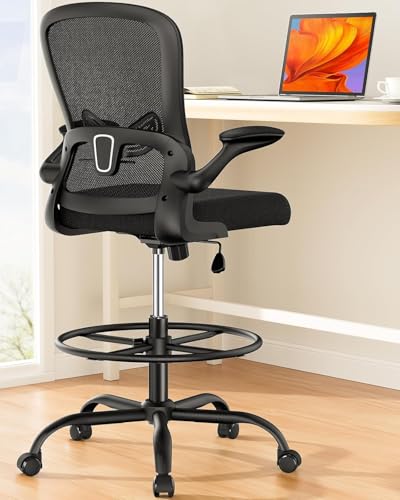
Some small-space buyers need a chair that can adapt to several work surfaces rather than fit one desk perfectly. The ErGear model is built around that flexibility. Its seat has eight inches of height adjustment, the foot ring adjusts through five inches, and the lumbar support moves through two inches. A 17-degree mesh backrest adds another layer of movement, so the chair can be configured for a drafting surface, standing desk, or bar-height work area.
The 19.7-inch foot ring is a notable detail for people who dislike dangling feet on tall chairs. Flip-up padded arms help the chair slide beneath a desk when a room needs to change from work mode to living space. The listing also specifies a 33 percent thicker seat than the brand’s earlier design, a Class 4 gas lift tested to endure 120,000 lift cycles, and support for up to 300 pounds. Those claims describe the product’s stated construction, while the extra-large base means buyers should still measure the available rolling area.
Pros
- Eight-inch seat-height adjustment suits several elevated work surfaces.
- Five-inch adjustable foot ring offers useful leg positioning.
- Two-inch lumbar adjustment supports a more individualized setup.
- Flip-up padded arms make storage under a desk easier.
- Breathable mesh back and thicker seat target longer work sessions.
Cons
- The extra-large base may feel oversized in a very narrow workstation.
- The listed 300-pound capacity is lower than some alternatives here.
Choose the ErGear when adjustment range is more important than the smallest possible footprint. It is particularly useful in a room with one high desk and one counter-height surface, or for users who regularly change between sitting and standing work. A compact armless chair will occupy less visual and physical space, but it will not offer the same level of foot-ring, lumbar, and seat-height tuning.
To buy the ErGear Drafting Chair, click here.
4. Simple Deluxe Armless Drafting Chair: Best Compact Footprint

The Simple Deluxe model takes a different route from the tall mesh chairs. Its armless profile measures 24.21 by 16.33 inches, according to the listing, so it is easier to slide alongside a bed, vanity, studio table, or compact desk. That narrow front-to-back dimension is the headline feature for small rooms. A chair can have an impressive cushion and still become a nuisance if its arms catch on the desk every time it moves, and this design avoids that particular shuffle.
The chair has a low curved back, a 2.5-inch high-density foam seat, PU leather upholstery, a footrest ring, and a 17.3 to 21.3-inch seat-height range. It is better suited to standard tables, lower drafting surfaces, studio work, or counter-adjacent tasks than to very tall standing desks. The wipe-clean upholstery may be useful around art materials, cosmetics, or workshop dust, while the listed 350-pound capacity gives the compact frame a broad stated load rating.
Pros
- Armless 24.21 by 16.33-inch profile suits tight rooms.
- PU leather surface is easy to wipe clean.
- 17.3 to 21.3-inch seat range fits many standard-height work surfaces.
- Built-in foot ring supports the feet during seated work.
- Listed 350-pound capacity and five casters provide useful everyday mobility.
Cons
- The low back provides less upper-back support than the taller mesh chairs.
- Its seat-height range may be too low for a high drafting table or standing desk.
This is the chair to choose when floor space is the main constraint and the work surface is not exceptionally tall. Picture a student using a small table beside a bookcase, or an artist shifting between a compact studio table and a vanity. The armless shape is genuinely convenient in those situations. Buyers who need pronounced lumbar adjustment or a high seat should look toward the Primy, ErGear, or KWKSV instead.
To buy the Simple Deluxe Armless Drafting Chair, click here.
5. DUMOS Armless Drafting Chair: Best Armless Value

The DUMOS shares the practical shape many compact workspaces need: no arms, a curved back, five casters, and a height range of 17.3 to 21.3 inches. It is a straightforward rolling chair for a small study corner where the seat must move out of the way quickly. The armless design lets a user turn, reach for supplies, or slide the chair under a table without negotiating around fixed arm supports.
Its cushioned seat uses PU leather and high-density sponge, while the heavy-duty metal base has a listed 350-pound capacity. Those details make it more substantial than a bare stool, yet the design remains visually simple. The curved back is intended to support a natural seated posture, but there is no listed adjustable lumbar mechanism. That distinction matters for someone who spends eight hours at a desk. For shorter drawing sessions, homework, makeup work, or a multipurpose home office, its uncomplicated layout may be exactly the appeal.
Pros
- Armless format preserves clearance around compact desks.
- 17.3 to 21.3-inch height range suits many standard tables.
- PU leather and high-density sponge provide a cushioned seat surface.
- Listed 350-pound capacity adds flexibility for different users.
- Five silent nylon casters support 360-degree movement.
Cons
- There is no listed adjustable lumbar support.
- The seat-height range is limited for tall drafting stations.
The DUMOS makes sense for a buyer who wants a compact rolling seat with a backrest and does not need arm support. It is a natural match for a bedroom desk, small studio, or table that sits close to a wall. Someone choosing between it and the similar Simple Deluxe chair should focus on the workspace first, then upholstery preference and the precise clearance available around the desk.
To buy the DUMOS Armless Drafting Chair, click here.
6. KWKSV Drafting Chair: Best for Elevated Workstations

The KWKSV is aimed at buyers who need substantial seating support at a tall desk. Its listing specifies a 19.69-inch-wide seat with a 5.12-inch-thick contoured cushion, an adjustable foot ring, flip-up armrests, and a breathable mesh back. That broad, heavily padded seat may be appealing during long drawing sessions, especially for users who find narrow stools uncomfortable. In a compact room, the flip-up arms provide a useful way to reduce the chair’s parked height and clearance needs.
The standout specification is the listed 500-pound capacity. It does not automatically prove that the chair will feel right for every user, but it gives this model a distinct position among the roundup options. The chair is presented for standing desks, elevated workstations, drawing, and creative work, so its height-adjustable design is more suitable for raised surfaces than the compact armless chairs with 17.3 to 21.3-inch ranges. The thicker cushion may feel generous, although it also contributes to a more substantial visual footprint.
Pros
- Listed 500-pound capacity distinguishes it from the other selected chairs.
- 19.69-inch-wide seat gives users more sitting room.
- 5.12-inch contoured cushion targets extended desk sessions.
- Adjustable foot ring supports the legs at elevated heights.
- Flip-up arms and breathable mesh back suit compact creative work areas.
Cons
- The broad, thickly cushioned design may occupy more space than an armless stool.
- The listing does not provide a precise seat-height range in the supplied specifications.
Select the KWKSV when your workstation is high and seat comfort or stated capacity carries more weight than having the slimmest silhouette. It fits a home drafting station where the chair remains in use for hours, while someone working at a low table may find the tall-chair design unnecessary. Measure the underside of the desk and the turning area around it before ordering, especially in a narrow room.
To buy the KWKSV Drafting Chair, click here.
7. Misolant Drafting Chair: Best Armless Tall Chair

The Misolant takes the tall-chair format and removes the arms, creating a cleaner profile for a compact counter-height desk or drafting station. Its listed overall height is 35 to 43.4 inches, with a cushion height of 23.5 to 31.9 inches. Those figures point toward elevated work surfaces rather than a conventional office desk. The chair also has a 16.5-inch-wide cushion and 16.3-inch front-to-back cushion measurement, dimensions that may work well where a broad office chair would crowd nearby furniture.
A wrap-around curved back and square padded seat give it a more enclosed shape than the low-back armless options. Faux leather upholstery adds a smooth surface that can be wiped down, while the listed installation time is about 25 minutes. The product description references BIFMA and SGS credentials, but buyers should still match the seat height to their specific desk rather than relying on the overall chair height. Without armrests, the Misolant is easier to slide beneath a surface, although users who like padded elbow support will miss that feature.
Pros
- Armless design preserves clearance around compact elevated desks.
- 23.5 to 31.9-inch listed cushion height suits tall work surfaces.
- Wrap-around back offers more coverage than a low-back stool.
- Square padded cushion provides a defined sitting surface.
- Faux leather upholstery gives the chair a wipe-clean finish.
Cons
- The tall cushion range may be unsuitable for ordinary desks.
- There is no listed adjustable lumbar mechanism or foot-ring specification.
The Misolant is a focused choice for a narrow standing-desk corner, lab-style counter, or high studio table. Its armless shape is easier to store than an armchair, and the tall cushion range gives it more reach than the compact stools above. Skip it for a standard-height drafting table unless the measurements line up carefully, since a tall chair can leave the elbows and work surface at an uncomfortable relationship.
To buy the Misolant Drafting Chair, click here.
8. FREEKYROCK Drafting Chair: Best Footrest Range
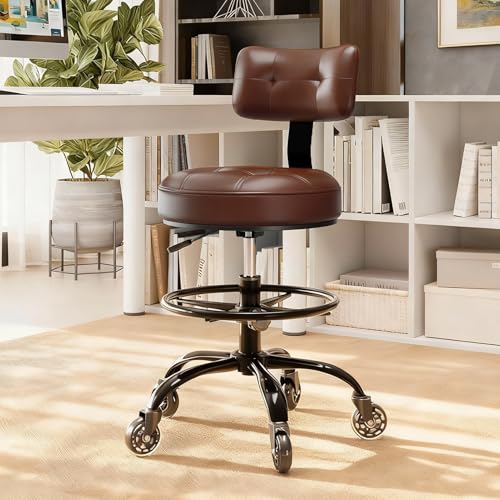
The FREEKYROCK chair is aimed at users who want a tall rolling seat that can cross between office, studio, salon, kitchen, and workshop duties. Its seat height adjusts from 24.01 to 31.89 inches, while the footrest adjusts from 9.45 to 16.93 inches. That unusually broad footrest range is the central reason to choose it. On a high workstation, the foot ring can help prevent the dangling-leg feeling that makes a tall stool feel precarious or tiring.
The design includes a contoured metal-frame backrest, a 3.15-inch high-density foam cushion, waterproof PU leather, silent silicone wheels, and a wide non-slip base. The listing gives a 330-pound capacity and describes BIFMA and SGS-certified gas-lift components. The chair has no armrests, which helps it move through tight spaces and beneath counters, but users who lean on arm supports during detailed drafting may prefer the Primy or ErGear. Its brown finish also gives it a less conventional office appearance, which may suit a multipurpose room.
Pros
- Seat height adjusts from 24.01 to 31.89 inches.
- Footrest adjusts from 9.45 to 16.93 inches for flexible leg support.
- Waterproof PU leather is easy to wipe clean.
- 3.15-inch foam cushion and contoured back target longer seated periods.
- Silent silicone wheels are intended for smooth movement across floors.
Cons
- The chair has no armrests for elbow support during detailed work.
- Its multipurpose stool styling may feel less traditional in a drafting office.
This model fits a compact workstation that doubles as a counter, craft area, or service station. The adjustable footrest is particularly useful for users who change desk heights or want a more precise leg position. Buyers seeking a conventional ergonomic office-chair shape should look elsewhere, while those who prize movement, wipe-clean upholstery, and broad footrest adjustment get a distinctive combination here.
To buy the FREEKYROCK Drafting Chair, click here.
9. Brick Attic Drafting Chair: Best Flexible Backrest

The Brick Attic is a rolling PU leather stool with a backrest that can be removed as needed. That feature gives a small workspace two seating modes: a supported chair for desk work and a more open stool for tasks that require frequent movement. Its overall height adjusts from 33.86 to 41.75 inches, and the foot ring moves through 7.87 inches. Those measurements make it a reasonable match for counter-height surfaces, studios, salons, and elevated home workstations.
The listing specifies a 15.8-inch cushion, a 23.6-inch five-star caster base, a 300-pound capacity, and high-density memory foam. The broad base is described as helping reduce tipping, although its 23.6-inch span deserves a place on the floor plan before purchase. PU leather is easy to clean around art supplies or workshop materials. The detachable backrest is the standout convenience, but buyers who need a full ergonomic back with adjustable lumbar support will find the Primy or ErGear more configurable.
Pros
- Detachable backrest allows chair or stool-style use.
- 7.87-inch adjustable foot ring range supports varied leg positions.
- 33.86 to 41.75-inch overall height suits elevated work surfaces.
- High-density memory foam and PU leather provide a cushioned, wipe-clean seat.
- 23.6-inch five-star caster base and listed 300-pound capacity support mobile use.
Cons
- The broad 23.6-inch base may take more floor space than the armless seat suggests.
- The backrest does not offer the listed lumbar adjustments found on the top ergonomic picks.
Choose the Brick Attic if flexibility matters more than a traditional office-chair silhouette. It is useful in a studio where the user alternates between drafting, reaching for tools, and moving around a counter. The detachable back makes it more adaptable than a fixed-back stool, while the Primy remains the better fit for long desk sessions that demand adjustable lumbar support and flip-up arms.
To buy the Brick Attic Drafting Chair, click here.
Buying Guide: How to Choose a Drafting Chair for a Small Space
A drafting chair should be measured against the workstation, the user, and the room at the same time. A chair that fits beneath a desk may still be too low for the drawing surface, while a tall chair that reaches the desk may have a base too wide for the available floor. Start with the dimensions that affect daily movement, then look at comfort features.
Match the Seat Height to the Desk
Measure from the floor to the underside and top of the work surface. Then compare that figure with the chair’s seat-height range, not the overall chair height. The seat needs to place the user’s elbows near the working surface without forcing the shoulders upward. The Misolant, FREEKYROCK, and Brick Attic are aimed at taller workstations, while the Simple Deluxe and DUMOS ranges are closer to standard table height.
A foot ring becomes more useful as the seat rises. Without one, the feet may hang or search for a nearby support, which is distracting during careful line work. Adjustable rings, such as those on the Primy, ErGear, KWKSV, FREEKYROCK, and Brick Attic, make it easier to position the legs after the seat is set.
Measure the Base and the Tuck-Away Space
Small-space shopping is often defeated by the base rather than the seat. Five-star drafting-chair bases need room for their casters to roll and turn. Measure the clear floor area under the desk, then add room for the chair to pull out and for the user’s knees to move. A chair that technically fits under a desk may still be frustrating if the casters strike a wall or cabinet.
Armless chairs usually provide the easiest clearance. The Simple Deluxe lists a 24.21 by 16.33-inch profile, and the DUMOS uses a similar armless concept. Chairs with flip-up arms, including the Primy, SONGMICS, ErGear, and KWKSV, give more upper-body support while allowing the arms to move out of the way when the chair is stored.
Decide Whether You Need Armrests
Armrests can relieve the shoulders during computer work or detailed drafting, but they add width and can interfere with a narrow desktop. Flip-up arms provide a useful compromise. They support the elbows during work and then lift when the chair needs to slide beneath the surface.
Armless models work well for users who frequently turn, reach, or move between tools. They also suit desks with a narrow apron or limited leg opening. The trade-off is simple: you gain clearance and movement but give up a place to rest the arms.
Compare Back Support Carefully
A curved backrest is different from adjustable lumbar support. The Primy offers adjustable lumbar support, and the SONGMICS and ErGear listings also specify lumbar adjustment. Those models are better suited to buyers who want to change the lower-back position rather than accept one fixed curve.
Low-back and armless chairs can still work well for shorter sessions, especially in a compact room. The Simple Deluxe and DUMOS offer curved back support, while the Misolant has a wrap-around back. Buyers who routinely spend several hours drafting should give adjustable support more weight than upholstery style.
Choose Upholstery for the Room
Mesh backs allow more airflow, which can feel useful in a warm bedroom or studio. The Primy, SONGMICS, ErGear, and KWKSV use breathable mesh back designs. PU leather wipes clean quickly and can be a practical choice around graphite, ink, paint, cosmetics, or workshop materials. The Simple Deluxe, DUMOS, Misolant, FREEKYROCK, and Brick Attic use leather or faux-leather-style surfaces according to their listings.
Fabric can feel softer, while PU leather is easier to clean. Neither material guarantees long-term comfort by itself. Cushion thickness, seat shape, height, and the relationship between the chair and desk usually matter more during a full work session.
Think About Mobility and Floor Protection
Casters make it easier to move between a desk and nearby supplies, but smooth rolling is useful only when the base can turn without bumping furniture. Check whether the chair will sit on hardwood, vinyl, tile, or carpet. The supplied listings describe nylon or silicone caster options, but they do not establish that every wheel will behave identically on every floor.
A chair that rolls too easily may drift while someone is drawing. A chair that barely moves becomes annoying in a shared workspace. The best fit depends on how often the user changes position and how much open floor remains around the desk.
Check the Listed Capacity and Seat Width
Weight capacity is one useful screening specification, but it should be read alongside seat width and base design. The KWKSV lists a 500-pound capacity, while the Simple Deluxe and DUMOS list 350 pounds. A wider seat may feel more comfortable for some users, while a narrow seat may preserve precious room in a compact office.
Do not choose from capacity alone. Confirm that the seat height, cushion dimensions, foot ring, and desk clearance suit the actual user. A strong capacity rating cannot correct a chair that places the elbows too high or leaves the feet unsupported.
Best Drafting Chairs for Small Spaces FAQ
What makes a drafting chair suitable for a small space?
A compact drafting chair usually has an armless or flip-up-arm design, a base that can roll beneath the work surface, and a seat height that matches the desk without requiring a separate footrest. The Simple Deluxe and DUMOS prioritize armless clearance, while the Primy and SONGMICS use folding arms for a balance between support and storage.
Are drafting chairs taller than regular office chairs?
Many are. Drafting chairs are made for raised tables, standing desks, counters, and drafting surfaces, so their seat ranges can sit considerably higher than a standard office chair. Check the seat height rather than the overall chair height, then compare it with the top of the desk and the position of your elbows.
Do I need a foot ring on a drafting chair?
A foot ring is helpful when the seat is high enough that the feet cannot rest comfortably on the floor. It gives the legs a stable resting place and may make elevated seating feel more natural. An adjustable ring is especially useful when the chair serves more than one desk or user.
Are armless drafting chairs better for small rooms?
Armless chairs generally provide more clearance and slide beneath a desk more easily. They are useful in bedrooms, apartments, and narrow studio corners. The trade-off is reduced elbow support, so users who work for long periods at a computer or drafting surface may prefer flip-up arms.
How much floor space does a drafting chair need?
Measure the base, then leave additional room for rolling out, turning, and pulling the chair toward the desk. The listed footprint of a seat does not always describe the full caster spread. A wide base can improve the chair’s stance while taking more room, so measure the floor area before ordering.
Which is better for long drafting sessions, mesh or PU leather?
Mesh can provide more airflow, especially through the back, while PU leather is easier to wipe clean. Long-session comfort also depends on lumbar adjustment, cushion shape, seat height, and foot support. Primy, SONGMICS, ErGear, and KWKSV emphasize mesh backs, while several armless models use PU leather upholstery.
Can a drafting chair work with a standing desk?
Yes, provided the chair reaches the desk comfortably and has a foot ring or another suitable foot support. The ErGear, SONGMICS, KWKSV, Primy, FREEKYROCK, and Brick Attic listings specifically describe compatibility with elevated desks or workstations. Measure the standing desk’s height range before choosing.
Should I choose a chair with a five-star base or a smaller stool base?
A five-star base with casters usually offers rolling mobility and a familiar office-chair layout, while a smaller stool-style design can preserve more room. A five-star base may also require more turning clearance. Pick the format that matches how often you move, how much floor space remains, and whether back or arm support is a priority.
Final Verdict
The Primy Drafting Chair is the strongest overall fit among these nine options for a small workspace that still needs genuine ergonomic adjustability. Its curved mesh back, adjustable lumbar support, foot ring, cushioned seat, rolling base, and flip-up armrests cover the main demands of elevated desk work without committing the room to a fixed executive chair. The SONGMICS is the more value-focused alternative, with a useful height range, folding arms, lumbar adjustment, and a listed 330-pound capacity.
For the tightest floor plan, the Simple Deluxe Armless Drafting Chair is easier to position, while the DUMOS offers a similar armless approach with a listed 350-pound capacity. The KWKSV deserves attention from buyers who want a wider, heavily cushioned seat and a listed 500-pound capacity. Before ordering, measure the desk height, underside clearance, caster spread, and storage path. The best drafting chair for a small space is the one that lets your elbows, feet, knees, and chair base fit the workstation without a daily wrestling match.
