A clean sheet of graph paper can turn a loose idea into a measured plan, but the wrong format can make drafting feel cramped before the first line is drawn. Buyers searching for the best graph paper for drafting usually need more room than a standard notebook page, a grid that stays visible without overpowering pencil marks, and paper sturdy enough for repeated erasing, notes, and technical sketches.
The products below differ in ways that matter at a drafting desk. Sheet size affects whether a floor plan or mechanical sketch has breathing room, while paper weight influences how pens, markers, and erasers behave. Perforation, backing-board stiffness, double-sided printing, border lines, and grid style also shape the everyday experience. A student may favor an affordable 8.5 x 11 pad, while an architect, engineer, or artist may prefer a large 22 x 17 surface. Our top overall pick is the GeekNavy quadrille pad because its 11 x 17 landscape format, non-photo blue grid, border, and firm backing create a particularly useful balance for clean drafting work.
For a fast comparison, the table below highlights the size, grid style, paper details, and strongest use for each selected pad.
Best Graph Paper for Drafting Comparison Table
| Product | Best For | Size | Grid and Paper |
|---|---|---|---|
| GeekNavy Quadrille Graph Paper | Best overall drafting balance | 11 x 17 inches | 0.25-inch non-photo blue grid, 75 gsm paper |
| Vishoitty Large Graph Paper Pad | Best value for general drafting | 11 x 17 inches | 4 squares per inch, double-sided printing |
| Large Engineering Graph Paper, 22 x 17 | Best for expansive layouts | 22 x 17 inches | 4 squares per inch, 100 gsm paper |
| GeekNavy Isometric Graph Paper | Best for 3D and isometric sketches | 11 x 17 inches | 0.25-inch isometric non-photo blue grid |
| 2 Pack Graph Paper Pad | Best for students and compact desks | 8.5 x 11 inches | 4 squares per inch, 70 gsm paper |
| Engineering Graph Paper Pads | Best 11 x 17 refill-style pad | 11 x 17 inches | 4 squares per inch, 100 gsm paper |
| 2 Pack Graph Paper Pad | Best for high-volume 11 x 17 work | 11 x 17 inches | 4 squares per inch, double-sided printing |
| Extra Large Engineering Graph Paper | Best for heavy large-format projects | 22 x 17 inches | 4 squares per inch, 100 gsm, single-sided |
| Mr. Pen Graph Paper Pad | Best simple budget pad | 17 x 11 inches | 4 squares per inch, double-sided use |
The detailed reviews below show where each pad fits, where it falls short, and which drafting habits it supports best.
1. GeekNavy 11 x 17 Quadrille Graph Paper Best Overall

For a drafting sheet to feel useful, it needs enough room for the drawing and enough visual restraint for the drawing to remain the star. This GeekNavy pad brings those qualities together in an 11 x 17 landscape format with a 0.25-inch quadrille grid, a border, and a high-brightness white surface. The listed non-photo blue grid is especially relevant for people who scan or reproduce drawings, since the grid is intended to disappear in many low-density black-and-white scans.
The paper is listed at 75 gsm and comes with a 50-point chipboard backing. That combination gives buyers a practical middle ground. It is lighter than the 100 gsm large engineering pads, yet the backing offers support for quick markups away from a full drafting table. A student sketching a site plan at a kitchen table or a contractor organizing measurements on a job visit may appreciate the landscape canvas and clean border, while someone needing thick marker work may prefer a heavier sheet.
Pros
- 11 x 17 landscape format gives drafting layouts useful horizontal space.
- 0.25-inch quadrille grid supports measured sketches and technical diagrams.
- Non-photo blue grid may reproduce more cleanly in suitable black-and-white scans.
- Border outline helps frame drawings and keep notes organized.
- 50-point chipboard backing provides a firm writing surface.
Cons
- 75 gsm paper is lighter than the 100 gsm sheets in several large engineering pads.
- The quadrille grid is less suitable than isometric paper for three-dimensional cube or perspective studies.
This pad suits drafters who want an organized 11 x 17 sheet without a visually heavy grid. Its border and non-photo blue treatment give it a more presentation-minded feel than a plain classroom graph pad. Buyers who routinely use broad markers or need the largest possible planning surface may prefer a heavier 22 x 17 option, but for pencil, pen, and structured technical sketching, this is the strongest all-around fit in the group.
To buy this product, click here.
2. Large Graph Paper Pad 11 x 17 Grid Paper Best Value

The Vishoitty pad is aimed at buyers who want a generous drafting surface without stepping up to an oversized 22 x 17 desk pad. Its 11 x 17 pages use blue lines arranged at four squares per inch, a familiar format for geometry, technical drawing, blueprint planning, and scaled sketches. The listing describes the lines as balanced in darkness, which may help keep measurements visible while allowing pencil marks and written labels to stand apart.
Each pad contains 30 sheets, printed on both sides, with micro-perforations for removal. That double-sided format can stretch a small supply across rough layouts, calculations, and practice sketches. The thick backboard is another practical touch for a student carrying a pad between classes or a drafter making notes away from a desk. The product information describes the paper as heavy and suitable for pen and pencil, although buyers who use wet markers should still match their tools to the actual sheet response.
Pros
- 11 x 17 size offers more room than standard letter-format graph paper.
- Four-square-per-inch blue grid works for technical drawing and scaled planning.
- Pages are printed on both sides for more usable drawing area.
- Micro-perforations support cleaner sheet removal.
- Sturdy backing helps with writing away from a desk.
Cons
- The 30-sheet count is smaller than the 50-sheet large-format pads.
- The listing does not identify the paper weight as precisely as some competing products.
This is a sensible pick for students, hobbyists, and home drafters who want an 11 x 17 canvas for a modest supply cost. It has the familiar feel of general-purpose quadrille paper rather than a specialized presentation sheet, which makes it flexible for rough plans and coursework. A buyer creating a large number of final drawings may prefer a 50-sheet pad, but someone who values double-sided use and easy portability gets a lot of practical range here.
To buy this product, click here.
3. Large Engineering Graph Paper, 22 x 17 Best for Expansive Layouts

Some drafting concepts simply need elbow room. This 22 x 17 engineering pad is built around a large desk-pad format, giving floor-plan ideas, engineering diagrams, and multi-part sketches more space than an 11 x 17 sheet. Its 4 x 4 blue quad rule keeps the familiar quarter-inch planning rhythm, while the listed 100 gsm acid-free paper is positioned for use with pencils, pens, and markers.
The pad contains 50 sheets, or 100 usable sides according to the product title, and includes perforations for removal. A 1,200 gsm backer is listed to protect the desktop and support writing, while triangle-bound corners are intended to help protect the pad. Picture a large drawing spread across a studio desk, with room at the edge for dimensions and notes. That is where this format earns its keep, although it demands more storage and a workspace that can accommodate the full sheet.
Pros
- 22 x 17 format provides substantial room for large drafting layouts.
- 100 gsm paper is specified for use with pencils, pens, and markers.
- 50-sheet pad supports repeated project work.
- Perforated sheets can be removed for filing or presentation.
- Heavy 1,200 gsm backer offers strong desk support.
Cons
- The 22 x 17 footprint requires a larger desk and more storage space.
- Its large size is less convenient for carrying between classes or job sites.
Choose this pad when drawing area matters more than portability. It fits architects, engineers, and students working on broad layouts where shrinking the sketch to an 11 x 17 sheet would force cramped labels or broken-up views. Compact-room buyers and commuters may find it cumbersome, but for a fixed drafting station, the generous canvas is the main attraction.
To buy this product, click here.
4. GeekNavy 11 x 17 Isometric Graph Paper Best for 3D Sketching

Regular square grids are excellent for plans, charts, and straight-on diagrams, but they are awkward for quick three-dimensional studies. This GeekNavy pad uses a 0.25-inch isometric blue dot grid on an 11 x 17 landscape sheet, giving the lines a directional structure that supports boxes, piping layouts, product concepts, and other 3D-looking forms. It also includes an engineering header, which can help keep project names, dates, or drawing references together.
The listing specifies 75 gsm high-brightness paper and a 50-point chipboard backing. That setup makes the pad suitable for classroom exercises, contractor sketches, and early concept work where a firm surface and visible geometry matter. The non-photo blue grid is intended to fade from many low-density black-and-white scans. A person drawing a quick equipment layout can move from a blank page to a readable 3D study quickly, though this is a specialized sheet rather than the most versatile everyday quadrille pad.
Pros
- Isometric grid supports three-dimensional sketches and spatial planning.
- 11 x 17 landscape format leaves room for larger concept drawings.
- Non-photo blue treatment may simplify suitable black-and-white scanning.
- Engineering header supports organized project documentation.
- 50-point chipboard backing gives the sheet a firm base.
Cons
- Isometric paper is less suitable for ordinary square-grid calculations and floor plans.
- 75 gsm paper is lighter than the 100 gsm engineering pads.
This is the specialist pick for buyers who regularly sketch objects, structures, or layouts in three dimensions. It can save time during the rough-idea stage because the isometric guides establish consistent angles without requiring a ruler for every construction line. Buyers seeking one pad for algebra, standard plans, and general notes should choose quadrille paper instead, but 3D-focused drafters will find this format far more natural.
To buy this product, click here.
5. 2 Pack Graph Paper Pad 8.5 x 11 Best for Students and Compact Desks

Large drafting paper is useful until it takes over a dorm desk, backpack, or crowded worktable. This two-pack uses a familiar 8.5 x 11 format, making it easier to store beside textbooks, slide into a folder, or carry to class. The 4 x 4 blue grid is aimed at technical drawing, geometry, engineering notes, and general drafting exercises, while the 70 gsm paper is listed for use on both sides.
Each pad contains 30 sheets, with perforations along the top for removal and a cardboard backing for support. That arrangement suits a student switching between calculations and sketches during a long study session. The smaller page can feel refreshingly manageable for detail work, but it leaves less space for broad plans and may require several connected sheets for a larger drawing. Buyers who draft mostly at home may prefer 11 x 17 paper, while mobile users gain a lot from the compact footprint.
Pros
- Standard 8.5 x 11 size fits common folders and compact desks.
- Two pads provide a practical supply for coursework and practice drawings.
- 4 x 4 blue grid supports technical and mathematical drafting.
- Perforations allow clean sheet removal.
- Cardboard backing supports writing without a full desk surface.
Cons
- The smaller page offers less room for large plans and multi-view layouts.
- 70 gsm paper is lighter than the 100 gsm options in this roundup.
Pick this set for portability, organization, and everyday schoolwork. A student can keep one pad in a backpack and another at home, while a hobbyist can use the compact sheets for measured furniture ideas or practice lettering. It is a poor fit for a single-sheet architectural presentation, but its manageable size makes it one of the easiest options to live with in a tight workspace.
To buy this product, click here.
6. Engineering Graph Paper Pads, 11 x 17 Best Refill-Style Option

This 11 x 17 engineering pad keeps the format straightforward: a blue four-square-per-inch grid, white 100 gsm paper, and a landscape-friendly sheet size for drafting and blueprint drawing. Its listing describes the pages as refill grid paper, which makes the product appealing to buyers who regularly remove finished sheets and keep a working pad nearby for the next drawing.
The product includes 25 sheets, or 50 pages in the listing, with double-sided grid printing, perforations, and a 1,200 gsm backer. That mix gives it a more substantial paper specification than many basic classroom pads. Imagine a drafter keeping a stack of completed diagrams in a project folder while using the firm-backed pad for the next rough layout. The smaller sheet count may matter for frequent users, but the 100 gsm paper and large format make it a useful middle option.
Pros
- 11 x 17 size provides a broad drafting area without the footprint of 22 x 17 paper.
- 100 gsm paper is specified for pencils, pens, and markers.
- Double-sided blue grid increases usable drawing area.
- Perforations support clean removal and filing.
- Heavy backer provides support during portable use.
Cons
- 25-sheet count is lower than the 50-sheet pads in this roundup.
- The product offers a conventional quadrille grid rather than a specialized isometric layout.
This pad fits buyers who want a sturdy 11 x 17 work surface for regular drafting but do not need a massive stack of pages. It is especially practical for blueprint studies, engineering exercises, and rough plans that will be removed from the pad after completion. A high-volume studio may go through it quickly, while an occasional drafter may appreciate the heavier paper and manageable supply.
To buy this product, click here.
7. 2 Pack Graph Paper Pad 11 x 17 Best for High-Volume Use
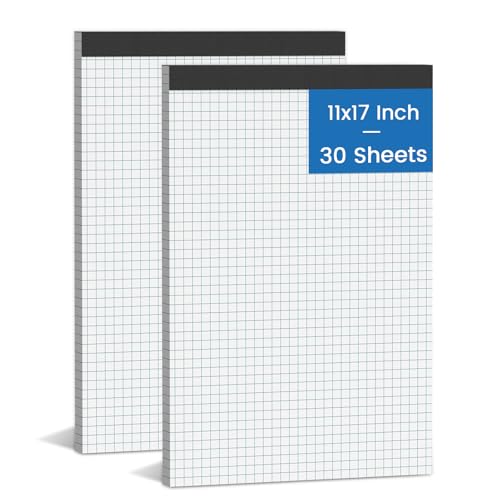
Two 11 x 17 pads make sense for a busy student, shared studio, or household where graph paper disappears in a hurry. This product uses a four-square-per-inch blue grid on white 70 gsm paper, with 30 sheets per pad according to the listing. The pages are printed on both sides, so rough sketches, calculations, and planning notes can use the reverse side rather than consuming a fresh sheet every time.
Perforations at the top are intended to make removal quick and clean, while the thicker cardboard backing supports handwriting on the go. The 11 x 17 size is large enough for many drafting exercises and small enough to carry more easily than 22 x 17 paper. Its 70 gsm construction is lighter than the engineering-grade 100 gsm choices, so buyers working heavily with markers or repeated erasing may prefer a heavier sheet.
Pros
- Two pads provide a useful supply for repeated drafting work.
- 11 x 17 pages balance drawing space with easier storage.
- Four-square-per-inch blue grid suits technical drawings and planning.
- Double-sided printing allows both sides of each sheet to be used.
- Perforated pages and cardboard backing support portable use.
Cons
- 70 gsm paper is lighter than the 100 gsm engineering alternatives.
- The listing information presents the package count somewhat inconsistently, so buyers should check the current package details before ordering.
This two-pack is a practical choice for people who value quantity and familiar sizing over premium paper weight. One pad can stay at a drafting desk while the other travels to class, a meeting, or a second workspace. Buyers producing polished marker drawings should look toward a heavier listed stock, but for pencil-led drafting and everyday diagrams, the extra pad is the key advantage.
To buy this product, click here.
8. Large Engineering Graph Paper 22 x 17 Best for Heavy Large-Format Projects

This extra-large pad is aimed at drafters who want a wide planning surface and do most of their work flat on a desk. Its 22 x 17 pages use a 4 x 4 blue grid, with 100 gsm paper and 50 sheets listed in the product details. That generous format leaves room for a primary drawing, dimensions, callouts, and revision notes without forcing everything into a tight cluster.
The pages are single-sided, which can be a drawback for people who routinely use the reverse side, but it can also make finished sheets easier to organize when every drawing has a clean face. Perforations support removal, and the hardboard backing helps when writing without a separate drawing board. The listing specifically recommends laying the large pad flat or hanging it when not in use, a useful reminder that this format needs a storage plan.
Pros
- 22 x 17 pages provide ample room for complex layouts and annotations.
- 100 gsm paper is suited to pencil, pen, and marker work according to the listing.
- 50-sheet pad supports a sustained project workflow.
- Hardboard backing provides a stable writing base.
- Perforations make completed sheets easier to remove.
Cons
- Single-sided printing provides less usable surface per sheet than double-sided pads.
- The large, heavy format is awkward for small desks and frequent travel.
Choose this product for fixed workstations, large diagrams, and projects where a clean, spacious face matters more than compact storage. It is particularly suitable for someone who wants to pin or file finished sheets without writing on the reverse side. A student moving between rooms may find an 11 x 17 pad easier, but large-format planners get the extra breathing room they are seeking here.
To buy this product, click here.
9. Mr. Pen Graph Paper Pad, 17 x 11 Best Simple Budget Pad

Sometimes a drafter needs a familiar pad without extra features, unusual grid treatments, or an oversized paper stack. The Mr. Pen pad offers 17 x 11-inch quadrille paper with four squares per inch, a format suitable for notes, technical drawings, and engineering sketches. Its dimensions provide more horizontal room than letter paper while remaining easier to store than the 22 x 17 pads.
The listing describes thick paper intended to resist bleed-through and allow use on both sides. A sturdy cardboard back supports writing, and top perforations are included for clean tearing. With 22 sheets, it is a smaller supply than the 30- and 50-sheet options above, but that can be useful for occasional drafting, a short course assignment, or a project where the pad will be used up quickly rather than stored for months.
Pros
- 17 x 11 format offers useful drafting space in a manageable package.
- 4 x 4 quadrille grid works for technical and engineering drawings.
- Paper is listed for double-sided use.
- Sturdy cardboard backing supports writing away from a desk.
- Top perforations allow clean sheet removal.
Cons
- 22-sheet count is smaller than most other pads in this roundup.
- The product provides fewer specialized features than the non-photo blue and isometric options.
This pad is best for buyers who want a straightforward drafting surface at a modest scale. It can handle classroom diagrams, measured sketches, and everyday notes without asking for much storage space. People creating large architectural layouts or scanning drawings for reproduction may prefer the larger or non-photo blue pads, but casual drafters and students will appreciate its uncomplicated format.
To buy this product, click here.
How to Choose Graph Paper for Drafting
Graph paper looks simple on a shelf, yet small specification differences can change how smoothly a drafting session goes. A 22 x 17 pad may feel luxurious for a floor plan and ridiculous on a narrow dorm desk, while an 8.5 x 11 sheet may fit perfectly in a folder but force a large design into several sections. Start with the way the paper will be used, then compare the details that affect control, storage, and finished presentation.
Match the Sheet Size to the Drawing
For broad layouts, 22 x 17 paper offers the most breathing room in this selection. It can hold a primary drawing alongside measurements and revision notes, but it needs a desk large enough to keep the sheet flat. The 11 x 17 pads are more adaptable for general drafting, blueprint exercises, and landscape sketches. Letter-size paper is easier to carry and store, making it a sensible choice for students or anyone working in several locations.
Choose the Correct Grid Style
A standard quadrille grid uses square cells and is the natural fit for floor plans, charts, measured diagrams, and mathematical work. The products here generally use four squares per inch, which corresponds to quarter-inch cells. Isometric paper follows angled directions and is better for 3D concepts, equipment studies, and object sketches. Buying an isometric pad for ordinary plan work can make a simple drawing feel strangely awkward, so grid style deserves attention before paper weight.
Look at Paper Weight and Tool Compatibility
The listings range from lighter 70 and 75 gsm sheets to 100 gsm engineering paper. Heavier paper may feel more substantial under an eraser and can be more appropriate for pen or marker work, but the listing alone cannot guarantee performance with every ink. Pencil-first users have more flexibility. If a project involves repeated revisions, dark pens, or broad markers, the 100 gsm options deserve a closer look.
Decide Whether Double-Sided Printing Matters
Double-sided grid printing lets a drafter use the back of a page for a second sketch, calculations, or practice lettering. That feature is valuable for students and rough-work pads. Single-sided paper can be preferable for final drawings, scanning, filing, or pinning sheets where a clean reverse side keeps the presentation tidy. Neither arrangement wins for every workflow. The important question is whether the back of the page is useful working space or part of the finished document.
Check the Backing and Perforation
A firm backboard is handy when the pad sits on a lap, a hallway counter, or a table shared with other supplies. It will not replace a rigid drawing board, but it can stop the paper from flexing during quick notes. Perforations matter when completed drawings need to leave the pad cleanly. If sheets will remain bound for reference, a glued pad with a sturdy backing may be preferable to tearing every page away.
Think About Storage Before Ordering Large Paper
Large graph paper has a habit of becoming a curling stack near the edge of a desk. The 22 x 17 options need a flat storage area, a portfolio, or a place where they can hang safely. An 11 x 17 pad is easier to slide into a drawer, folder, or shelf. For a student carrying work between home and campus, the smaller format may save more frustration than its reduced drawing area creates.
Best Graph Paper for Drafting FAQ
What Size Graph Paper Is Best for Drafting?
For general drafting, 11 x 17 is a versatile middle ground because it provides more room than letter paper without the storage demands of 22 x 17. Choose 22 x 17 for broad plans and multi-view layouts. Use 8.5 x 11 when portability, folders, and compact desks matter most.
Is Four Squares per Inch Suitable for Technical Drawing?
Yes. A four-square-per-inch grid creates quarter-inch cells that are useful for measured sketches, diagrams, charts, and many classroom drafting exercises. The appropriate scale still depends on the drawing and the level of detail, so the grid should support the plan rather than replace a formal scale system.
Should Drafting Graph Paper Be Single-Sided or Double-Sided?
Double-sided paper gives more usable workspace for rough sketches and notes. Single-sided paper may be better for final drawings, scanning, filing, or presentation because the reverse side remains clean. The choice depends on whether the page is a working surface or a finished document.
Is Isometric Graph Paper Good for Architectural Drafting?
Isometric paper can be useful for three-dimensional concepts, furniture studies, equipment layouts, and quick spatial sketches. Standard quadrille paper is generally more flexible for floor plans, elevations, measurements, and ordinary technical diagrams.
What Paper Weight Works Best With Drafting Pens?
The products in this roundup list paper weights from 70 to 100 gsm. Heavier 100 gsm sheets may be more suitable for buyers who use pens or markers frequently, while lighter paper can work well for pencil sketches and everyday coursework. Test the specific ink on a spare area before committing to a finished drawing.
Does Non-Photo Blue Graph Paper Scan Better?
Non-photo blue grids are intended to become less visible in many black-and-white scanning or reproduction workflows. Results depend on the scanner, settings, and drawing medium, so this feature is helpful rather than a guarantee. The GeekNavy quadrille and isometric pads specifically list non-photo blue treatment.
Can Graph Paper Be Used Without a Drafting Table?
Yes. Pads with sturdy cardboard backers can support quick writing and sketching on a less rigid surface. A full drafting table or drawing board remains more comfortable for long sessions, especially with large 22 x 17 paper, but a backed pad is useful for field notes, classwork, and portable planning.
Final Verdict
The GeekNavy 11 x 17 Quadrille Graph Paper is the strongest overall recommendation for drafting because it combines a useful landscape size, a quarter-inch grid, a border, non-photo blue treatment, and a firm chipboard backing. It is especially well suited to pencil and pen work, organized technical sketches, and drawings that may later be scanned. The Vishoitty 11 x 17 pad is a more straightforward value-oriented alternative with double-sided printing, while the 22 x 17 engineering pad gives large-format planners considerably more room.
Choose the GeekNavy Isometric pad if your work leans toward 3D concepts rather than ordinary plans. Students with compact desks can save space with the 8.5 x 11 two-pack, and frequent 11 x 17 users may prefer the two-pad package for a deeper supply. Before ordering, measure the place where the pad will live, check whether you need a square or isometric grid, and decide whether the reverse side should be working space or remain clean. Those small choices will shape the drafting experience long after the first sheet is pulled from the pad.
