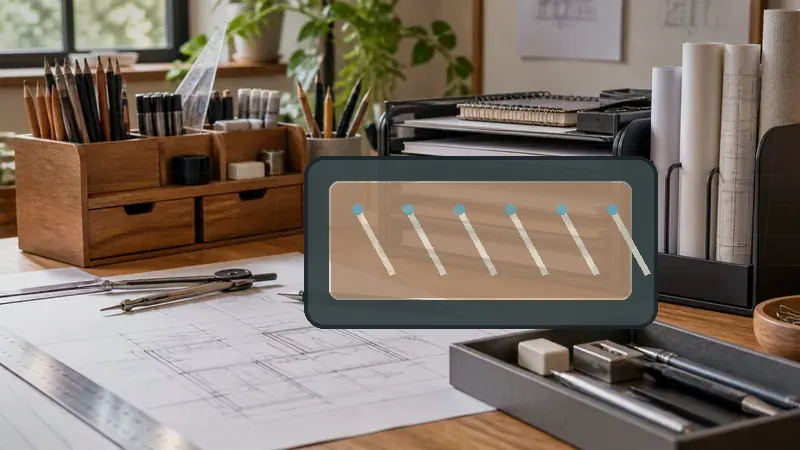
A lettering guide earns its place beside a drafting board when clean spacing matters more than freehand guesswork. A student laying out a title block, an artist labeling a presentation sheet, or a drafter adding notes to a plan may need different letter heights, line spacing, and stencil shapes. The products in this roundup range from traditional Ames guides for technical lettering to broader stencil kits for envelopes, journals, cards, and classroom projects.
The main buying trap is choosing a guide because it includes many pieces without checking whether its letter sizes suit drafting work. Clear plastic, readable openings, usable spacing, ink clearance, and the difference between alphabet stencils and guide-line templates matter far more than a large piece count. Our top overall pick, the Pacific Arc Ames Lettering Guide, offers the most drafting-focused balance of English and metric spacing, transparent construction, and multiple lettering systems, while the other options serve narrower needs.
Some buyers need precise architectural lettering, while others want a portable guide for small labels, envelope addressing, or presentation accents. The comparison below separates those priorities at a glance.
Quick Answer
Best Overall: Pacific Arc Ames Lettering Guide for drafting-focused lettering, guide lines, and mixed English and metric work.
Best for Broad Letter Heights: Staedtler Ames Lettering Guide, which covers guide and slope lines from 1/16 inch to 2 inches.
Best Compact Option: Pacific Arc Modern Bold Lettering Template Guide for smaller lettering, travel, and work across paper, vellum, fabric, canvas, wood, and mylar.
Best for Traditional Drafting Letter Sizes: Helix Standard Font Lettering Guide, with four larger standard sizes and raised features intended to help prevent ink smearing.
Best Lettering Guides for Drafting Comparison Table
| Product | Best For | Lettering Or Guide Range | Material |
|---|---|---|---|
| Pacific Arc Ames Lettering Guide | Overall drafting use | English and metric spacing, three lettering systems | Transparent plastic |
| Staedtler Ames Lettering Guide | Wide range of drafting sizes | 1/16 inch to 2 inches | Not specified in listing |
| Pacific Arc Modern Bold Lettering Template Guide | Compact bold lettering | 1/8, 3/16, and 1/4 inch | Translucent plastic |
| Pacific Arc Ames Lettering Guide 2-Pack | Shared workspaces and backups | English and metric spacing, three lettering systems | Transparent plastic |
| 5-Piece Metal Straight Line Stencil Set | Handwriting and addressing support | 0.24, 0.51, and 0.75 inch guide formats | Metal |
| Teling 5-Pack Straight Line Stencil Set | Budget line and envelope guides | Approximately 0.9 cm line spacing | Translucent plastic |
| SKATAN Lettering and Envelope Addressing Guide | Mixed lettering and stationery | 1/6, 1/4, 1/3, and 1/2 inch slots | Translucent plastic |
| Westcott Lettercraft Plastic Lettering Guide Set | Signs, reports, and classroom projects | Four listed sizes from 6 mm to 21 mm | Clear plastic |
| Helix Standard Font Lettering Guide Set | Large standard lettering | 1/4, 1/2, 3/4, and 1 1/4 inches | Not specified in listing |
The detailed reviews below explain how each guide behaves on paper, where its format fits, and which drafting tasks may call for a different design.
1. Pacific Arc Ames Lettering Guide for Lettering, Writing, Architecture, and Drawing | Best Overall

The Pacific Arc Ames Lettering Guide is the strongest match for buyers searching specifically for a drafting lettering aid. Its listing identifies English and metric line spacing, transparent plastic, and three lettering systems commonly used by draftsmen. That combination gives it a broader technical focus than a basic alphabet stencil, especially for someone moving between a class assignment, a presentation sheet, and a measured drawing.
Picture a student preparing a title block late in the evening, with a T-square nearby and a row of small notes still waiting for clean alignment. An Ames-style guide helps establish consistent lines before the letters are formed, which can make a page feel orderly without demanding flawless freehand control. The transparent body also helps the user see the underlying paper, a practical detail when positioning lettering beside construction lines or a drawing border.
Pros
- Includes English and metric spacing for varied drafting work.
- Transparent plastic allows the paper and layout to remain visible.
- Provides three lettering systems according to the listing.
- Fits architecture, engineering, drawing, and craft applications.
- Supports guide-line work as well as lettering layout.
Cons
- Its traditional drafting format may feel less useful for decorative lettering.
- The listing does not specify a full range of individual letter heights.
This guide suits students, technical drawing users, and anyone who wants one compact tool for standard lettering practice. Buyers focused on large poster letters or envelope decoration may prefer a dedicated stencil set with clearly separated alphabets. For drafting notes, title blocks, and measured presentation work, the English and metric layout gives this model the most useful balance in the group.
To buy this product, click here.
2. Staedtler Ames Lettering Guide | Best for Broad Letter Heights

The Staedtler Ames Lettering Guide stands out for the range stated in its listing. It supports guide lines and slope lines for lettering from 1/16 inch to 2 inches in height, a span that reaches from small technical notes to much larger headings. That makes it especially useful for buyers who do not want to keep switching between a tiny drafting guide and a separate large-letter stencil.
A person working on a drawing sheet might use the smaller end for annotations, then move up in size for a project title or section label. The practical appeal is flexibility rather than decorative variety. Since the listing focuses on guide and slope lines, this model appears better suited to structured lettering practice than to creating complete filled alphabet shapes for signs or scrapbook work.
Pros
- Listed range covers lettering heights from 1/16 inch to 2 inches.
- Includes guide-line and slope-line functions.
- Works across small technical notes and larger headings.
- Uses the familiar Ames guide format for drafting practice.
- Offers more stated size range than several compact picks here.
Cons
- The listing provides limited material and construction details.
- Guide-line functionality may be less suitable for decorative alphabet stenciling.
This is a sensible choice for a classroom desk or shared drafting station where lettering size changes from project to project. It may be excessive for someone who works almost entirely with 1/8-inch or 1/4-inch labels. Buyers who value a clearly stated size range above extra accessories should place this near the top of their list.
To buy this product, click here.
3. Pacific Arc Modern Bold Lettering Template Guide | Best Compact Option

The Pacific Arc Modern Bold guide takes a narrower, more portable approach. Its 8.75 by 2 inch format contains vertical letters and numbers in 1/8, 3/16, and 1/4 inch sizes. Those are useful dimensions for compact labels, drawing notes, and bold callouts where a full-size lettering kit would feel fussy on the desk.
Its translucent green plastic is a handy visual detail. A student sliding the template across vellum or mylar can see the underlying marks rather than working through an opaque slab. The listing also names paper, vellum, fabric, canvas, wood, and mylar as compatible surfaces, so this guide reaches beyond strict technical drawing without becoming a bulky craft organizer.
Pros
- Compact 8.75 by 2 inch format fits easily in a work bag.
- Includes 1/8, 3/16, and 1/4 inch letters and numbers.
- Translucent green plastic keeps the working surface visible.
- Supports vertical lettering for consistent compact labels.
- Listed for use on paper, vellum, fabric, canvas, wood, and mylar.
Cons
- Offers fewer stated letter sizes than broad-range Ames guides.
- Its compact format is less suited to large headings or oversized signage.
Choose this model for portability, small annotations, and mixed drawing surfaces. It makes particular sense for a student who carries a small kit between studio, classroom, and home. Someone preparing large title lettering will need a taller template, but buyers working in the compact sizes listed here get a tidy tool with little wasted bulk.
To buy this product, click here.
4. 2 Pack Pacific Arc Ames Lettering Guide | Best for Shared Workspaces

This two-pack uses the same listed Ames-style feature set as the single Pacific Arc guide, including English and metric spacing, transparent plastic, and three lettering systems. The extra guide is the reason to choose it. In a classroom, studio, or household with two people working on drawings, a second template prevents the familiar desk shuffle when someone has left the only guide in another room.
The pair also provides a straightforward backup for frequent users. A lettering guide is easy to misplace beneath tracing paper, folders, and scale rulers, so keeping one in a portable drafting case and one at the main desk can be convenient. The trade-off is simple: buyers who need only one guide may gain more value from a single unit or a model with a more specialized letter-size range.
Pros
- Includes two Ames lettering guides in one listing.
- Provides English and metric spacing.
- Uses transparent plastic for visible layout positioning.
- Lists three lettering systems for drafting-related work.
- Useful for shared desks, classrooms, or keeping a spare.
Cons
- Duplicates the same basic guide format rather than adding different sizes.
- Less economical for a solo user who needs only one template.
This package is a practical fit for architecture students sharing supplies or for a drafter who works between two locations. It is also a sensible gift when the recipient already uses Ames-style lettering. Choose another product if variety of letter forms matters more than having a spare.
To buy this product, click here.
5. 5-Piece Metal Straight Line Stencil Templates Set | Best Multi-Use Writing Kit
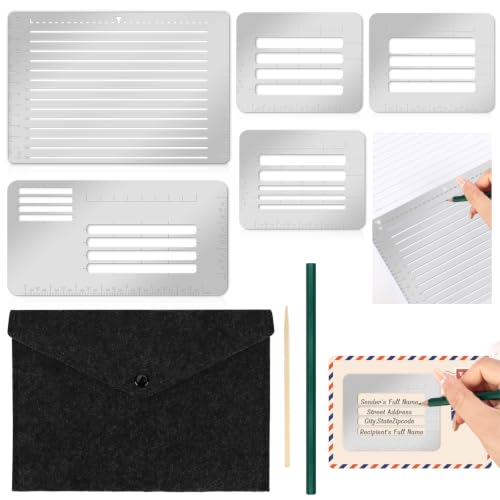
This set sits slightly outside traditional technical lettering, yet it can help buyers who combine drafting-style lettering with stationery and presentation work. The package includes a straight-line stencil, four envelope addressing templates, a bamboo pen, an HB pencil, and a felt pouch. The metal construction and multiple guide formats give it a more substantial, kit-like character than the slim plastic Ames guides.
Its straight-line stencil is listed at approximately 5 inches and creates 14 lines up to about 6.5 inches long, with spacing of approximately 0.9 cm. That layout is better suited to short notes, cards, labels, and addressing than a large architectural sheet. A student preparing presentation cards or practicing neat lettering away from the drafting table may appreciate the bundle, while a technical drafter seeking conventional lettering alphabets may find the format indirect.
Pros
- Includes five metal stencil components for varied writing tasks.
- Provides four envelope addressing guide formats.
- Includes a straight-line stencil with approximately 0.9 cm spacing.
- Comes with a bamboo pen, HB pencil, and felt storage pouch.
- Portable kit format suits stationery and presentation work.
Cons
- Its envelope and handwriting focus is less specific to technical drafting.
- The listed straight-line stencil length is better for short work than large drawing sheets.
Buy this set if your lettering routine moves between drafting notes, invitations, cards, and envelope work. The metal components may appeal to someone who prefers a firmer stencil, but the set does not replace a traditional Ames guide for measured technical lettering. It is a useful secondary kit rather than the purest drafting choice.
To buy this product, click here.
6. Teling 5-Pack Straight Line Stencil Set | Best Budget Stationery Guide

The Teling set combines one straight-line writing guide with four letter-addressing stencils. Its approximately 28 cm guide can create 30 lines of about 16 cm, and the listed 0.9 cm spacing leaves room for a medium nib or pen. Those details make it useful for ruled notes, postcards, cards, and short lettering exercises rather than full-size architectural lettering.
The translucent plastic is helpful when placing a guide over an envelope or sheet because the writing area remains visible. Imagine addressing a stack of invitations and wanting every line to sit at the same height. This set is built for that moment. It also offers a low-complexity way for a student to practice alignment, though its plastic stencil format lacks the specialized drafting systems found in the top Ames picks.
Pros
- Includes one line guide and four addressing stencils.
- Lists approximately 28 cm of guide length.
- Creates about 30 lines with approximately 0.9 cm spacing.
- Translucent plastic keeps the writing area visible.
- Supports postcards, cards, diaries, envelopes, and scrapbooking.
Cons
- Its lettering focus is primarily handwriting and envelope addressing.
- The approximately 16 cm line length is limited for broad drafting sheets.
This is a better fit for buyers who want an inexpensive alignment aid that can travel in a notebook or stationery pouch. It may help beginners build steadier spacing, but technical drafting students should look toward an Ames-style guide for dedicated lettering systems. The broad everyday use is the appeal, not advanced drafting precision.
To buy this product, click here.
7. SKATAN Lettering and Envelope Addressing Guide | Best for Mixed Stationery

The SKATAN guide combines three translucent plastic templates in one set. The listed lettering slots include 1/6, 1/4, 1/3, and 1/2 inch sizes, along with two envelope-addressing templates. That mixture gives it a broader stationery role than a conventional drafting guide, but the stated fractions overlap with lettering sizes that may appear in presentation labels and informal drawing annotations.
Its flexible, translucent, non-glare plastic is intended to keep the underlying stationery visible while writing. A person decorating a wedding invitation may use the larger spacing, then switch to a smaller slot for a return address or short note. For drafting, the guide is most useful for general lettering practice and presentation accents, since the listing does not identify metric spacing or a full range of technical lettering systems.
Pros
- Combines three templates in one set.
- Includes listed 1/6, 1/4, 1/3, and 1/2 inch lettering slots.
- Provides two envelope-addressing templates.
- Uses translucent plastic for easier placement.
- Supports letters, invitations, cards, envelopes, and handwriting designs.
Cons
- Its stationery focus makes it less specialized for architectural drafting.
- The listing does not specify metric spacing or traditional Ames systems.
Choose SKATAN if your projects move between lettering practice and personal stationery. It offers more flexibility than a single-purpose envelope guide, while remaining compact enough for a drawer or pencil case. Buyers producing formal technical sheets should select one of the dedicated Ames or standard-font guides instead.
To buy this product, click here.
8. Westcott Lettercraft Plastic Lettering Guide Set | Best for Signs and Reports

The Westcott Lettercraft set is aimed at visible, reusable alphabet lettering rather than guide-line drafting. It includes four listed sizes, from 6 mm to 21 mm, with uppercase letters, numbers, and punctuation symbols. That makes it a useful choice for signs, reports, classroom displays, labels, and presentation boards where the letter shapes themselves matter.
Raised ribs are listed as a way to reduce smudging and help with alignment. That detail may appeal to someone using ink or a marker on a sign, while the clear colored plastic helps with positioning. A drafting student could use the set for a large project heading or presentation title, but the available sizes are less tailored to small technical notes than the Ames guides.
Pros
- Includes four stated sizes from 6 mm to 21 mm.
- Provides uppercase letters, numbers, and punctuation.
- Raised ribs are intended to help reduce smudging.
- Smooth die-cut edges support outline tracing.
- Useful for signs, reports, classrooms, cards, and craft projects.
Cons
- Its alphabet stencil format is less suited to guide-line lettering.
- The listed range begins above the smallest sizes used for many technical notes.
This set belongs on the shortlist for large labels, presentation boards, and classroom drafting displays. It can add clean, repeatable headings to a drawing package, but it does not provide the same technical layout function as an Ames guide. Choose it for visible letter shapes and choose another pick for fine annotations.
To buy this product, click here.
9. Helix Standard Font Lettering Guide 4 Piece Set | Best for Large Standard Lettering

The Helix Standard Font set includes four listed letter sizes: 1/4, 1/2, 3/4, and 1 1/4 inches. It also includes uppercase and lowercase letters, numbers, and common symbols. That makes it a straightforward option for users who want complete character coverage in several larger formats rather than a guide centered on line spacing and slope.
The ink risers on the reverse are a useful drafting-oriented detail because they are intended to keep an inking pen from smearing the template or freshly drawn shapes. Imagine lettering a bold sheet title with technical ink, where a small drag across the plastic can leave a murky edge. The listed risers address that specific concern, although the set may feel too large for tiny annotations.
Pros
- Includes four standard lettering sizes.
- Covers uppercase, lowercase, numbers, and common symbols.
- Offers sizes from 1/4 inch to 1 1/4 inches.
- Reverse-side ink risers are intended to help prevent smudging.
- Useful for headings, labels, reports, and presentation lettering.
Cons
- Does not list the very small sizes used for fine technical notes.
- The listing provides limited information about the material.
The Helix set is a practical match for large, readable lettering on presentation sheets, signs, and reports. Its character coverage gives it more range than a single-size alphabet stencil, while the ink risers make it more relevant to drafting than many general craft templates. Buyers seeking compact 1/8-inch lettering should choose the Pacific Arc Modern Bold guide instead.
To buy this product, click here.
Buying Guide: How to Choose Lettering Guides for Drafting
Match the Guide to the Lettering Style
Ames-style guides are built around guide lines, spacing, and lettering alignment. They are useful when the goal is controlled technical lettering across a drawing sheet. Alphabet stencil sets take a different path. They provide letter openings or character outlines, which can be more convenient for signs, headings, labels, and presentation boards.
For example, a student adding small notes to a floor-plan sheet may prefer the Pacific Arc Ames guide, while someone making a large project title may find the Westcott or Helix format faster. Decide whether you need help constructing consistent letters or simply need repeatable letter shapes before choosing.
Check the Stated Size Range
Letter height controls how useful a guide feels in practice. Small sizes work for annotations and technical notes. Medium sizes suit labels and title blocks. Larger formats are better for headings, signs, and presentation displays. The Staedtler listing gives the broadest stated range in this roundup, from 1/16 inch to 2 inches, while the Pacific Arc Modern Bold guide focuses on 1/8, 3/16, and 1/4 inch.
Do not assume that a guide with many pieces covers every size. The Helix set includes four pieces, yet its listed sizes begin at 1/4 inch. That could be ideal for large lettering and still leave a small-note user reaching for another tool.
Look for Transparent or Translucent Construction
Clear material lets you see borders, construction lines, and the position of the paper beneath the guide. That matters when a letter must sit inside a title block or align with an existing layout. Translucent plastic can also make it easier to center an address or label without lifting the template repeatedly.
Metal offers a different feel. The 5-piece metal set may appeal to users who want a firmer template for stationery work, but metal can be less visually forgiving if the material blocks the page. For technical drafting, visibility is usually more useful than sheer thickness.
Consider Ink Clearance
Ink can turn a tidy lettering task into a smudged mess if the pen tip drags against the template. The Helix set specifically lists ink risers, while the Westcott set lists raised ribs intended to help with smudging and alignment. These features are relevant for technical pens, markers, and wet inks.
Pencil users have more flexibility, though a guide still needs to sit flat enough to keep lines controlled. Check whether the listing identifies features for ink before assuming a stencil will work equally well with every writing tool.
Separate Drafting Tools from General Writing Kits
The Teling, SKATAN, and 5-piece metal sets are useful for handwriting, addressing, cards, and stationery. They can support neat lettering practice, but they are not interchangeable with a dedicated architectural lettering guide. Their strengths are line alignment, portability, and varied envelope formats.
For architecture, engineering, or formal technical drawing, begin with the Pacific Arc Ames, Staedtler Ames, Pacific Arc Modern Bold, or Helix guide. Then add a broader stationery set only if your projects genuinely include cards, envelopes, or decorative presentation work.
Think About Portability and Storage
A slim guide can disappear beneath a stack of vellum, so storage matters more than it may seem. The Pacific Arc Modern Bold guide is compact at 8.75 by 2 inches, and the metal set includes a felt pouch. A two-pack can also solve the simple problem of keeping one guide at home and another in a drafting case.
For a shared classroom, duplicate guides may be practical. For a solo user with limited drawer space, one focused guide is usually easier to organize than a large assortment of overlapping templates.
Best Lettering Guides for Drafting FAQ
What Is the Best Lettering Guide for Drafting?
The Pacific Arc Ames Lettering Guide is the strongest overall match in this selection. Its listing specifies English and metric spacing, transparent plastic, and three lettering systems for drafting-related work. It is a better fit for technical lettering than a general envelope or journaling stencil.
What Is an Ames Lettering Guide Used For?
An Ames lettering guide helps establish consistent guide lines, spacing, and slope for hand lettering. It can support title blocks, drawing notes, labels, and other technical writing tasks where freehand alignment is difficult to maintain.
Are Lettering Stencils the Same as Drafting Guides?
No. A lettering stencil usually provides letter and number shapes that can be traced. A drafting guide may focus on guide lines, spacing, and slope so the user can form letters consistently. The Westcott and Helix sets lean toward character stencils, while the Pacific Arc and Staedtler Ames products are more drafting-focused.
What Letter Sizes Should a Drafting Guide Include?
The right range depends on the drawing. Small sizes suit technical notes, medium sizes work for labels and title blocks, and larger sizes suit headings or presentation boards. The Staedtler guide lists a range from 1/16 inch to 2 inches, while the Pacific Arc Modern Bold guide concentrates on 1/8, 3/16, and 1/4 inch.
Is Transparent Plastic Useful for Drafting Lettering?
Yes. Transparent or translucent plastic allows the user to see borders, lines, and paper placement through the guide. That makes alignment easier when lettering must sit beside existing drawing marks or inside a defined title area.
Which Guide Is Best for Large Lettering?
The Staedtler Ames guide has the broadest stated range, reaching up to 2 inches. The Helix Standard Font set also suits larger headings, with listed sizes up to 1 1/4 inches. The Westcott set is useful for visible signs and reports, with listed sizes up to 21 mm.
Can General Handwriting Stencils Be Used for Drafting?
They can help with line alignment and practice, but they may lack technical lettering systems, metric spacing, or suitable small sizes. The Teling and SKATAN sets are better for stationery and envelope work, while an Ames-style guide is a more direct choice for formal drafting.
Final Verdict
The Pacific Arc Ames Lettering Guide earns the top spot because it speaks most directly to drafting needs. English and metric spacing, transparent plastic, and three listed lettering systems give it a useful balance for students, designers, and technical drawing users. The Staedtler Ames guide is the better alternative for buyers who need a stated range that stretches from very small notes to large lettering, while the Pacific Arc Modern Bold guide is easier to pack for compact work.
For larger headings and full character coverage, the Helix set is a practical alternative. The Westcott set also makes sense for signs, classroom displays, and presentation boards. Buyers who want envelope or stationery support can look toward the SKATAN, Teling, or metal stencil sets, but those products should be treated as broader writing aids rather than replacements for a dedicated technical lettering guide. Start with the letter heights and writing surfaces you actually use, then choose the guide that keeps those marks clean, aligned, and easy to repeat.
