A drafting compass earns its keep in the quiet moment after a pencil point touches paper and the legs begin to open. A slight wobble can turn a clean circle into a lopsided loop, while a compass that loses its setting can make repeated arcs frustrating. That is why buyers compare more than the basic ability to draw a circle. Center-wheel control, leg stability, maximum diameter, pencil compatibility, storage, and included accessories all shape the experience.
The products below range from compact geometry kits to larger beam compasses made for arcs up to 22 inches. A student may value a pouch filled with rulers, triangles, and lead, while an architectural drafter or woodworker may care more about extension range and a secure locking mechanism. A frequent mistake is choosing a compass based only on its maximum size, then discovering that the tool is awkward for small classroom drawings. Our top overall pick, the Nicpro 22-piece set, stands out because it combines three compass styles with a useful collection of supporting tools in one case.
For a quick overview, the table below makes it easier to compare the leading drafting compass options side by side.
Best Drafting Compasses Quick Answer
Best overall: The Nicpro 22 PCS Compass Geometry Tools with Case offers the broadest classroom and general drafting package, with three compass types, a divider, protractors, triangles, pencils, and storage.
Best for large circles: The Drafting Compass Geometry Set with Large Extension Beam reaches circles and arcs up to 22 inches in diameter, making it the most suitable option here for oversized layouts.
Best for woodworking: The Mr. Pen Compass for Woodworking combines an 8-inch metal compass body with a pencil holder, wing lock, and divider function.
Best premium option: The Faber-Castell Quick-Set Compass focuses on a dedicated compass format with quick adjustment features, spare parts, and a case.
Best Drafting Compasses Comparison Table
| Product | Best For | Maximum Listed Diameter | Key Feature |
|---|---|---|---|
| Nicpro 22 PCS Compass Geometry Tools | Students and complete drafting kits | Up to 6 inches | Three compass types and full geometry set |
| Mr. Pen Professional Bow Compass | Basic precision circle work | Up to 8 inches | All-metal body with center wheel |
| Drafting Compass Geometry Set with Extension Beam | Large circles and architectural layouts | Up to 22 inches | Extension beam and interchangeable attachments |
| Mr. Pen Compass for Woodworking | Woodworking and layout marking | Up to 18 inches | Wing lock, pencil holder, and divider use |
| Mr. Pen Professional Geometry Set | Portable school and office kits | Not specified | Two compasses, drawing tools, and plastic case |
| Mr. Pen Professional Geometry Set, 7 Pieces | Large-circle drafting in a compact kit | Up to 20 inches | Extension beam and slip handle |
| 9-Inch Drafting Compass | Technical drafting and medium circles | Up to 9.5 inches | Steel point and locking center wheel |
| Sooez Professional Compass Drawing Tool | Quick adjustment and everyday drawing | Up to 7 inches | Quick buttons plus fine center adjustment |
| Faber-Castell Quick-Set Compass | Dedicated geometry and drafting work | Up to 340 mm | Quick-set design and spare parts case |
The detailed reviews below show where each compass fits, where its limitations may matter, and which type of drafting work it handles most naturally.
1. Nicpro 22 PCS Compass Geometry Tools with Case | Best Overall

For a student opening a geometry notebook beside a ruler, protractor, and mechanical pencil, this Nicpro set feels refreshingly complete. It includes a study compass, graphic compass, bow compass, and divider, so the buyer gets several approaches to circle construction and measurement rather than one basic instrument. The listing specifies circles up to 6 inches in diameter, which suits common classroom exercises, small technical drawings, and compact sketchbook work.
The surrounding tools give this kit its strongest advantage. Two protractors, two triangle squares, a 6-inch ruler, pencils, erasers, lead refills, needles, and a sharpener are all packed into a storage case. A pen holder on one compass also allows more flexibility with arcs and curves. That broad mix makes it a practical first drafting kit, although someone who already owns geometry tools may prefer a more specialized compass with a larger reach.
Pros
- Includes three compass types for different drawing situations
- Comes with a divider, two protractors, triangles, ruler, pencils, and supplies
- Adjustable pen holder supports pens and other drawing instruments
- Listed to create circles up to 6 inches in diameter
- Compact case keeps the set organized for class or travel
Cons
- Its 6-inch maximum diameter is smaller than several dedicated large-circle compasses
- The number of included pieces may be more than casual users need
This is the strongest fit for students, beginners, and anyone assembling a drafting kit from scratch. It also makes sense for a shared classroom supply drawer, where having a ruler and triangle available can prevent a small project from stalling over one missing tool. Buyers working on large architectural arcs or woodworking layouts should skip the compact range and choose a beam-style model instead. For broad everyday usefulness, however, this set offers the most balanced package in the roundup.
To buy this product, click here.
2. Mr. Pen Professional Compass for Geometry | Best Dedicated Bow Compass

Some desks are already crowded with drafting supplies, and adding another oversized kit only creates a fresh problem. This Mr. Pen model keeps the focus on one all-metal bow compass with a spring bow head and center wheel. The listing gives it an 8-inch circle capacity, a useful middle ground for geometry assignments, art projects, and technical drawings that exceed the reach of a small school compass.
The center-wheel design is the key detail for buyers who care about setting control. Instead of relying only on loose leg movement, the user can adjust the legs and set the desired span through the central mechanism. It arrives in a clear reusable pouch with extra lead, so it is easy to slide into a backpack or desk drawer. It does not include a ruler, protractor, or triangles, but that stripped-down format can be a benefit for someone who already has those tools.
Pros
- All-metal nickel-plated construction
- Center wheel helps control leg movement
- Creates circles up to 8 inches in diameter
- Includes extra lead for continued drawing work
- Reusable pouch supports simple storage and transport
Cons
- Does not include supporting geometry tools
- Less suitable for very large circles than beam-equipped designs
This compass suits a high school or college student who needs a dedicated instrument rather than a full geometry bundle. It can also work well as a replacement for a lost classroom compass, especially when a center wheel matters more than extra accessories. A buyer starting from zero will need to purchase a ruler and angle tools separately, while a fully equipped drafting desk may find this focused format pleasantly uncomplicated.
To buy this product, click here.
3. Drafting Compass Geometry Set with Large Extension Beam | Best for Large Circles

A small compass is perfectly happy on a worksheet, but it reaches its limit quickly on a large construction drawing or a full-size layout. This Ferocious Viking set addresses that gap with two bow compasses, an extension beam, interchangeable attachments, and a slip handle for pens, pencils, styluses, or markers. The listed maximum diameter is 22 inches, making it the broadest-reaching option in this selection.
The extension beam changes the kind of work the tool can handle. A student drawing a large architectural curve can use the added reach, while a maker laying out an oversized circular shape can choose a pencil or marker attachment. The set also includes a sharpener, lead container, and small stylus. That range is useful, but it makes the kit more specialized and potentially less convenient for someone who only needs 2- or 3-inch geometry circles.
Pros
- Extension beam reaches circles and arcs up to 22 inches in diameter
- Includes two bow compasses for different working ranges
- Interchangeable attachments support pencils, pens, styluses, and markers
- Center set screw helps establish the desired circle size
- Includes a sharpener and replacement lead container
Cons
- Large-circle equipment is more than most basic classroom assignments require
- Its expanded format needs more storage space than a standard compass
This is the clear choice for architectural students, construction-design learners, and makers who genuinely need oversized arcs. It also gives artists more freedom for large-format circular layouts. A buyer working at a small desk may find the beam cumbersome, and someone who mainly draws small circles can save space with a compact bow compass. The extra reach is the reason to choose it, so it makes sense only when that reach will see regular use.
To buy this product, click here.
4. Mr. Pen Compass for Woodworking | Best for Woodworking

Picture a pencil line sweeping across a board, marking a rounded edge before the saw ever starts. This Mr. Pen compass is aimed at that kind of layout work, with an 8-inch leg length, all-metal construction, a pencil holder, and a wing design that locks the setting. The listing states that it can draw circles up to 18 inches in diameter, giving it considerably more reach than a typical classroom compass.
Its divider function adds another practical layer. A woodworker or leatherworker can use the tool to copy measurements, scribe a line, or mark repeated arcs, while the pencil holder handles circle drawing. That makes it a better match for workshops than for a pencil case, although students who work across math, art, and shop projects may appreciate the crossover.
Pros
- Designed for woodworking, carpentry, metalwork, leatherwork, and drafting
- Listed 8-inch leg length supports larger layouts
- Pencil holder draws circles up to 18 inches in diameter
- Lockable wing design helps maintain a repeated setting
- Can function as a scribe or divider for copying measurements
Cons
- Workshop-focused design is less convenient for small classroom geometry kits
- Does not include rulers, protractors, or other geometry accessories
Choose this model for layout marking where the surface may be wood, leather, or another material rather than a sheet of notebook paper. Its large-circle range is particularly useful for furniture parts and curved construction marks. A student who needs a full set of geometry tools should look toward Nicpro or one of the Mr. Pen kits, while a maker who already owns measuring tools will likely value this compass’s focused design.
To buy this product, click here.
5. Mr. Pen Professional Geometry Set, 15 Pieces | Best Portable Geometry Kit
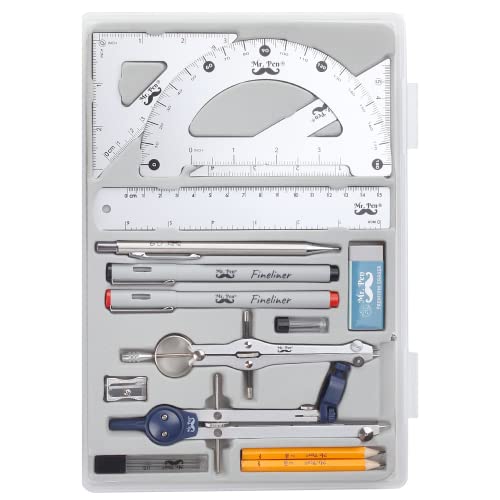
A student who moves from home to class to the library needs a kit that behaves itself in a backpack. This 15-piece Mr. Pen set gathers two compasses, two triangles, a 6-inch ruler, a protractor, pencils, fineliners, a mechanical pencil, eraser, sharpener, and lead refills in a plastic case. The combination covers the basic tools needed for geometry, sketching, and introductory drafting without requiring a separate shopping list.
The presence of two compasses gives the kit more flexibility than a single-instrument pouch, while the fineliners add a way to distinguish construction marks from finished lines. The listing does not specify a maximum circle diameter, so shoppers who need a particular reach should confirm that detail before choosing it. For ordinary school assignments and compact desk work, its organization and breadth are the bigger attraction.
Pros
- Includes two compasses in one portable set
- Provides triangles, ruler, protractor, pencils, and fineliners
- Includes lead refills, sharpener, and eraser
- Durable plastic case keeps the pieces together
- Fits student, teacher, art, and introductory drafting use
Cons
- The listing does not specify a maximum circle diameter
- Its accessory-heavy format may be unnecessary for buyers seeking one dedicated compass
This set is a sensible fit for a student who wants a ready-to-carry geometry kit and prefers clear organization over a large specialty compass. It can also serve as a backup classroom set, where a missing triangle or pencil can derail an otherwise simple exercise. Buyers focused on architectural arcs, woodworking, or exact circle capacity should choose a model with a stated diameter instead.
To buy this product, click here.
6. Mr. Pen Professional Geometry Set, 7 Pieces | Best for Large-Circle Drafting
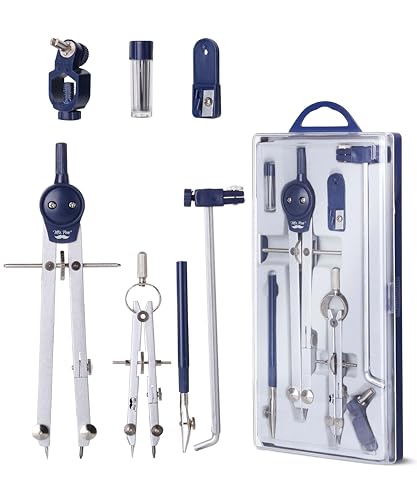
This seven-piece set takes a more focused route than a full geometry bundle. It includes two professional compasses, an extension beam, interchangeable attachments, and a slip handle for pens, pencils, styluses, or markers. The listed circle capacity reaches 20 inches in diameter, placing it close to the large extension-beam set while keeping the component count more restrained.
Imagine laying out a broad arc on a poster board, then switching from pencil to marker without reaching for a different tool. That is the practical appeal here. The spring bow head and center wheel are specified to help prevent unintended leg movement, while the clear reusable box keeps the specialized pieces together. It does not include the ruler, protractor, or triangles found in larger school kits, so its value depends on already having those basics.
Pros
- Creates circles up to 20 inches in diameter
- Includes an extension beam for larger arcs
- Interchangeable attachments accept pens, pencils, styluses, and markers
- Spring bow head and center wheel support controlled adjustments
- Reusable box simplifies storage and transport
Cons
- Does not include standard measuring tools such as a ruler or protractor
- Large-circle reach may be excessive for routine classroom geometry
This set suits an architecture student, artist, or designer who already owns basic measuring equipment and wants more reach from the compass itself. It is more targeted than a 15-piece school kit and less expansive than a full beam system with multiple extras. Pick it for large arcs and interchangeable drawing attachments, not for an all-in-one beginner package.
To buy this product, click here.
7. 9-Inch Drafting Compass | Best Mid-Size Technical Compass

A medium-size drafting compass can be the comfortable middle ground between a small geometry tool and a full extension beam. This model has a precision metal body, a steel point, a spring bow head, and an adjustable center wheel. The listing specifies a diameter of up to 9.5 inches, giving it enough range for larger technical drawings without moving into the 18- or 22-inch category.
The steel point matters at the moment the compass meets the paper. A firm center point helps establish the circle’s location, while the center wheel allows the legs to be locked at the chosen span. There is no included geometry kit or stated case in the supplied product details, so this is best viewed as a standalone drafting instrument for a desk that already has the other essentials nearby.
Pros
- Precision metal body is suited to technical drawing tasks
- Steel point helps position the center of a circle
- Center wheel locks the legs at the desired setting
- Creates circles up to 9.5 inches in diameter
- Spring bow design supports adjustable drafting work
Cons
- Does not provide the broader accessories found in geometry sets
- Its medium reach is less suitable for very large architectural or workshop layouts
This compass fits the buyer who wants one dedicated metal tool for technical drawing, diagrams, and medium-sized circles. It makes more sense beside an existing ruler and triangle than inside a beginner’s first supply kit. Choose a beam model for oversized work, or select a compact set if portability and supporting tools matter more than the 9.5-inch reach.
To buy this product, click here.
8. Sooez Professional Compass Drawing Tool | Best for Quick Adjustments

Repeatedly changing circle sizes can turn a calm drawing session into a series of tiny adjustments. The Sooez compass addresses that routine with two adjustment methods: quick buttons on the legs for fast opening and closing, followed by a center knob for finer control. Its listed range extends up to 7 inches, enough for classroom geometry, technical drawing, art, and many everyday layout tasks.
The metal body and integrated construction give this model a straightforward, contained feel in the product description, while the fitted storage box keeps it from floating loose in a drawer or toolbox. The case is especially useful for a student who carries a compass between rooms. It lacks the ruler-and-protractor collection of a full kit, but that is a fair trade for buyers who want faster size changes from one dedicated instrument.
Pros
- Combines quick leg buttons with a fine center adjustment knob
- Metal body is suited to geometry, drafting, art, and woodworking
- Adjusts for circles up to 7 inches in diameter
- Integrated construction is intended to reduce looseness and maintain alignment
- Fitted storage case supports transport and organization
Cons
- Does not include a ruler, protractor, triangles, or divider
- Its 7-inch range is smaller than large-circle and woodworking models
This is a useful choice for anyone who changes dimensions often and values speed between rough setup and fine adjustment. A student sketching several nested circles can benefit from the two-stage control, while a drafting desk with a full supply of measuring tools will not pay for accessories it does not need. Buyers drawing very large arcs should move up to an extension-beam compass.
To buy this product, click here.
9. Faber-Castell Quick-Set Compass | Best Premium Option

A dedicated compass can feel far more refined than a crowded kit when the work calls for repeated, controlled circles. The Faber-Castell Quick-Set Compass is listed with an ergonomic leg-opening design, gear wheels, firm center-wheel spindles, non-slip needles, and lead clamps. Its stated maximum is 340 mm, or roughly 13.4 inches, giving it more reach than several standard school compasses while staying smaller than a beam tool.
The marble-effect case stores spare parts and leads, which gives the compass a tidy home between drawing sessions. That matters in a college bag, where loose needles and lead pieces can disappear under notebooks. It is a premium-leaning dedicated instrument rather than a complete geometry kit, so the buyer pays for the compass format, adjustment hardware, and included spares instead of receiving triangles and protractors.
Pros
- Listed circle capacity reaches 340 mm
- Quick-set design supports convenient leg adjustment
- Gear wheels and center-wheel spindles are specified for controlled setting
- Includes non-slip needles, lead clamps, spare parts, and leads
- Marble-effect case stores the compass and replacement components
Cons
- Does not include a complete set of geometry measuring tools
- Its dedicated format may be more than beginners need for basic circles
This model is best for a buyer who wants a dedicated compass with a larger stated range and a case for spare parts. It is a more polished alternative to basic single-compass designs, while the extension-beam models remain better for very large arcs. A student who needs every geometry tool in one purchase should choose a kit, but a regular drafter may appreciate the focused design and orderly storage.
To buy this product, click here.
Drafting Compass Buying Guide
Match Circle Size to the Work
Maximum diameter is one of the easiest specifications to compare, but it should match the drawings you actually make. A 6-inch compass is sensible for many geometry worksheets and small diagrams. A 9.5-inch model gives more breathing room for technical drawings, while an extension beam reaching 20 or 22 inches belongs on a larger sheet, board, or workpiece. Buying the largest compass available can leave a small desk feeling like a toolbox, so reach should serve the project rather than dominate it.
Choose Between a Kit and a Dedicated Compass
Complete kits are useful for students who need a compass, ruler, triangles, protractors, pencils, and storage in one purchase. The Nicpro and Mr. Pen geometry sets reduce the familiar classroom scramble for one missing triangle. A dedicated compass is a better fit for a buyer who already owns those basics and wants a particular mechanism, larger diameter, or woodworking function. Look inside your existing drawer before paying for duplicate accessories.
Understand Adjustment Mechanisms
A center wheel helps set and maintain the distance between the legs, while a spring bow design supports controlled movement. Quick-adjust buttons, such as those on the Sooez, can speed up large changes before the center knob handles fine tuning. Beam compasses use an extension component to create much larger radii. For repeated circles, a mechanism that stays predictable matters more than a long feature list.
Check the Drawing Attachment
Some compasses use a fixed lead, while others include a pencil holder or interchangeable attachments. Pencil holders are useful for artists, designers, and woodworkers who prefer a particular pencil, pen, stylus, or marker. The Ferocious Viking and Mr. Pen beam sets are especially flexible in this area. For basic geometric constructions, a dedicated lead holder may be simpler and less fussy.
Think About the Surface
Paper drafting and workshop layout are different jobs. A sharp point and lead holder suit technical drawings, while a woodworking compass may need to copy measurements or scribe a line across a board. The Mr. Pen woodworking model is built around that broader layout role. If the compass will travel in a backpack, a fitted case or reusable pouch also protects the point and keeps spare leads from rattling around beside a laptop.
Do Not Ignore Storage
A compass point can damage other supplies when it is tossed loose into a drawer. Cases and pouches provide a simple barrier, and full kits use them to keep small lead pieces, needles, and pencils together. Larger extension beams need more room, so measure the storage area before choosing one for a compact workspace. A tool that is easy to find is far more useful than one buried under old sketchbooks.
Best Drafting Compasses FAQ
What Type of Compass Is Best for Drafting?
A metal compass with a controlled center wheel is a strong starting point for drafting because it allows the user to set a radius and maintain it while drawing. The best format depends on the work. A complete geometry kit suits students, a dedicated bow compass suits routine circle work, and an extension-beam compass suits large arcs.
What Size Drafting Compass Should I Buy?
Choose a maximum diameter slightly larger than the circles you normally draw. Models in this selection range from 6 inches to 22 inches. A compact 6- or 7-inch compass works for many classroom tasks, while a 9.5-inch or 13.4-inch option gives more room for technical drawings. For oversized layouts, choose a beam model with a stated 18-, 20-, or 22-inch reach.
Are Geometry Sets Better Than Standalone Compasses?
Geometry sets are more convenient for students who need several tools at once. They commonly include rulers, triangles, protractors, pencils, lead, and storage. Standalone compasses are more suitable for buyers who already own those supplies or who need a specific feature, such as a woodworking divider, quick adjustment, or large extension beam.
Can a Drafting Compass Draw on Wood?
Some can, especially models with a pencil holder, wing lock, or divider function. The Mr. Pen woodworking compass is specifically listed for woodwork, carpentry, metalwork, and leatherwork. A standard classroom compass may be better suited to paper and should not be assumed to handle workshop marking simply because it can draw circles.
What Is an Extension Beam Used For?
An extension beam increases the distance between the center point and the drawing attachment, allowing much larger circles and arcs. It is useful for architectural layouts, large-format artwork, construction designs, and workshop projects. The trade-off is extra storage space and more equipment than a small geometry assignment requires.
Do I Need a Pencil Holder?
A pencil holder is useful if you want to use a preferred mechanical pencil, drawing pencil, pen, marker, or stylus. It can also make the compass more versatile across paper, art, and layout work. For standard geometry exercises, a fixed lead or included compass pencil may be perfectly adequate.
How Should I Store a Drafting Compass?
Keep the point protected in a case or pouch, especially if the compass travels in a backpack. Store replacement leads and needles with the tool so they are available when needed. Large beam compasses deserve a longer compartment or drawer, while compact kits can usually stay in their supplied plastic case or pouch.
Final Verdict
The Nicpro 22-piece compass geometry set is the strongest overall recommendation because it covers the widest range of ordinary drafting and geometry needs in one organized case. Three compass types, a divider, protractors, triangles, pencils, and refills give students a practical starting point without forcing them to assemble a kit one item at a time. Its 6-inch circle limit is a genuine boundary, so buyers working on large drawings should choose a different format.
For oversized circles, the extension-beam options from the large Drafting Compass Geometry Set and the Mr. Pen seven-piece set are better matched to the job. Woodworkers should look closely at the Mr. Pen woodworking compass, while buyers seeking a dedicated premium instrument may prefer the Faber-Castell Quick-Set Compass. Before ordering, compare the required circle diameter, adjustment style, drawing attachment, and storage space. The best drafting compass is the one that fits the paper, workpiece, and daily routine waiting on the desk.
