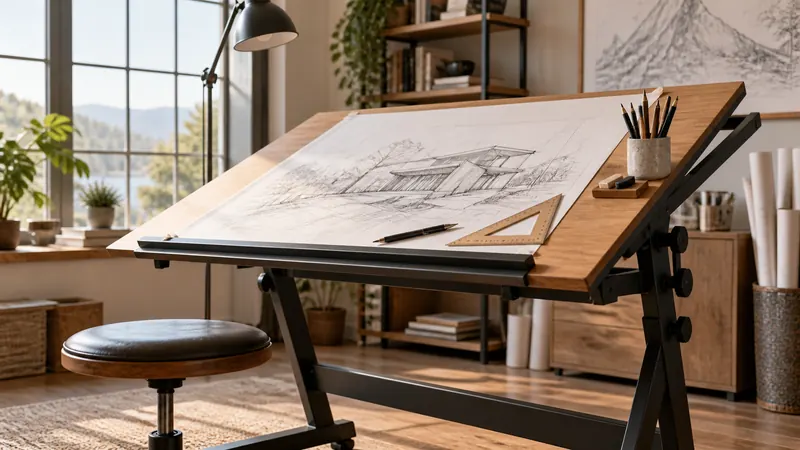
A drafting table earns its keep when a flat desk starts feeling like a compromise. A tilted surface can bring a drawing closer to a comfortable viewing angle, while height adjustment helps the same station work for sitting, standing, reading, or computer tasks. The challenge is that these tables vary sharply in useful ways. Some pair a generous worktop with a wide height range, others add drawers and a stool, and glass models bring a bright, easy-clean surface that behaves differently from wood or MDF.
Buyers often focus on the maximum tilt angle and overlook the details that shape daily use. Check the actual work-surface dimensions, the lowest and highest table positions, the type of pencil ledge, available storage, and the space needed for a side tray or stool. A compact student workspace may need a different balance than a dedicated studio. Among the options below, the Yaheetech Adjustable Drafting Table Art Desk with Storage Drawers and Stool stands out as the strongest overall fit because it combines 0 to 60-degree tilt, adjustable height, a slide-out auxiliary surface, storage, and an included stool.
For a quick look at the main differences, the table below puts the nine selected options side by side.
Best Adjustable Drafting Tables Comparison Table
| Product | Best For | Work Surface | Height Adjustment | Tilt |
|---|---|---|---|---|
| Yaheetech Adjustable Drafting Table, Black | Best overall | 47.5 × 23.6 in. | 27.5 to 36.5 in. | 0 to 60° |
| Yaheetech Tilting Glass Art Desk | Glass-surface work | 35.4 × 23.6 in. | 28 to 36 in. | 0 to 40° |
| ZENY Adjustable Drafting Table | Artists needing storage | 34 × 23.6 in. | 28 to 35.8 in. | 0 to 60° |
| VECELO Drafting Table, Rustic Brown | Storage and broad tilt | 40.2 × 23.7 in. | Not specified | 0 to 65° |
| conda Wood Drafting Table | Natural wood styling | 35.4 × 23.6 in. | 31.5 to 37 in. | 0 to 45° |
| VECELO Vintage Drawing Table | Compact rolling setup | 40.15 × 23.6 in. | Not specified | 0 to 45° |
| Yaheetech Glass Drafting Table | Tracing and mobility | Not specified | Not specified | 0 to 60° |
| MEEDEN Wood Adjustable Drafting Table | Large wooden worktop | 35.5 × 23.5 in. | 29.7 to 38.4 in. | 0 to 60° |
| DJAR 42 × 30 Adjustable Wooden Drafting Table | Large premium workspace | 42 × 30 in. | 34 to 38.9 in. | 25° increments |
The detailed reviews below show where each table fits, from compact student corners to spacious drawing studios.
Quick Answer
- Best overall: Yaheetech Adjustable Drafting Table, Black, for its broad adjustment range, storage, side surface, and included stool.
- Best for a large work area: DJAR 42 × 30 Adjustable Wooden Drafting Table, with the largest listed work surface in this selection.
- Best for wood styling: conda Wood Drafting Table, with a natural wood tabletop, adjustable height, and built-in ruler.
- Best for tracing: Yaheetech Glass Drafting Table, with a tempered glass top that can work with a light source.
- Best value-oriented setup: VECELO Drafting Table, Rustic Brown, which combines a broad tilt range, storage drawers, shelf, and stool.
1. Yaheetech Adjustable Drafting Table Art Desk, Storage Drawers & Stool, Black: Best Overall

The black Yaheetech table covers the features most buyers mean by adjustable drafting table without becoming a single-purpose station. Its height runs from 27.5 to 36.5 inches, and the main work surface tilts from flat to 60 degrees. That combination lets a user lower the table for seated sketching, raise it for a taller setup, or keep it flat for a laptop and paperwork. The listed 47.5-inch overall length also leaves room for a useful side surface beside the main top.
That side surface is one of its more practical touches. The 15 by 23.6-inch auxiliary top pulls out for a laptop, tablet, palette, or reference documents, then slides under the main surface when the extra room is unnecessary. Two fabric drawers, an open lower shelf, a detachable stationery tray, and an adjustable metal pencil ledge create a place for the tools that otherwise gather in a messy pile. Since a matching stool is included, this is especially appealing for a bedroom studio, hobby corner, or first dedicated art station.
Pros
- Height adjusts from 27.5 to 36.5 inches.
- Main tabletop tilts from 0 to 60 degrees.
- Includes a retractable 15 by 23.6-inch auxiliary surface.
- Provides fabric drawers, an open shelf, and a stationery tray.
- Includes a matching padded stool and adjustable pencil ledge.
Cons
- The storage components use fabric, which may feel less substantial than rigid drawers.
- The broad overall length needs more wall or floor space than a compact tabletop board.
This is the strongest all-round fit for buyers who want one station for drawing, writing, reading, and computer work. It may be more furniture than a casual sketcher needs, while artists working with very large sheets may want a wider professional-style surface. For a home user who wants height adjustment, meaningful storage, and a seat in one package, its versatility gives it a clear edge.
To buy this product, click here.
2. Yaheetech Adjustable Drafting Table & Stool, Tilting Glass Art Desk: Best Glass Surface

A tempered glass tabletop changes the feel and function of a drafting station. The Yaheetech glass model offers a 35.4 by 23.6-inch work surface that tilts through five locked positions from flat to 40 degrees. The transparent top can be useful for diagram work and tracing, especially when paired with a suitable light source beneath it. Spilled paint, coffee rings, and pen marks can also be wiped from the glass more readily than from many porous-looking wood surfaces.
The table height adjusts from 28 to 36 inches, and the listing gives separate load figures for the glass top, side surface, and included stool. A powder-coated iron frame supports the table, while the MDF side countertop gives a place for supplies or a computer. The stool has a padded PU-covered seat and metal legs, making this a ready-made setup for someone who wants a coordinated desk and seat rather than a table alone.
Pros
- Tempered glass surface supports tracing and diagram work.
- Table height adjusts from 28 to 36 inches.
- Top tilts from 0 to 40 degrees with five lockable positions.
- Glass and powder-coated surfaces are relatively easy to wipe clean.
- Includes a padded stool and side countertop.
Cons
- The glass top offers less visual warmth than wood or wood-look MDF.
- The 40-degree maximum tilt is narrower than the 60- to 65-degree ranges of several other picks.
Choose this model for tracing, cleanability, and a lighter visual appearance in a studio or study. It is less compelling for buyers who prefer a deep wooden-feeling surface or need a very steep drawing angle. A student working with diagrams, light-based tracing, and mixed desk tasks may find the glass top especially useful.
To buy this product, click here.
3. ZENY Adjustable Drafting Table with Stool Tilting Drawing Desk: Best for Organized Art Projects

The ZENY model brings a compact art-studio feel to a 34 by 23.6-inch main tabletop. Its height range runs from 28 to 35.8 inches, and the work surface tilts from 0 to 60 degrees. Those figures make it adaptable for seated drawing, writing, and computer tasks, while the triangular leg design and steel-and-wood construction give the desk a traditional drafting-table profile.
Storage is the headline feature here. Two slide-out drawers, a lower shelf, a right-side pencil box, and a slide-out 15 by 23.6-inch tray give separate homes to paper, tools, a laptop, or a palette. Picture a student moving between a reference screen and a drawing sheet without stacking everything on the main surface. The included 20-inch stool completes the arrangement, although buyers should compare that seat height with their preferred table position before settling in for long sessions.
Pros
- Height adjusts from 28 to 35.8 inches.
- Tabletop tilts through a 0 to 60-degree range.
- Includes two drawers, a lower shelf, and a pencil box.
- Provides a slide-out 15 by 23.6-inch auxiliary tray.
- Includes a 20-inch stool for a coordinated workspace.
Cons
- The 34-inch main width is more compact than the largest tables here.
- The included stool height may not suit every user or table position.
This table makes sense for artists, design students, and hobbyists who want supplies close at hand without filling a room with separate storage furniture. Large-format drafters may outgrow the main surface, and anyone who prefers a minimalist desk may find the drawers and tray visually busy. Its strongest appeal is the way it packages storage, adjustability, and seating into one practical station.
To buy this product, click here.
4. VECELO Drafting Table Art Desk with Storage Drawers and Stool, Rustic Brown: Best for Storage and Tilt Range

The VECELO rustic brown table is aimed at buyers who want a drafting surface that can shift from a flat everyday desk to a steep art station. Its tabletop tilts from 0 to 65 degrees, the widest stated tilt range in this group. The 40.2 by 23.7-inch footprint gives drawing materials a comfortable amount of width without reaching the size of the largest wooden tables.
Its storage arrangement is refreshingly direct. Two non-woven fabric drawers, a lower fabric shelf, a right-side pencil box, and separate utensil slots help sort the small items that tend to vanish under sheets of paper. The 12 mm MDF top sits on a metal frame with triangular supports, and four protective foot pads help shield the floor. Since the package includes a 20-inch padded stool, a buyer can establish a basic drawing corner without matching furniture piece by piece.
Pros
- Offers a 0 to 65-degree tabletop tilt range.
- Provides a 40.2 by 23.7-inch work area.
- Includes two drawers, a lower shelf, and pencil storage.
- Uses a metal frame with triangular leg support.
- Includes a 20-inch padded stool and floor-protective foot pads.
Cons
- The listing does not specify a height-adjustment range for the table.
- Fabric drawers and shelf are less rigid than hard-sided storage.
This VECELO is a sensible match for a seated artist who values steep tilt and easy-access supplies more than a fully height-adjustable frame. Buyers who regularly alternate between sitting and standing should favor a model with a stated height range. For painting, sketching, crafting, and reading at a strong angle, the broad tilt and built-in organization do much of the practical work.
To buy this product, click here.
5. conda Wood Drafting Table, 35.5 × 23.5-Inch Plan Table: Best Natural Wood Style
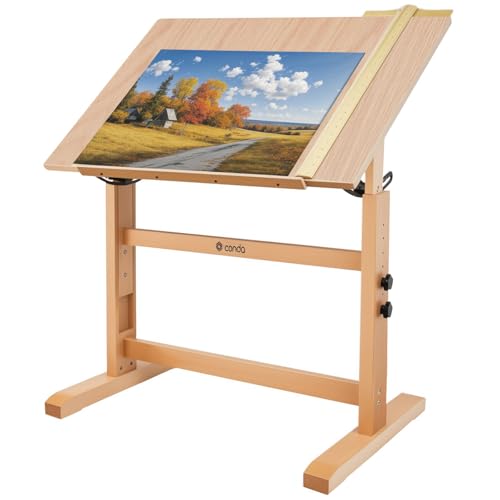
The conda table takes a cleaner, more architectural approach than the drawer-and-stool combinations above. Its natural wood work surface measures 35.4 by 23.6 inches, and the listed height range of 31.5 to 37 inches suits users who want a somewhat taller drafting position. The tabletop tilts from flat to 45 degrees, giving enough flexibility for drawing, writing, and design work without aiming for the steepest easel-like angles.
A built-in pencil ledge and ruler keep basic tools close to the front edge, which can be handy for measured drawing or quick markups. The listing describes a high-quality solid wood construction and includes assembly instructions, tools, and pre-sorted parts. There are no listed drawers or included stool, so this model leaves more room beneath the surface for a preferred chair and keeps the visual profile relatively uncluttered.
Pros
- Offers a 35.4 by 23.6-inch natural wood work surface.
- Height adjusts from 31.5 to 37 inches.
- Tabletop tilts from 0 to 45 degrees.
- Includes a built-in pencil ledge and ruler.
- Its simple table format leaves room for a separate preferred chair.
Cons
- Does not include drawers, a side tray, or a stool.
- Its 45-degree maximum tilt is less steep than several storage-focused tables.
The conda is a good fit for a home office, student room, or studio where natural wood styling matters and the user already owns a suitable chair. It is less convenient for someone building a complete station from scratch. Pick it for the uncluttered surface, taller height range, and integrated ruler rather than for storage or included extras.
To buy this product, click here.
6. VECELO Vintage Drawing Drafting Table with Rolling Wheels: Best Compact Rolling Option

A rolling base can be handy in a craft room that changes shape from one project to the next. This VECELO model measures 40.15 by 23.6 by 29.5 inches and combines a metal frame with an MDF tabletop. Its top adjusts from 0 to 45 degrees, while a pencil ledge helps hold paper and supplies as the surface rises. Lockable slide wheels are listed for moving the table and keeping it positioned during work.
The removable side tray adds small-item organization without making the whole desk dependent on drawers. Separate slots and pen holes give markers, pencils, brushes, and similar tools a place to land between tasks. At a flat angle, the table can serve as a writing, study, or general craft surface. A buyer working in a shared room could roll it aside after a drawing session, then bring it back near a window or storage cabinet when the next project begins.
Pros
- Includes lockable rolling wheels for easier repositioning.
- Tabletop adjusts from 0 to 45 degrees.
- Provides a 40.15 by 23.6-inch work area.
- Includes a removable tray with slots and pen holes.
- Works as a drafting, writing, study, or craft table.
Cons
- The listing does not specify table height adjustment.
- The 45-degree tilt range is less versatile for steep-angle drawing than several alternatives.
This model suits renters, hobbyists, and shared-space users who value mobility and a tidy footprint. It may be a weaker fit for users who need a height-adjustable sit-to-stand arrangement or extensive enclosed storage. The wheels are the distinguishing feature, especially for a room where a drafting station cannot remain in one fixed spot.
To buy this product, click here.
7. Yaheetech Glass Drafting Table with Storage: Best for Tracing and Mobility

This Yaheetech table focuses on the combination of tempered glass, tool storage, and flexible movement. The glass tabletop tilts from 0 to 60 degrees and includes a pencil ledge for keeping paper and stationery in place. Its transparent blue-tinted surface can be paired with a light to create a tracing-oriented setup, a feature that gives it a different purpose from the wood-top tables in this roundup.
Mobility is unusually configurable here. The table includes screw-in flat feet for a more stationary arrangement and wheels for easier movement, with two wheels featuring brakes. Four embedded stationery trays, honeycomb pen holes, assorted slots, and two pull-out fabric drawers create plenty of places for small tools. The listing describes a powder-coated steel frame and high-load-capacity construction, although it does not provide a table height range, so buyers should measure their chair and intended working position carefully.
Pros
- Tempered glass top supports light-based tracing work.
- Tabletop tilts from 0 to 60 degrees.
- Includes both flat feet and wheels for different placement needs.
- Provides four stationery trays and two pull-out drawers.
- Rounded glass edges and a pencil ledge support everyday use.
Cons
- The listing does not specify a height-adjustment range.
- Glass requires a different handling and cleaning approach than wood or MDF.
Select this table if tracing, tool organization, and the ability to move the station matter more than height customization. It can be especially appealing in a comic, illustration, or craft setup that uses a light source beneath the work. Buyers who want a warm wooden surface or a clearly stated sit-to-stand range have better matches elsewhere in the list.
To buy this product, click here.
8. MEEDEN Wood Adjustable Drafting Table, 35.5 × 23.5-Inch: Best Height Range

The MEEDEN table is a strong candidate for buyers who care about height flexibility and a broad traditional drawing surface. Its height adjusts from 29.7 to 38.4 inches, the tallest upper position among the tables with clearly listed ranges here. The 35.5 by 23.5-inch tabletop tilts from flat to 60 degrees, giving the user room to switch between a writing desk, computer station, and angled drawing surface.
The construction combines a natural particle-board wood finish with beech legs, cross supports, and side bracing. The listing also includes a 25-inch built-in pencil ledge and a 24-inch T-square with inch and metric calibrations. That accessory is particularly useful for students or hobbyists starting a drafting setup, since it reduces the need to purchase a straightedge immediately. There are no listed drawers, stool, or side tray, so the open area beneath the tabletop is the trade-off for its clean layout.
Pros
- Offers a broad 29.7 to 38.4-inch height range.
- Tabletop tilts from 0 to 60 degrees.
- Provides a 35.5 by 23.5-inch work surface.
- Includes a 25-inch pencil ledge and 24-inch T-square.
- Uses cross supports and side legs for a braced table design.
Cons
- Does not include drawers, a lower shelf, or a stool.
- The particle-board tabletop finish may appeal less to buyers seeking a fully solid-wood work surface.
MEEDEN is the pick for a user who wants more control over working height and appreciates having a T-square included. It fits a student room, home studio, or office where a separate chair and storage cabinet are already available. Buyers who want an all-in-one art station will find the Yaheetech and ZENY packages more complete, while users who alternate between sitting and standing may prefer MEEDEN’s stated range.
To buy this product, click here.
9. DJAR 42 × 30 Adjustable Wooden Drafting Table & Art Drawing Desk: Best Large Premium Option

The DJAR table is the spacious choice in this group. Its 42 by 30-inch surface gives larger drawings, painting projects, and reference materials more elbow room than the many 23.5-inch-deep options. The height adjusts from 34 to 38.9 inches, placing it toward the taller end of the category. A walnut-finished top, solid pine legs, and H-frame construction give the station a substantial furniture profile.
Its adjustment system differs from the simpler lift-and-lock designs elsewhere. The listing describes 25-degree tilt increments and 330-degree rotation through a double semi-circular frame. That arrangement may appeal to artists who want to position the work surface around a project, although the larger top needs a room with enough clearance to make the rotation useful. There are no listed drawers, stool, or side tray, so the premium appeal rests on surface area, wood construction, and unusual positioning flexibility.
Pros
- Provides the largest listed work surface at 42 by 30 inches.
- Height adjusts from 34 to 38.9 inches.
- Uses an H-frame with solid pine wood legs.
- Offers 25-degree tilt increments and 330-degree rotation.
- Supports drafting, painting, crafting, writing, and computer work.
Cons
- Its larger footprint needs more room than compact drafting tables.
- Does not include drawers, a stool, or dedicated stationery storage.
This is the table for a dedicated studio where surface area matters more than compact storage. It may be excessive for a dorm room or casual sketching corner, and users who need a very low seated position should review the listed 34-inch minimum height carefully. For large drawings, painting layouts, and buyers who want a substantial wooden centerpiece, its size and rotation system make it the most distinctive premium-oriented option here.
To buy this product, click here.
Buying Guide: How to Choose an Adjustable Drafting Table
Start With the Work Surface
Measure the paper, tablet, ruler, and reference material you expect to use at the same time. A 34-inch-wide surface can work well for compact drawing sessions, while a 42 by 30-inch top gives larger projects more breathing room. Depth matters too. A table that looks broad in a product photo may leave little space for a laptop once a sheet of paper and pencil ledge are in place.
Think about the real scene at your desk. If a drawing occupies the main surface and a tablet needs to stay visible beside it, a retractable auxiliary top such as the one on the Yaheetech black model can be more useful than a few extra inches of width. A large, open worktop such as the DJAR may be preferable for painting or oversized layouts, provided the room can accommodate it.
Compare Height and Tilt Separately
Height adjustment and tabletop tilt solve different problems. Height changes the relationship between your chair, arms, and work surface. Tilt changes the viewing and drawing angle. A table with a steep 65-degree tilt but no stated height range may be excellent for angled art while offering less flexibility for users who switch between sitting and standing.
Review the full range rather than focusing on the maximum number. The MEEDEN extends from 29.7 to 38.4 inches, while the Yaheetech black model runs from 27.5 to 36.5 inches. A lower minimum may matter to a shorter seated user, while a higher maximum can help with a taller chair or elevated drafting posture. If the listing does not provide a height range, measure your existing chair and desk setup before ordering.
Decide Between Wood, MDF, and Glass
Wood and wood-look surfaces give a familiar feel for sketching, writing, and craft work. The conda and DJAR tables emphasize a natural or walnut-style appearance, while MEEDEN combines a particle-board wood finish with beech legs. MDF tables often pair a practical smooth surface with metal frames and storage components.
Glass brings a different set of advantages. The Yaheetech glass tables can support tracing-oriented work and are easier to wipe clean after a spill, but they may feel less traditional than wood. Glass also changes the visual character of a room and may require more care when moving or arranging equipment around the surface.
Look Closely at Storage
Storage is useful only when it matches the supplies you actually keep nearby. Fabric drawers are convenient for paper, notebooks, and lighter tools. Open shelves suit paint cans, rolls, or larger objects. Side trays and pencil boxes are best for small items that need to be within arm’s reach while the top is tilted.
The Yaheetech black, ZENY, and VECELO rustic models offer the most complete storage packages in this selection. A cleaner table such as the conda or MEEDEN leaves more room beneath the top for a personal drawer unit or rolling cart. That simpler layout can be preferable if you already have storage and want the table itself to remain visually quiet.
Check the Stool and Chair Position
An included stool makes a package convenient, but it does not guarantee a perfect ergonomic match. Compare the stool height with the table’s lowest position and with your own preferred working posture. The Yaheetech black, ZENY, and VECELO rustic tables include stools, while the conda, MEEDEN, and DJAR models leave seating to the buyer.
A separate adjustable chair may offer more control for long sessions. It also lets you replace the seat without replacing the drafting table. Buyers working at a taller surface should leave enough clearance for knees and foot placement, especially if the table includes a lower shelf or storage frame.
Measure the Room Before Ordering
Write down the table’s width and depth, then add clearance for the chair, stool, side tray, and walking path. A rolling model such as the VECELO Vintage table can move more easily, but its wheels still need a clear route. A rotating or larger table such as the DJAR needs extra surrounding space if its positioning features are going to be useful.
Check the wall, window, and power outlet locations too. A side tray pulled out for a laptop may need more room than the closed table dimensions suggest. Five quiet minutes with a tape measure can prevent the familiar delivery-day surprise of a desk that technically fits but makes the room feel cramped.
Best Adjustable Drafting Tables FAQ
What Makes a Drafting Table Adjustable?
An adjustable drafting table usually changes the tabletop angle, table height, or both. Tilt adjustment moves the surface from flat to an angled position for drawing and reading. Height adjustment changes the working position for different chairs, users, and tasks. Product listings vary, so check whether “adjustable” refers to the top, the legs, or both.
Is Height Adjustment More Important Than Tilt?
It depends on how the table will be used. Tilt matters most for drawing, painting, and reading from an angled surface. Height matters more for users who alternate between sitting and standing or share the table with people of different heights. A table with both features offers more flexibility, while a tilt-only model can work well for a dedicated seated station.
What Is a Useful Drafting Table Size?
Many home drafting tables in this selection fall near 35 to 40 inches wide and 23.5 to 24 inches deep. That range gives room for common drawing materials without requiring a large studio. A 42 by 30-inch surface provides more space for large layouts, but it needs more floor clearance. Match the worktop to your paper size and the reference materials you keep beside it.
Are Glass Drafting Tables Good for Drawing?
Glass tables can work well for tracing, diagrams, and projects that benefit from a light source beneath the surface. Tempered glass is also relatively easy to wipe clean. Wood or MDF may feel more familiar for general sketching and writing, so the better material depends on whether transparency and cleanability matter more than a traditional drawing-table feel.
Do I Need a Pencil Ledge?
A pencil ledge is useful whenever the tabletop tilts. It keeps pencils, rulers, brushes, and paper from sliding toward the user. Adjustable ledges are especially convenient because they can be positioned or loosened for different materials. A flat-only workspace may not need one, but it adds practical value to an angled drafting surface.
Are Drafting Tables Suitable for Standing?
Some are, provided the height range reaches a comfortable standing position. The Yaheetech black, ZENY, conda, and MEEDEN listings provide stated height ranges, while several other tables list tilt adjustment without a height range. A maximum height alone does not establish that a table will suit every standing user, so compare the dimensions with your elbow height and preferred posture.
Should I Choose a Table With an Included Stool?
An included stool is convenient for setting up a complete station and can reduce the need to shop for matching furniture. The trade-off is less freedom to choose seat height, back support, or padding style. A buyer who already owns a suitable chair may prefer a table-only model such as the conda, MEEDEN, or DJAR.
How Much Storage Does an Artist Need?
Start with the tools used during a typical session. A pencil tray may be enough for technical drawing, while painters and crafters may benefit from drawers, an open shelf, and a side surface. Fabric drawers work well for lighter supplies, but rigid storage or a separate cart may be better for heavier materials. Avoid paying for storage that makes the table harder to fit into your room.
Final Verdict
The Yaheetech Adjustable Drafting Table Art Desk with Storage Drawers and Stool is the strongest overall recommendation because it balances the features that matter most in a home drafting station. Its 27.5 to 36.5-inch height range, 0 to 60-degree tilt, retractable auxiliary surface, storage, pencil ledge, and included stool give it a broad use case. It can support sketching in the afternoon, a laptop task in the evening, and a flat writing surface when the angled setup is no longer needed.
Different buyers may reasonably choose another path. The VECELO rustic model offers a wider 0 to 65-degree tilt and a practical storage package, while the MEEDEN provides a particularly broad stated height range and includes a T-square. For a large studio surface, the DJAR is the standout, and the Yaheetech glass table with storage is the more distinctive choice for tracing. Measure your room, compare the table height with your chair, and choose the work surface that matches your actual drawing size before placing an order.
