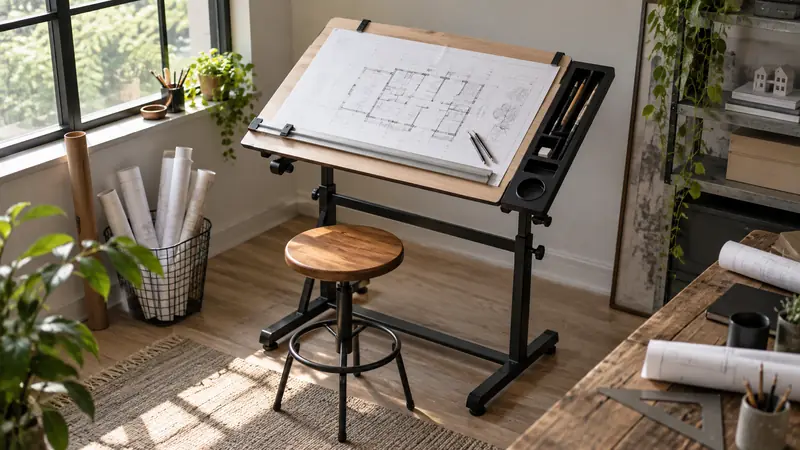
A compact drafting table has to earn its floor space. In a bedroom, dorm, apartment, or crowded studio, a few inches can decide whether the table feels useful or becomes one more obstacle to step around. Buyers are usually balancing several needs at once: enough room for a sketchbook or plan, a tilting surface, comfortable working height, storage for pencils and rulers, and a frame that does not feel flimsy under everyday use.
The common mistake is focusing on tilt range alone. A table that reaches 80 degrees may still disappoint if its work surface is too shallow, while a handsome desk with drawers may leave little room for a large drawing pad. Footprint, surface dimensions, height, storage, mobility, and the difference between a true drafting table and a general-purpose rolling desk matter more. Priorities vary widely, so this guide includes everything from a full-size compact art desk to foldable and tabletop options. The VECELO drafting table is our top overall pick because it combines a useful tilt range, storage, a stool, and a manageable footprint.
For a quick overview, the table below compares the nine selected options before the detailed reviews.
Best Compact Drafting Tables Comparison Table
| Product | Best For | Size or Surface | Adjustment |
|---|---|---|---|
| VECELO Drafting Table, Rustic Brown | Best overall | 40.2 × 23.7 inches | 0 to 65° tilt |
| QZJIKE Drafting Table | Organized art stations | Dimensions not specified | 0 to 50° tilt |
| QZMDSM Portable Rolling Desk | Mobile small-space work | 32-inch desk | 28 to 36.4-inch height |
| Yaheetech Glass Drafting Table | Easy-clean surfaces | 35.4 × 23.6-inch tabletop | 0 to 40° tilt |
| Lurinthal Drafting Table | Maximum integrated storage | 47.2 × 23.6-inch footprint | 0 to 80° tilt |
| conda Wood Drafting Table | Traditional drafting setup | 35.4 × 23.6-inch surface | 0 to 45° tilt |
| Liftsync Mobile Standing Desk | Rolling sit-stand use | 27.6 × 17.7-inch desktop | 0 to 90° tilt |
| GreenForest Folding Desk | Very tight rooms | 31.5 × 16.5-inch desk | 0 to 90° tilt |
| DJAR Tabletop Drafting Table | Portable tabletop drawing | 27 × 19 inches | Five positions, flat to 70° |
The reviews below show where each design fits, from a furnished art corner to a table that can slide under a bed.
1. VECELO Drafting Table, Rustic Brown — Best Overall

The VECELO earns the top position by covering the details that tend to matter in a compact creative corner. Its 40.2-inch length and 23.7-inch width provide a useful working area without reaching the broad footprint of a large studio drafting station. The tabletop tilts from flat to 65 degrees, so the desk can handle writing, reading, sketching, and angled drawing in the same spot.
Storage is particularly practical here. Two fabric drawers, a lower shelf, a pencil box, and separate tool slots give loose pencils, paper, and brushes somewhere to land instead of forming a messy little drift beside the drawing pad. The included 20-inch stool also saves a separate furniture purchase. Its 12mm MDF top and metal frame are specified for a tabletop capacity of 55 pounds, while the stool is listed at 220 pounds, although buyers should still place the table on a level floor and avoid treating it like a heavy-duty workbench.
Pros
- Tilts from 0 to 65 degrees for flat and angled work.
- Includes two drawers, a lower shelf, pencil storage, and tool slots.
- Comes with a matching 20-inch padded stool.
- Metal frame and 12mm MDF tabletop provide a substantial structure.
- Compact 40.2 × 23.7-inch footprint suits many home workspaces.
Cons
- The fabric drawers are lighter-duty than rigid wood or metal drawers.
- The 55-pound tabletop capacity is lower than what a heavy studio setup may require.
This is the strongest fit for an artist, student, or hobbyist who wants a complete station rather than a bare tabletop. The included stool and storage make the setup feel ready for a bedroom corner, while the 65-degree range gives it more drawing flexibility than a fixed writing desk. Buyers who need a larger plan surface, adjustable standing height, or hard-sided storage may prefer another model, but for a balanced compact arrangement, this VECELO is the easiest recommendation.
To buy this product, click here.
2. QZJIKE Drafting Table — Best for Organized Art Supplies
Some compact desks feel tidy for about ten minutes, then brushes, markers, and sketchbooks spill across the surface like a colorful toolbox tipped over. The QZJIKE addresses that problem with four fabric drawers, an elevated shelf, and a suspended organizer with compartments for smaller tools. That arrangement gives a dedicated place for supplies while leaving the desktop open for a laptop, pad, or current project.
The work surface adjusts through three stated ranges: 0 to 15 degrees for writing and laptop work, 15 to 35 degrees for sketching, and 35 to 50 degrees for painting or watercolor. Those preset zones are less expansive than the VECELO’s maximum angle, yet they make the table easy to think about during daily use. The metal frame, 12mm MDF panels, rubber feet, and built-in power panel add convenience for a home office or art station, although the available listing does not specify the overall dimensions.
Pros
- Four fabric drawers provide useful hidden storage.
- Suspended organizer keeps brushes, markers, and small tools close by.
- Three stated tilt ranges cover writing, sketching, and painting.
- Open desktop area accommodates a laptop or sketchbook collection.
- Power panel adds convenient charging access near the workspace.
Cons
- Overall table dimensions are not specified in the supplied listing.
- Its maximum 50-degree tilt is less steep than several alternatives here.
The QZJIKE makes sense for the person whose biggest compact-workspace problem is clutter. A student can keep markers and notebooks in the drawers, while a hobby painter can use the raised organizer for brushes and tools. Buyers who need verified measurements before planning a tight room should check the current listing carefully, and those who prefer a more traditional drafting angle may want a model with a higher maximum tilt.
To buy this product, click here.
3. QZMDSM Portable Rolling Desk — Best for Mobility

A rolling desk changes the rhythm of a small room. Instead of committing one corner to drafting, you can move the work surface toward a window, beside a sofa, or out of the way when guests arrive. The QZMDSM is built around that flexibility, with casters, an adjustable height from 28 to 36.4 inches, and a listed weight of about 15 pounds.
This is a general-purpose desk with drafting-table usefulness rather than a traditional angled art desk. Its 32-inch desktop and three storage shelves suit a laptop, notebook, light drawing pad, or study setup. The waterproof tabletop is easy to wipe clean, and the listing says assembly can be completed in about five minutes with the supplied tool kit. Since the product information does not state a tilt range, buyers should view it as a height-adjustable mobile work surface rather than a substitute for a dedicated tilting drafting table.
Pros
- Casters make it easy to move between rooms or work areas.
- Height adjusts from 28 to 36.4 inches.
- Three storage shelves use vertical space efficiently.
- Waterproof tabletop is convenient for everyday cleanup.
- Light listed weight supports a more portable setup.
Cons
- The listing does not specify a tilting tabletop angle.
- Its 32-inch surface is more limited for large drawings or plan sheets.
This model suits renters, students, and anyone who needs a desk that can roll into a closet or another room. It is also a sensible choice for mixed laptop, writing, and light sketching use. Serious drafting buyers who work at an angle for long sessions may find the lack of a stated tilt mechanism limiting, while a person with shelves already nearby may prefer a dedicated drawing table with a larger angled surface.
To buy this product, click here.
4. Yaheetech Glass Drafting Table — Best for Easy-Clean Work

Paint, ink, glue, and coffee have a way of finding the one surface you hoped would stay pristine. The Yaheetech uses a tempered glass tabletop that can be wiped with a damp cloth and mild cleanser, giving messy creative work a cleaner landing place. Its 35.4 × 23.6-inch main surface is compact enough for a home studio while still offering more room than a tabletop board.
The table tilts from 0 to 40 degrees and locks in five heights. A separate MDF side countertop adds room for supplies, while the powder-coated iron bracket forms the base. The transparent top may also help with tracing or precise diagrams, although buyers should remember that glass feels different from MDF or natural wood under a pencil. The included foam-padded stool has a listed capacity of 265 pounds, and the glass tabletop is listed at 88 pounds.
Pros
- Tempered glass surface is easy to wipe clean.
- 35.4 × 23.6-inch tabletop provides useful drawing room.
- Five locking positions cover a 0 to 40-degree tilt range.
- Separate side countertop provides space for tools or supplies.
- Includes a padded stool with a listed 265-pound capacity.
Cons
- Glass can feel less forgiving than wood or MDF for some drawing tasks.
- The 40-degree maximum tilt is more limited than the steepest options here.
This table is particularly appealing for painters, crafters, and anyone who wants quick cleanup after a splashy session. The side shelf keeps a palette or cup away from the main drawing area, and the transparent surface gives the design a lighter visual feel. Buyers who want integrated drawers, a very steep angle, or a warmer wood surface may be happier with another pick.
To buy this product, click here.
5. Lurinthal Drafting Table — Best for Maximum Storage

Compact does not have to mean storage-starved. The Lurinthal uses a 23.6-inch depth and 47.2-inch width to build a substantial work station with three drawers, three open shelves, and a storage cabinet. That is a helpful layout for people who keep sketchbooks, sewing materials, paints, and office supplies close to the table instead of stacking them in boxes on the floor.
Its tabletop angle adjusts from flat to 80 degrees, which gives it one of the broadest tilt ranges in this group. The MDF construction and multifunctional layout support writing, reading, crafting, computer work, sketching, and painting. The trade-off is clear in the dimensions. Although the depth is moderate, the 47.2-inch width and storage structure require more dedicated wall space than a folding or rolling desk.
Pros
- 0 to 80-degree tilt range supports a broad range of creative tasks.
- Three drawers, three open shelves, and a cabinet provide substantial storage.
- 47.2-inch width offers a generous work area for a compact room.
- Works as a drafting, painting, reading, crafting, or computer station.
- Classic styling can blend into a home office or craft corner.
Cons
- Its 47.2-inch width makes it less suitable for very tight floor plans.
- The listing does not provide a tabletop weight capacity.
The Lurinthal is best for a dedicated craft corner where organization matters as much as the drawing surface. A painter can keep supplies in the cabinet, while a student can use the drawers for paper and tools. People who need to fold the table away after each session, or who have only a narrow strip of floor available, should look toward the GreenForest or DJAR instead.
To buy this product, click here.
6. conda Wood Drafting Table — Best Traditional Work Surface
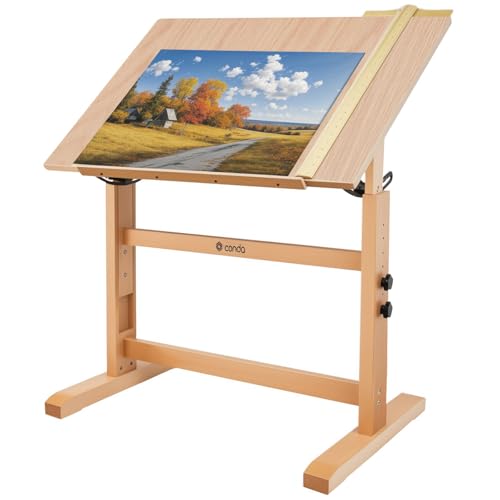
The conda table has the familiar look many people picture when they imagine a drafting station: a broad natural wood surface, a built-in pencil ledge, and a ruler close to the front edge. Its 35.4 × 23.6-inch worktop gives plans and sketchbooks more breathing room than a narrow mobile desk, while the rustic finish brings a warmer feel than black metal and glass.
Height adjusts from 31.5 to 37 inches, and the tabletop tilts from flat to 45 degrees. That combination gives seated users more control over working position without turning the table into a full standing desk. The listing describes a solid wood construction and includes assembly tools and pre-sorted parts. Storage is limited to the built-in ledge and ruler, so loose supplies will need a nearby cart, drawer unit, or container.
Pros
- 35.4 × 23.6-inch natural wood work surface suits larger sketchbooks and plans.
- Height adjusts from 31.5 to 37 inches.
- Tabletop tilts from 0 to 45 degrees.
- Built-in pencil ledge and ruler keep essential tools within reach.
- Wood construction and rustic styling suit a traditional drafting corner.
Cons
- Storage is limited compared with the drawer-and-shelf models.
- Its 45-degree maximum tilt is less flexible for steep-angle drawing.
This is a strong match for students, technical drawing hobbyists, and home users who care more about a straightforward wood surface than built-in organizers. It leaves the floor around the table visually open, which can be refreshing in a small room. Buyers who need a stool, extensive storage, or a maximum angle above 45 degrees will need to add accessories or choose another design.
To buy this product, click here.
7. Liftsync Mobile Standing Desk — Best Mobile Sit-Stand Option

The Liftsync takes a different path from a conventional drafting table. Its pneumatic lift changes the desk height from 29.5 to 44 inches, while four casters let the unit move beside a sofa, bed, or office chair. The 27.6 × 17.7-inch desktop is modest, but that shallow profile is exactly what makes it useful in a narrow passage or flexible home workspace.
The top tilts from 0 to 90 degrees and includes an anti-slip bar for writing and drawing. A two-tier shelf adds room for a laptop or small supplies, with cup holders and card slots built into the upper area. The main board is listed to hold 17.6 pounds, so the desk is better suited to a laptop, notebook, tablet, or light drawing materials than a heavy drafting-board setup.
Pros
- Pneumatic height adjustment reaches from 29.5 to 44 inches.
- Desktop tilts from flat to 90 degrees.
- Four casters support mobile use around the home.
- Two-tier shelf design adds storage in a small footprint.
- Anti-slip bar helps keep paper or a device from sliding.
Cons
- The 27.6 × 17.7-inch desktop is small for large-format drafting.
- The main board has a listed 17.6-pound load limit.
The Liftsync belongs in a room where adaptability is the priority. Someone working from a couch in the morning and a desk chair later can reposition the table without dragging heavy furniture across the floor. It is less convincing as a primary architectural drawing station, but its height range and 90-degree tilt make it one of the more flexible choices for light drafting, digital work, reading, and study.
To buy this product, click here.
8. GreenForest Folding Desk — Best for Extremely Small Rooms

A table that folds to 3.8 inches thick can disappear behind furniture, slide under a bed, or wait in a closet until the sketching mood arrives. That is the GreenForest’s defining advantage. Its 31.5 × 16.5-inch size is compact, and four lockable casters make it easier to move between a bedroom, office, and studio corner.
The tabletop tilts from 0 to 90 degrees with a gas strut, while an anti-slip guardrail helps keep a book, tablet, or drawing materials in place. A side area holds a mouse, bottle, and pens. The listing describes the desk as suitable for light-to-moderate home-office, art, and study work, and it also warns that minor wobble may occur under heavy loads. That limitation is useful context, since the folding design favors storage and convenience over a heavy permanent drafting station.
Pros
- Folds to a listed 3.8-inch thickness for compact storage.
- 0 to 90-degree tilt range supports flat and steep-angle work.
- Four lockable casters improve relocation around the room.
- Side area provides space for a mouse, bottle, and pens.
- Works for light-to-moderate art, study, and home-office tasks.
Cons
- The 16.5-inch width limits room for large drawing sheets.
- The listing acknowledges that minor wobble may occur with heavy loads.
This is the pick for a dorm, tiny apartment, guest room, or temporary studio where every square inch has a job. It can appear for an evening drawing session, then fold away before dinner. A buyer working with thick boards, heavy tools, or forceful technical drafting should choose a more substantial fixed-frame table, while casual sketchers will appreciate the GreenForest’s disappearing act.
To buy this product, click here.
9. DJAR Tabletop Drafting Table — Best Portable Tabletop Option
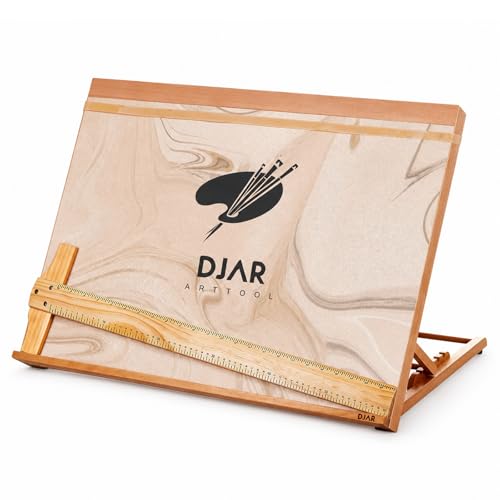
When a full desk simply will not fit, a tabletop drafting station can turn an ordinary kitchen table or desk into a temporary drawing surface. The DJAR measures 27 by 19 inches and folds for storage, giving artists and students a portable angled platform without adding another full-size piece of furniture to the room.
Its five-position adjustment runs from flat to 70 degrees. The beech wood construction has a smooth polished finish, while a non-slip rubber block helps keep the board planted. A T-ruler and rubber rope are included, with the ruler intended for measurement and the rope helping with paper holding or storage. At 19 inches high, it is a tabletop easel-style unit rather than a standalone desk, so a stable supporting table is part of the setup.
Pros
- Folds for convenient storage in a corner or closet.
- Five positions cover flat work through a 70-degree angle.
- 27 × 19-inch size is portable while offering useful drawing room.
- Includes a T-ruler and rubber rope.
- Beech wood surface and non-slip rubber support suit tabletop use.
Cons
- Requires a separate table, desk, or other stable support.
- It does not provide drawers, shelves, or adjustable standing height.
The DJAR makes sense for a student who moves between rooms, an artist who works at the dining table, or anyone who wants a drafting surface without surrendering permanent floor space. It is also a practical backup for travel or occasional drawing. Buyers who spend long hours drafting or need a dedicated ergonomic seated height should choose one of the full desk models instead.
To buy this product, click here.
Buying Guide: How to Choose a Compact Drafting Table
Measure the Usable Surface, Not Just the Outer Frame
A table can look compact in a product photo and still leave little room for an actual drawing sheet. Check the listed tabletop dimensions, then compare them with the paper, pad, tablet, or plan you expect to use. The 35.4 × 23.6-inch surface on the conda and Yaheetech models gives more elbow room than the 16.5-inch-wide GreenForest desk, while the DJAR’s 27 × 19-inch platform works best on top of another table.
Leave room for the tools that appear beside the page: a ruler, eraser, cup, laptop, or palette. A surface that fits the paper exactly can feel cramped once the pencil case lands beside it, so a few extra inches can make a surprisingly large difference.
Match Tilt Range to the Way You Draw
For writing and laptop work, a flat or mildly angled surface may be enough. Sketching often benefits from a moderate tilt, while painting or detail work may call for a steeper angle. The VECELO reaches 65 degrees, the Lurinthal reaches 80 degrees, and the Liftsync and GreenForest reach 90 degrees. Those numbers describe available movement, not a guarantee that every angle will feel equally comfortable for every task.
Check how the tabletop locks or supports itself. A broad range is useful only when the surface stays where you set it and leaves enough room for paper retention. Anti-slip bars, pencil ledges, rubber supports, and side lips can matter as much as the maximum angle.
Decide Between a Fixed Desk, Rolling Desk, and Folding Surface
A fixed-frame table usually gives a more settled work station, especially when paired with storage or a stool. The VECELO, QZJIKE, and Lurinthal models suit buyers who expect the table to remain in one place. A rolling desk such as the QZMDSM or Liftsync trades some traditional drafting features for the ability to move around a room.
Folding designs are excellent for multipurpose rooms. The GreenForest can fold to a listed 3.8 inches, while the DJAR folds into a tabletop unit. These options are easier to store, but their smaller surfaces and lighter-duty construction may be less comfortable for large drawings or heavy materials.
Think About Seated Height and Standing Height
Many compact drafting tables are intended for seated work, with a fixed or modestly adjustable frame. The conda adjusts from 31.5 to 37 inches, while the QZMDSM reaches 36.4 inches. The Liftsync rises to 44 inches, making it more suitable for changing between seated and standing positions.
Check stool height if one is included. The VECELO comes with a 20-inch stool, and the Yaheetech includes a 21-inch stool. A compatible seat can make the setup feel cohesive, but buyers should still compare the seat height with the table’s working position and their own leg clearance.
Storage Can Save Space, or Consume It
Drawers and shelves reduce clutter, yet they also add width, depth, and visual weight. The QZJIKE keeps tools in four fabric drawers and an organizer, while the Lurinthal adds three drawers, three open shelves, and a cabinet. Those features are valuable for a dedicated craft corner, but they may be unnecessary if a nearby bookcase or rolling cart already handles supplies.
For a quiet, open room layout, the conda’s pencil ledge and ruler offer a simpler approach. For a table that must support an entire art routine, the storage-heavy models are more practical. Ask where the paper, paints, rulers, and unfinished work will live after the session ends.
Check Construction and Load Information
Metal frames, MDF panels, glass, and wood each create a different working feel. The VECELO and QZJIKE use metal frames with 12mm MDF panels. The Yaheetech combines powder-coated iron, tempered glass, and MDF, while the conda listing specifies solid wood construction. These materials describe the build, but they do not automatically prove that one table will be more stable than another.
Use stated load limits as boundaries rather than targets. The VECELO lists a 55-pound tabletop capacity, the Yaheetech lists 88 pounds for its glass tabletop, and the Liftsync lists 17.6 pounds for its main board. Heavy drawing boards, equipment, or stacked supplies belong on a model with a clearly suitable capacity.
Best Compact Drafting Tables FAQ
What size is suitable for a compact drafting table?
A useful compact size depends on the paper and tools you use. Surfaces around 35 × 23 inches provide more room for a drawing pad and ruler, while desks around 27 × 19 inches suit smaller work. Measure your largest regular sheet and add space for tools before choosing.
Are compact drafting tables suitable for architecture students?
They can be, especially for sketching, study, and smaller drawings. Students working with large plans should prioritize surface dimensions and a stable frame over storage or extreme portability. The conda, VECELO, and Yaheetech offer more room than the narrow folding and mobile options.
Is a tilted drafting table better than a flat desk?
A tilted surface can make drawing and reading more comfortable for some users, while a flat position remains useful for laptops, writing, and general work. Adjustable models offer more flexibility than a permanently angled surface, provided the mechanism holds the chosen position securely.
What is the advantage of a folding drafting table?
Folding tables are easier to store in apartments, dorms, guest rooms, and multipurpose spaces. The trade-off is usually a smaller work surface or lighter-duty frame. The GreenForest is a good example of a storage-friendly design, while the DJAR folds into a tabletop unit.
Do compact drafting tables need storage drawers?
No. Drawers are useful when the table must hold pencils, paper, brushes, and craft materials, but they add structure and can increase the footprint. A simple table with a pencil ledge may be better if you already have a nearby cart or shelf.
Are glass drafting tables practical for artists?
Glass can be practical for artists who value quick cleanup, and the Yaheetech model uses a tempered glass tabletop that is listed as easy to wipe clean. Some users may prefer the feel of wood or MDF for drawing, so surface preference and the type of materials used should guide the choice.
Can a rolling desk replace a drafting table?
A rolling desk can replace one for light sketching, writing, study, and digital work, especially when mobility matters. It may be less suitable for large-format drafting if it lacks a tilt mechanism, has a small surface, or carries a lower load limit.
What should I place under a compact drafting table?
Use a level, clear floor and check the space needed for your chair or stool. Protective foot pads or casters can help reduce floor marking, while a thin floor mat may make movement easier on hard surfaces. Keep the area below shelves and drawers clear so knees and feet have room.
Final Verdict
The VECELO Drafting Table is the strongest overall choice among these compact options because it balances a 40.2 × 23.7-inch footprint with a 0 to 65-degree tilt, practical storage, a pencil organizer, and an included stool. It feels more complete than a bare mobile desk without taking on the broad footprint of a large studio station. Buyers who want a tidy supply layout may prefer the QZJIKE, while the Lurinthal is better suited to a dedicated craft corner that can accommodate more drawers and shelving.
For very small rooms, the GreenForest offers the clearest storage advantage, and the DJAR is the simplest answer when a full desk cannot fit at all. The Yaheetech stands apart with its easy-clean glass top, while the conda favors a traditional wood work surface and adjustable seated height. Before ordering, measure the room, the largest sheet you use, and the clearance for your chair. A compact drafting table works best when its tilt, surface, storage, and mobility match the way you actually draw.
